No items found.
blog
Machine downtime tracking and reporting: the definitive guide
By: Guidewheel
Updated:
May 2, 2026
9 min read
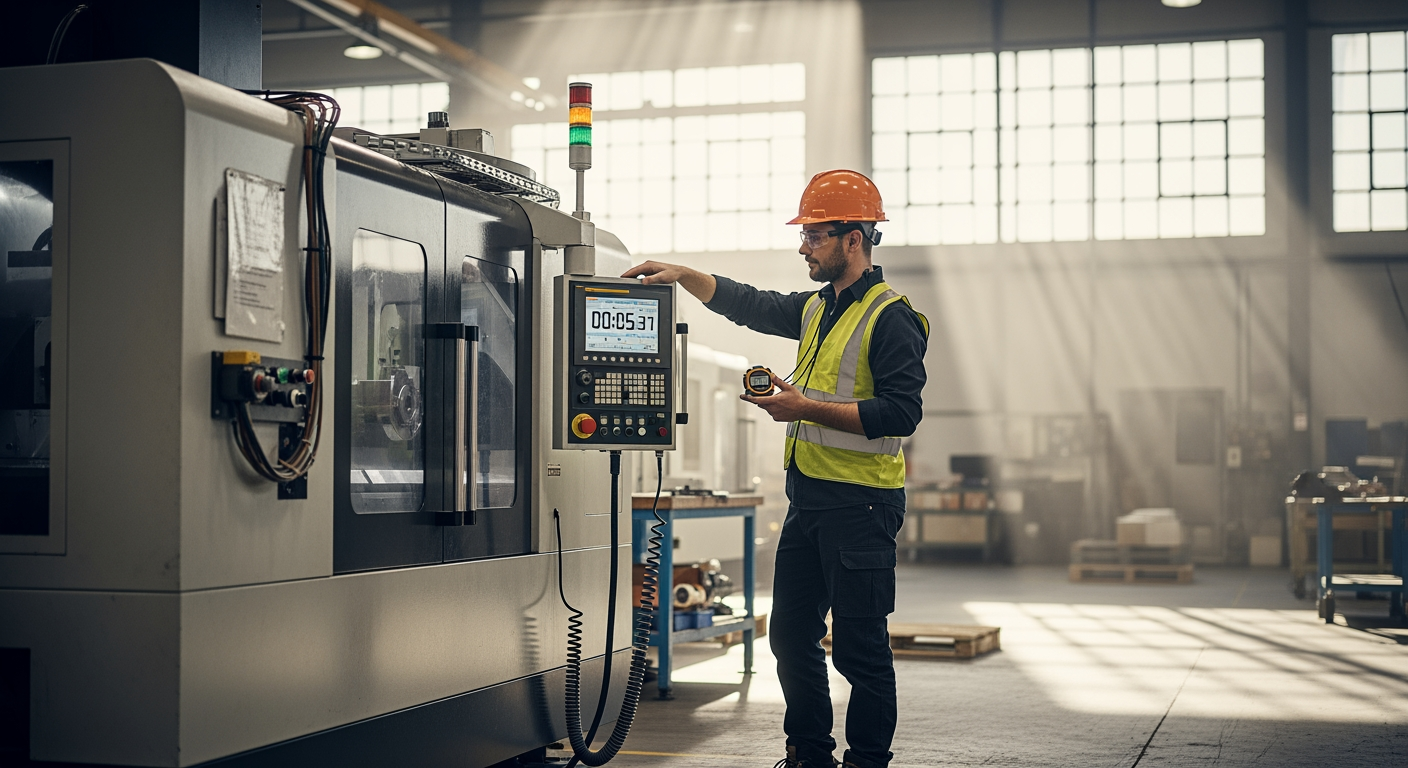
Every plant manager knows the feeling: you're reviewing last month's production numbers, the OEE report finally lands, and the data doesn't match what you saw on the floor. One shift logged a breakdown as "planned maintenance"; another shift didn't log it at all. Your spreadsheet says 78% OEE, your gut says closer to 65%, and you can't prove either number.
This gap between what actually happens on your production lines and what gets captured in your reports is the single biggest barrier to improving throughput. The good news? Closing that gap doesn't require a massive IT project or ripping out your existing systems. It starts with getting machine downtime tracking right.
This guide walks you through how to build a practical, trustworthy downtime tracking and reporting system, from foundational definitions through implementation, using real benchmark data to set realistic targets for your operation.
Understanding the basics before you start tracking
Before diving into software and sensors, let's align on the terms that matter most. These definitions form the foundation of every OEE dashboard and downtime report you'll build.
Term | What it means | Why it matters |
|---|---|---|
OEE (Overall Equipment Effectiveness) | Availability × Performance × Quality | The "gold standard" KPI for equipment performance in Lean and TPM programs |
Availability | Run Time / Planned Production Time | Measures the direct impact of downtime on your output |
Performance | Actual output rate vs. ideal cycle time | Captures speed losses, minor stops, and sub-optimal rates |
Quality | Good pieces / Total pieces produced | Accounts for scrap, rework, and first-pass yield |
MTBF | Mean Time Between Failures | Indicates equipment reliability |
MTTR | Mean Time To Repair | Indicates maintenance responsiveness |
Here's the critical insight most teams miss: OEE's three components multiply together. So even if each factor is 85%, your actual OEE is only 61% (0.85 × 0.85 × 0.85). That multiplicative effect explains why you can feel busy on the floor yet still miss throughput targets.
Why downtime is the fastest lever to pull
Of OEE's three components, Availability typically accounts for 40–55% of total OEE loss across discrete and process manufacturing environments. Performance losses average 25–35%, and Quality losses 15–25%.
What this means practically: for a plant running at 70% OEE, improving Availability by 10 points yields roughly 8 points of OEE gain, while the same improvement in Performance or Quality yields about 6 points. Downtime is your highest-leverage target.
The problem isn't that teams don't know downtime hurts. The problem is that manual tracking, whether on clipboards, paper logs, or shared spreadsheets, systematically underreports and misclassifies it. In our experience analyzing thousands of manually logged records, 50–70% lack a valid root cause (Source: Guidewheel Performance Analysis). When your data is incomplete, every decision downstream suffers: maintenance can't prioritize, CI teams can't build a business case, and you can't benchmark line against line with any confidence.
What "good" performance actually looks like by sector
One of the most common questions from operations leaders is straightforward: "What OEE should I be targeting?" The honest answer is that it depends heavily on your equipment type, production environment, and product mix.
That said, here are widely referenced benchmark ranges as starting reference points:
OEE range | General characterization |
|---|---|
Below 60% | Significant unquantified losses; largely reactive operations |
60-75% | Some loss visibility; opportunities for structured improvement |
75-85% | Preventive maintenance in place; active tracking and response |
85-90% | Strong TPM discipline; proactive downtime management |
Above 90% | Predictive maintenance; continuous optimization culture |
These benchmarks serve as reference points, not absolute standards. Automotive assembly typically lands in the 78–85% range, food and beverage processing often achieves 80–88%, while high-complexity environments like semiconductor manufacturing may run 45–70% due to inherently lower yields and longer cycle times. Your facility's goals, materials, and production mix all influence what "good" looks like for you.
What's more revealing than industry averages is how you measure performance in the first place. Analysis from Guidewheel's FactoryOps platform across 3,000+ machines shows that simple median uptime averages can dramatically misrepresent true plant performance, particularly when some machines run continuously while others sit idle between orders (Source: Guidewheel Performance Analysis).

In pharmaceuticals, for example, the median runtime sits at roughly 1% while the volume-weighted average is nearly 44%, a massive gap that proves simple averages obscure what's really happening on your floor (Source: Guidewheel Performance Analysis). The takeaway: how you calculate your baseline matters as much as the number itself.
The downtime categories that actually move the needle
Not all downtime is created equal, and the categories within your direct control deserve the most attention. While "No Business/Orders" may dominate total idle time in some environments, secondary loss drivers represent the most immediately actionable opportunities for your operations and maintenance teams.

Here's how the top controllable downtime categories break down (Source: Guidewheel Performance Analysis):
Downtime category | Avg. duration per event | % of total downtime | Key intervention |
|---|---|---|---|
Other Operational | 81 min | 28% | Root-cause analysis to reclassify and eliminate vague categorization |
Mechanical Breakdowns | 72 min | 20% | Preventive schedules informed by failure-frequency trends |
Electrical & Controls | 107 min | 18% | Faster diagnostic protocols; sensor-based anomaly detection |
Material & Supply Issues | 119 min | 17% | Upstream coordination; buffer stock policies tied to line data |
Maintenance & Cleaning | 85 min | 11% | Standardized procedures; SMED-style optimization for routine tasks |
Notice the pattern: Mechanical breakdowns happen most frequently but resolve relatively quickly, while material and supply stoppages occur less often but cause nearly two-hour disruptions per event. Each category demands a different response strategy. That's why automated downtime tracking software is so valuable: it captures the frequency, duration, and pattern data you need to prioritize the right interventions.
How real-time machine monitoring works, even on legacy equipment
A common concern: "Our machines are too old to connect." In practice, that's rarely the case.
For modern CNC, robotic, or automated lines, machine monitoring software can read machine status directly from PLCs via OPC-UA or MQTT. Every state change, from running to stopped to alarm state, gets captured with sub-second precision.
For older lathes, mills, presses, and conveyors that lack digital interfaces, the approach is different but equally effective. Simple clip-on sensors that read electrical current can detect whether a machine is drawing operational power. When the power draw changes, the system recognizes the machine state change and logs it. Guidewheel's FactoryOps platform, for example, uses clip-on current sensors and proprietary algorithms to monitor any equipment — from decades-old legacy machines to brand-new lines — without requiring PLC integration or an internet connection (cellular connectivity works just fine).
This means you can capture run/idle/down data on conveyors, auxiliary equipment, and everything in between without touching a PLC or opening the cabinet. Operators confirm or add context with a single tap on a mobile interface, rather than filling out paper forms.
✅
Plants that deploy real-time downtime tracking frequently see a 15–25% reduction in unplanned downtime within 6–12 months, driven primarily by faster response times and reduced repeat failures. Even on legacy equipment without PLC connections, clip-on current sensors can capture run/idle/down states automatically — meaning you don't need a major infrastructure upgrade to start gaining visibility into your biggest losses.
The ROI expectation from real-time downtime tracking is practical: plants frequently see a 15–25% reduction in unplanned downtime within 6–12 months, driven primarily by faster response times and reduced repeat failures (Source: Guidewheel Performance Analysis).
A phased implementation that won't disrupt your floor
The fastest path to value follows a simple, low-risk progression:
Phase | Timeline | What happens | Quick win |
|---|---|---|---|
Foundation | Weeks 1–2 | Define OEE methodology, standardize 12–15 reason codes, audit current data | Even without new software, standardizing definitions alone typically produces a meaningful improvement in data quality before any new software is deployed. |
Pilot | Weeks 3–8 | Deploy on 1–2 high-priority machines; collect baseline data; compare auto-captured vs. manual logs | Identify top 1–2 downtime reasons on pilot machines; launch targeted improvement |
Scale | Weeks 9–16 | Roll out to full line or plant; establish daily downtime huddles; integrate with MES/CMMS if applicable | Shift-level accountability begins; peer-driven improvement accelerates |
Embed | Weeks 17–26 | Weekly Pareto reviews; launch CI projects targeting top 3 loss drivers; set OEE targets by machine type | Operations evolve from reactive to proactive loss elimination |
The entire approach works as an overlay on your existing systems, alongside your MES, CMMS, and ERP. No rip-and-replace required.
A realistic first-year expectation: 3–5 OEE points from downtime visibility alone, translating to a 4–7% throughput improvement on assets that are already paid for (Source: Guidewheel Performance Analysis). Year 2 typically adds another 5–7 points as maintenance optimization and process improvements compound (Source: Guidewheel Performance Analysis).
Keeping your data honest: avoid "gaming" OEE
Trustworthy data is the foundation of every improvement effort. Three common pitfalls to watch for:
Reason-code manipulation: Downtime classified as "planned" when it's actually unplanned. Mitigation: cross-reference reason codes against CMMS work orders and flag inconsistencies.
Missing micro-stops: Events under 5 minutes that operators fix without logging. Mitigation: set sensor thresholds to capture all state transitions automatically, then educate your team that "all downtime counts, and the system is here to help, not blame."
Shift boundary confusion: Events spanning shift changes get double-counted or missed entirely. Mitigation: apply consistent roll-up rules and aggregate to machine-shift level.
Post OEE results by shift. When Shift 1 sees Shift 2's data, healthy peer accountability emerges naturally.
Start turning downtime data into throughput gains
The path from inconsistent spreadsheets to a trusted, plant-wide OEE monitoring system doesn't have to be a multi-year transformation project. Start with one or two machines, prove the value in weeks, and scale from there. The data will tell you where your biggest opportunities are, and your team will have the credible, machine-level evidence they need to act.
We had our best month of the year, increasing production from 26,000–35,000 cases/month to 46,000 cases in March. I attribute this to Guidewheel. Being able to see downtime data and address downtime reasons directly correlates to higher production.
Michael Palmer, VP of Operations, Direct Pack via Guidewheel's Customer Research
Ready to find out how much capacity is hiding in your existing equipment? Book a Demo and start with your toughest line — in weeks, not months.
💡
Frequently asked questions
What is OEE and why does it matter in manufacturing?
OEE stands for Overall Equipment Effectiveness. It multiplies three factors — Availability, Performance, and Quality — into a single percentage that tells you how much productive output a machine delivers relative to its planned production time. It matters because even seemingly strong individual scores compound into surprisingly low OEE when multiplied together, revealing hidden losses that simpler metrics like utilization alone will miss.
How do you calculate OEE accurately?
The formula is Availability (%) × Performance (%) × Quality (%). Availability equals Run Time divided by Planned Production Time. Performance compares your actual output rate to the ideal cycle time. Quality measures good pieces against total pieces produced. A practical example: 87.5% Availability × 90% Performance × 97.2% Quality yields approximately 76.5% OEE.
How do you track machine downtime without PLC data?
You don't need a PLC connection. Clip-on current sensors detect whether a machine is drawing operational power and identify state transitions, running, idle, or stopped, from the electrical signal alone. This approach works on legacy equipment of any age, including conveyors and auxiliary machines, and can operate over cellular connections without requiring plant-floor internet infrastructure.
Can OEE be gamed, and how do you build trustworthy metrics?
Yes, OEE can be gamed through reason-code manipulation, excluding micro-stops, or misclassifying unplanned downtime as planned. Build trust by automating data capture at the machine level (removing manual entry bias), cross-referencing reason codes against maintenance work orders, and posting shift-level results transparently so teams hold each other accountable.
What ROI should a manufacturer expect from downtime tracking software?
The honest answer depends on where you're starting. A plant at 60% OEE has more room to move than one at 80%. That said, many facilities see a 15–25% reduction in unplanned downtime within 6–12 months (Source: Guidewheel Performance Analysis). A realistic first-year target is 3–5 OEE points gained primarily through Availability improvements. For a typical production line, that translates to payback within 6–12 months from throughput gains alone.
About the author
Lauren Dunford is the CEO and Co-Founder of Guidewheel, a FactoryOps platform that empowers factories to reach a sustainable peak of performance. A graduate of Stanford, she is a JOURNEY Fellow and World Economic Forum Tech Pioneer. Watch her TED Talk—the future isn't just coded, it's built.