No items found.
blog
How to automatically track downtime on older machines without touching the PLC
By: Guidewheel
Updated:
March 19, 2026
9 min read

If you run a plant with older machines, you already know the frustration: your best equipment has zero built-in connectivity, your PLC is a black box nobody wants to open, and your "downtime tracking" lives on a clipboard that gets filled in at the end of shift, if at all.
The result? You know output was short, but you can't pinpoint why, or where to focus improvement efforts.
Here's the good news. You don't need a controls overhaul, a PLC integration project, or a six-figure MES rollout to start capturing reliable machine downtime data. Current-based sensing, a simple, non-invasive approach that reads the electrical signal already flowing to your motors, can give you automated machine state detection on virtually any electrically driven asset. No PLC touch required. Results in weeks, not quarters.
This guide walks through exactly how it works, what sensor types to consider, what the data looks like once you have it, and how to go from pilot to plant-wide deployment without disrupting production.
Key terms to know before you start
Before diving into sensor types and implementation, a few definitions worth aligning on. These show up in every downtime conversation, and getting them straight across shifts matters more than most people think.
Term |
What it means |
Why it matters |
|---|---|---|
Uptime |
Time equipment is operating and producing output |
Your primary target metric for scheduling and throughput |
Downtime |
Time equipment can't produce, whether planned (maintenance, changeovers) or unplanned (breakdowns, jams) |
Broken into planned vs. unplanned to prioritize actions |
Availability |
Uptime divided by total scheduled time, expressed as a percentage |
Core input for OEE; reflects how often the machine is ready |
OEE |
Availability x Performance x Quality; a composite score of equipment effectiveness |
Industry reference: 65–80% for most mid-market plants (Source: ISA, SEMI, and Lean Manufacturing standards) |
MTTR |
Mean Time To Repair; average minutes to fix a failure |
Shorter MTTR = faster recovery; target under 15 minutes for routine stops |
MTBF |
Mean Time Between Failures; average operating hours between breakdowns |
Rising MTBF signals improving asset health |
Without standard definitions enforced by automated capture, Operator A logs "waiting for material" as downtime while Operator B doesn't log it at all. Same plant, two different uptime numbers.
Automated systems fix that.
Why manual tracking on legacy machines falls short
Most mid-market plants still rely on some combination of manual operator logs, shift supervisor recall, and end-of-shift ERP entries to track downtime. Industry research suggests manual logging captures only 40–60% of actual losses (Source: Society of Manufacturing Engineers, SMIP program).
Plants without automated tracking typically underestimate downtime by 8–15 percentage points compared to machine-level data.
The problem compounds on older equipment. These machines often lack network connectivity, have outdated or proprietary PLCs, and were never designed to report their own status. Spreadsheet-based reporting shows over 30% data entry error rates and offers no drill-down capability for root-cause analysis (Source: ISA white papers on manufacturing visibility).
What does that look like in practice? You get shift reports that say "Line 3 went down around 2 PM" with no detail on which motor stopped first, how long the cascading stoppage lasted, or whether it's the third time this week.
You can't benchmark shifts against each other, can't distinguish chronic problems from one-off events, and can't build a maintenance plan based on anything more than gut feel.
The data backs this up. According to Guidewheel performance analysis, the single largest category of actionable downtime across thousands of tracked machines is "Other Operational," accounting for nearly 28% of total downtime. That's not a root cause; it's a visibility gap where operators didn't record a specific reason code.
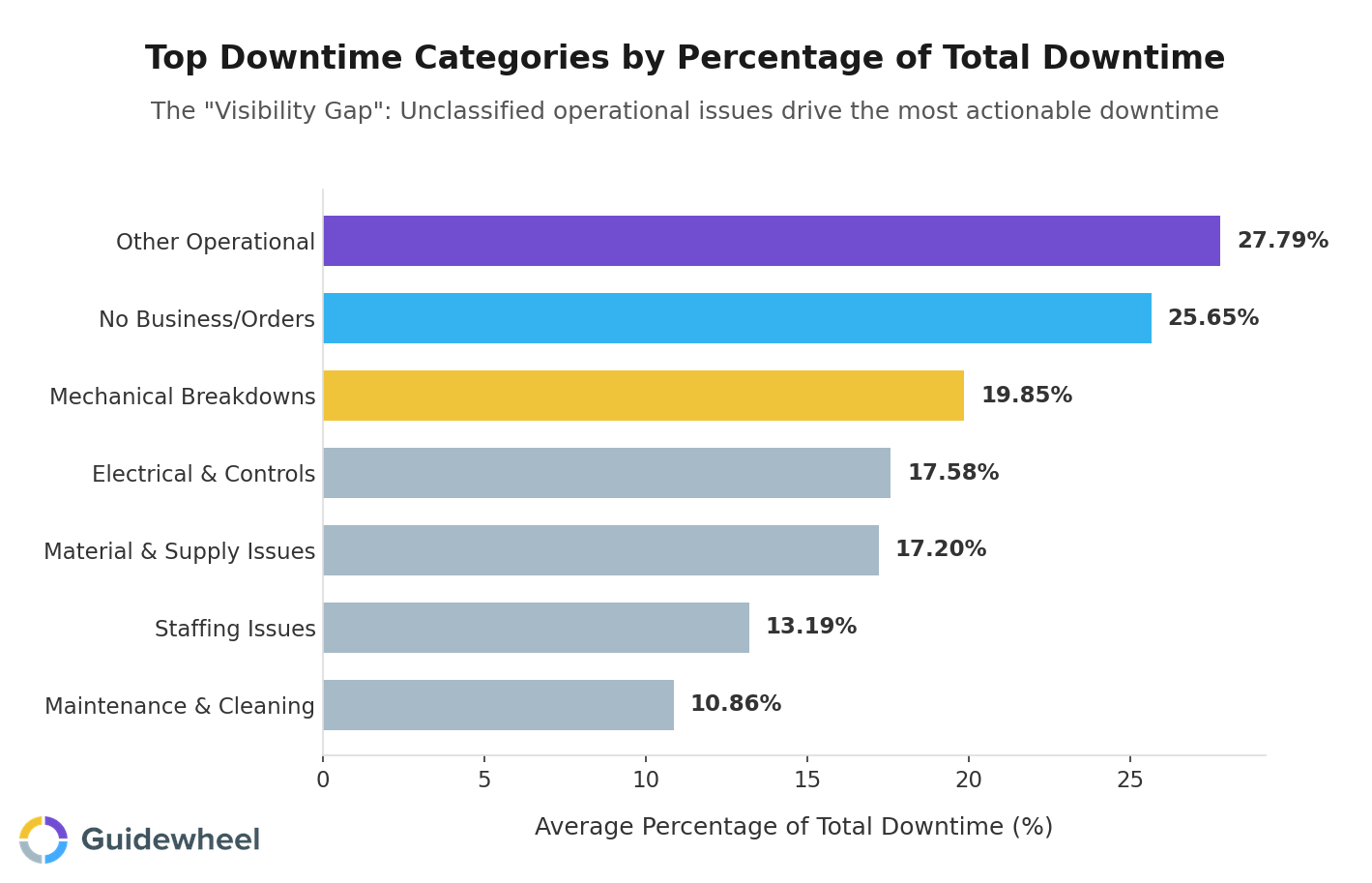
This breakdown of 3,100+ downtime events across 3,000+ machines shows that unclassified stops, the kind manual logs consistently miss, represent the largest slice of controllable lost time. (Source: Guidewheel Performance Analysis)
How current-based sensing detects machine state without PLC access
Every motor on your floor draws electrical current when it runs. That current signature is like a heartbeat: it tells you whether the machine is running under load, idling, starting up, or stalled. Current sensors read this signal from the existing power conductor feeding the motor, completely outside the PLC.
Here's what the sensor sees:
Running under load: Motor draws steady current proportional to torque, typically 15–25 amps on a loaded conveyor
Idle or unloaded: Current drops to a low baseline, often under 2 amps
Stalled or jammed: Current surges sharply before protective devices trip, detectable within milliseconds
Gradual degradation: Slight current rise over days or weeks can flag bearing drag or belt tension issues before a full breakdown
✅
Current-based sensing requires no PLC modification, no production flow sensor, and no wireless installation on the machine itself. A clamp-on sensor installs in 15–45 minutes per machine with no electrical downtime, and with proper threshold calibration, run-vs-idle state detection achieves over 98% accuracy with a false positive rate below 0.5% per hour. This makes it the fastest, least disruptive path to automated machine state visibility on legacy equipment.
The practical advantage: this approach requires no PLC modification, no production flow sensor, and no wireless installation on the machine itself. A sensor clips onto the power cable, reads the secondary (low-voltage) signal, and sends that data to an edge gateway.
With proper threshold calibration, run-vs-idle state detection achieves over 98% accuracy with a false positive rate below 0.5% per hour.
So when someone asks, "How do I prove uptime data is trustworthy without PLC signals?", the answer is straightforward: current doesn't lie. The electrical draw is physics, not opinion.
Choosing the right sensor type for your equipment
Not all current sensors are created equal, and the right choice depends on your motor types and electrical environment.
Sensor type |
How it works |
Accuracy |
Best for |
Typical cost |
|---|---|---|---|---|
Current Transformer (CT) |
Toroidal inductor clamped around power conductor; outputs proportional voltage |
±0.5–2% |
Permanent installations on main power feeds; continuous monitoring |
$75–200 |
Hall Effect Sensor |
Detects magnetic field from current-carrying conductor; analog or PWM output |
±1–3% |
Vibration-heavy environments like automotive and food processing lines |
$30–150 |
Rogowski Coil |
Flexible wire coil detects rate of current change; integrator circuit converts signal |
±0.5–1.5% |
Variable-frequency drive (VFD) environments; CNC and metalworking |
$100–400 |
Motor Current Monitoring Relay (MCSA) |
Microprocessor-based relay monitoring phase currents, harmonics, and frequency |
Load changes ±5–10% |
Integrated protection + monitoring on motor starters; detects bearing wear and winding issues |
$200–800 |
For most retrofit scenarios on older machines, clamp-on current transformers offer the fastest path. Installation takes 15–45 minutes per machine with no electrical downtime, no live conductor exposure, and no disruption to production.
A licensed electrician handles the install, and you're collecting data before the shift ends.
When your equipment includes VFD-driven motors, like CNC spindles or variable-speed packaging lines, Rogowski coils handle harmonic distortion better than traditional CTs. And if you want combined motor protection with monitoring, an MCSA relay can replace your existing contactor setup while adding diagnostic intelligence.
What the benchmark data reveals about hidden capacity
Once you start collecting automated data, you'll likely discover your machines have more latent capacity than you expected. Performance analysis across major manufacturing industries reveals a significant spread between median and top-quartile runtime, which represents a practical improvement target, recognizing that every facility's product mix and demand patterns are different.
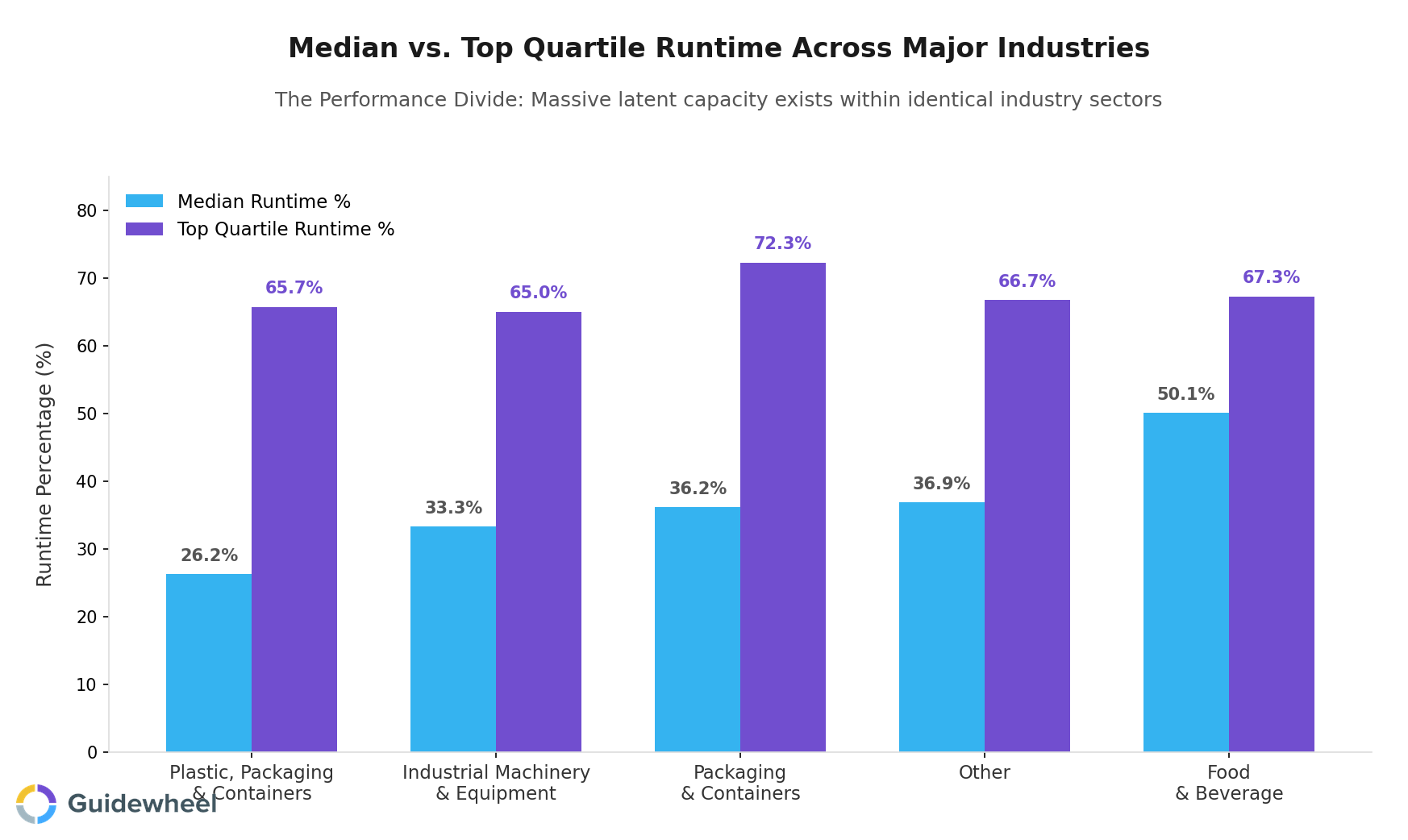
This comparison across 1,500+ machines shows the gap between typical and top-tier performance. In Packaging & Containers, for instance, the median runtime is roughly 36% while top-quartile facilities reach 72%. (Source: Guidewheel Performance Analysis)
These benchmarks serve as reference points, not universal targets. Optimal runtime varies by facility context, demand cycles, and product complexity.
But the pattern is consistent: plants running automated machine downtime monitoring tend to close the gap faster because they can see exactly where time is lost and act on it.
Start recovering hidden production time this month
Every shift your machines run without automated tracking, you're making decisions based on incomplete data. The technology to fix that is simpler, cheaper, and faster to deploy than most people expect, especially when you don't need to touch the PLC.
Current-based sensing gives you a trusted source of truth across your operation, from older presses to modern packaging lines. The ROI compounds quickly: better maintenance planning, fewer unplanned stops, higher throughput, and standardized KPIs you can actually benchmark across shifts and sites.
The results speak for themselves:
We had our best month of the year, increasing production from 26k-35k/month to 46k cases in March. I attribute this to Guidewheel. Being able to see downtime data and address downtime reasons directly correlates to higher production.
Michael Palmer, VP of Operations, Direct Pack. Source: Guidewheel's Customer Research.
Ready to see what your machines are actually doing? Book a Demo and start capturing real downtime data in weeks, not months.
💡
Frequently asked questions
How do I monitor machine uptime without connecting to the PLC?
Clamp-on current sensors read the electrical signal on the power conductor feeding your motor. Because they operate on the secondary (low-voltage) side, they never interact with your PLC, control wiring, or machine logic.
The sensor detects whether the motor is drawing load current (running), baseline current (idle), or zero current (off/faulted), and software translates those signals into timestamped machine states with over 98% accuracy.
What types of current sensors work best for industrial machine monitoring?
The four main options are current transformers (CTs), Hall effect sensors, Rogowski coils, and motor current monitoring relays (MCSA). For most retrofit projects on legacy equipment, CTs offer the fastest, most cost-effective path at $75–200 per sensor.
If your machines use variable-frequency drives, Rogowski coils handle harmonic distortion better. MCSA relays add motor protection alongside monitoring and are ideal when you're replacing aging contactor setups.
How much does automated downtime tracking cost per machine?
Total hardware cost typically runs $500–2,000 per machine, including sensors, wiring, and a share of the edge gateway. Cloud-based software adds roughly $240–1,200 per machine per year depending on the platform and feature set.
Payback periods are commonly measured in weeks rather than months, since even modest uptime gains on production-critical lines translate to significant throughput recovery.
Can current sensors detect slow-running machines or micro-stops, not just full shutdowns?
Yes. Because current monitoring captures the continuous electrical signal, it detects gradual changes like increasing motor load from bearing wear, brief current drops during micro-jams that operators clear in seconds and never log, and speed reductions after changeovers that aren't restored.
These "invisible losses" are exactly what manual tracking misses and where significant capacity hides.
How do I connect machine monitoring data with our existing maintenance workflows?
Most monitoring platforms offer integration with CMMS systems. The practical workflow looks like this: automated tracking captures a recurring downtime event with a specific reason code, a software rule triggers a work order in your CMMS, and the maintenance planner schedules the task during the next planned window.
When the technician completes the repair, the loop closes, and the system watches for recurrence. This shifts your team from reactive emergency calls toward planned, predictive work.
About the author
Lauren Dunford is the CEO and Co-Founder of Guidewheel, a FactoryOps platform that empowers factories to reach a sustainable peak of performance. A graduate of Stanford, she is a JOURNEY Fellow and World Economic Forum Tech Pioneer. Watch her TED Talk—the future isn't just coded, it's built.