No items found.
blog
The ROI of Production Monitoring
By: Guidewheel
Updated:
June 16, 2026
9 min read
Every plant has a "hidden factory" buried inside its existing operations. It's the capacity lost to unplanned stops nobody fully tracks, speed losses that feel normal, and changeovers that vary wildly from shift to shift. The frustrating part? Most teams know these losses exist but can't quantify them well enough to act, let alone build a credible production monitoring business case for the CFO.
If you're trying to figure out the ROI of production monitoring, this guide walks through the practical math, realistic benchmarks, and a straightforward framework you can use to make the case in terms finance will actually trust.
Understanding the basics before we talk dollars
Before we get into ROI formulas, let's define a few key terms that come up throughout this guide.
Term |
What it means in plain language |
|---|---|
OEE (Overall Equipment Effectiveness) |
Availability x Performance x Quality. It tells you what percentage of scheduled time produced good parts at full speed. |
Availability |
The percentage of planned time your equipment actually ran, minus all downtime. |
Performance |
When the machine is running, is it running at ideal speed? This captures slowdowns and micro-stops. |
Quality |
The ratio of good units to total units. Scrap and rework drag this down. |
Downtime cost per hour |
Throughput rate x contribution margin per unit. This is the single most useful number for any business case. |
Payback period |
Initial investment divided by annual net benefit. Under 12 months is compelling; under 6 months is hard to argue with. |
With those definitions in hand, let's dig into where the money actually hides.
The problem: manual reporting misses the losses that matter most
Here's a pattern I see constantly. A plant runs shift-end reports built on operator logs and spreadsheets. Those reports capture the big breakdowns, sure. But they systematically undercount the small, frequent losses that add up fast: micro-stops lasting a minute or two, lines running at 90% of rated speed "just to be safe," and changeover times that swing wildly depending on who's on the floor.
The result? Your reported OEE might say 65%, but reality could be closer to 50%. That gap represents real dollars, and it's invisible without automated OEE data collection.
Manual tracking also makes it nearly impossible to standardize metrics across shifts or plants. When different supervisors use different downtime categories and different assumptions about "planned" versus "unplanned" time, you end up with a KPI landscape where nobody trusts the numbers enough to act on them.
This is the core problem machine monitoring ROI solves: it gives you a single source of truth that both operations and finance can trust.
How production monitoring actually works (no rip-and-replace required)
The biggest misconception about production monitoring is that it requires PLC changes or a multi-year IT project. It doesn't have to.
Modern approaches use simple, non-invasive methods to capture machine state data. Guidewheel's FactoryOps platform uses clip-on sensors that read electrical current from any machine, whether it's a decades-old stamping press or a brand-new CNC center. The system then translates those current signatures into run/idle/down data, along with cycle counts and anomaly detection. It can operate over cellular connections, meaning you don't even need plant-floor internet in place.
The key steps for getting trustworthy data look like this:
Instrument the machine with a non-invasive sensor (clip-on current sensor, photo-eye, or stack light reader)
Map raw signals to logical states (running, idle, down, changeover) through configuration rules
Layer in context by associating data with shifts, operators, products, and downtime reason codes
Calculate OEE automatically using consistent definitions across every line and plant
Surface actionable dashboards that show Pareto-ranked loss drivers in near real time
✅
Non-invasive clip-on sensors can instrument virtually any machine — regardless of age, brand, or existing controls — often in under a week during a planned maintenance window. Because you're observing rather than controlling the machine, there's zero risk to existing controls, and you can create a unified performance view across your entire floor without PLC changes or IT infrastructure projects.
This works on older equipment just as well as newer lines, which matters if your floor has a mix of both. And because you're observing rather than controlling the machine, there's zero risk to existing controls.
Where the dollars hide: downtime categories you can actually control
When building a production monitoring system ROI model, the temptation is to focus on the single biggest downtime bucket. But in practice, the most actionable opportunities are often in the secondary drivers that are directly within your team's control.
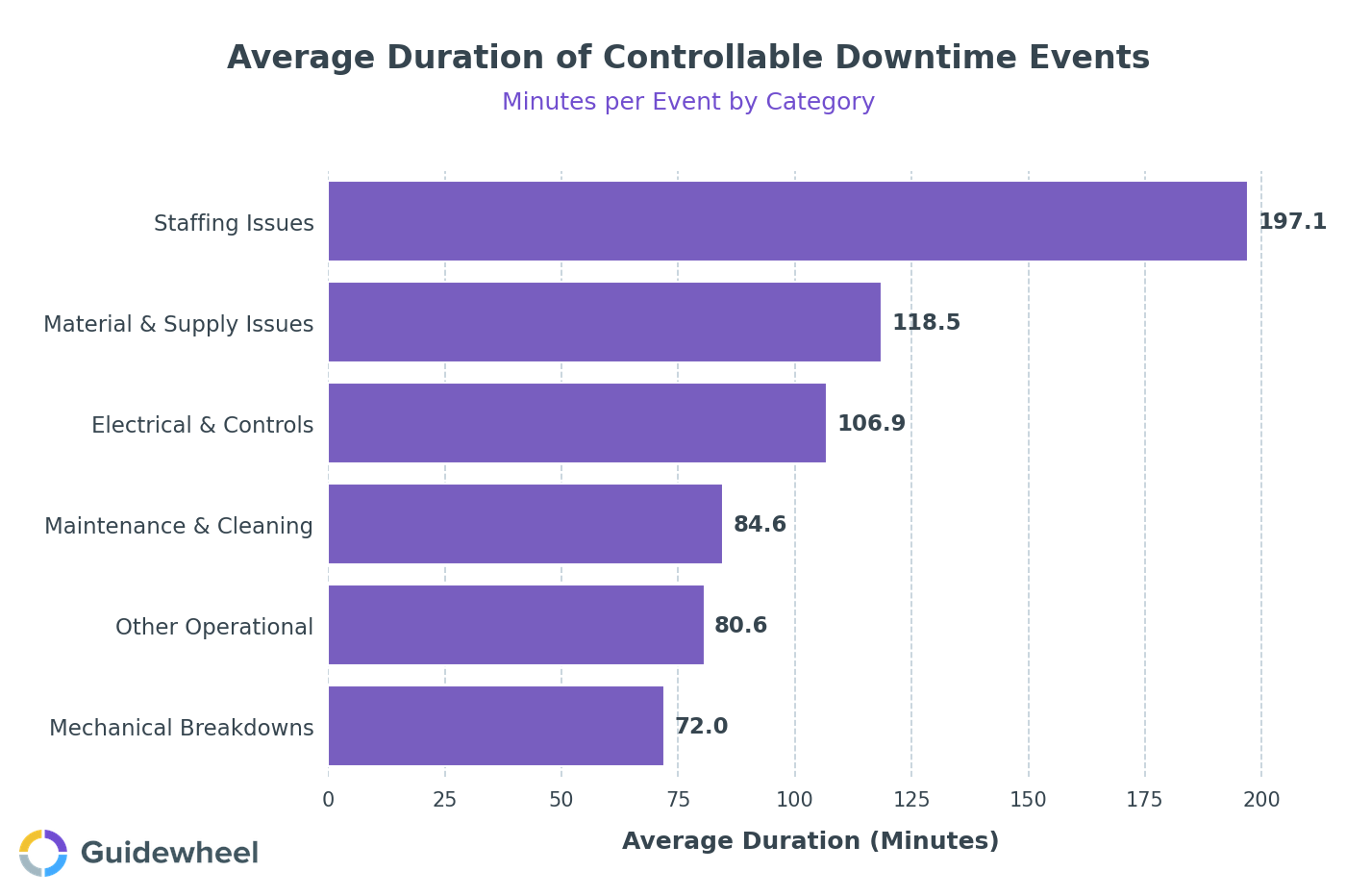
Recent performance data from Guidewheel's FactoryOps platform (spanning 11,400+ downtime events) shows that staffing-related stops average 197 minutes per event, material and supply issues average 119 minutes, and electrical and controls problems average 107 minutes (Source: Guidewheel Performance Analysis). These aren't catastrophic breakdowns, but their duration and frequency make them high-value targets for faster response and root-cause elimination.
Downtime category |
Avg. duration per event |
Why it's actionable |
|---|---|---|
Staffing issues |
197 min |
Remote alerts and better shift planning cut response gaps |
Material & supply |
119 min |
Upstream visibility prevents starvation events |
Electrical & controls |
107 min |
Pattern detection catches recurring faults early |
Maintenance & cleaning |
85 min |
Standardized procedures reduce variability |
Mechanical breakdowns |
72 min |
Condition-based maintenance replaces calendar schedules |
Each of these categories represents hours per year of recoverable capacity. And because they're within direct control of plant management, they're exactly the kind of improvement that production monitoring makes visible and trackable.
The ROI formula: simple math your CFO will respect
Let's get specific. Here's how to calculate the machine monitoring payback for your operation.
Step 1: Calculate your downtime cost per hour.
Downtime Cost/Hour = Throughput Rate (good units/hr) x Contribution Margin per Unit
For a packaging line producing 24,000 units per hour at $0.08 contribution margin, that's $1,920 per hour of lost production.
Step 2: Quantify your recoverable downtime.
If your line experiences 400 hours of unplanned downtime annually and monitoring helps you cut that by 25%, you recover 100 hours.
Step 3: Multiply.
100 hours x $1,920 = $192,000 in annual benefit from downtime reduction alone.
Step 4: Stack your benefit streams.
Benefit stream |
How to estimate |
Example annual value |
|---|---|---|
Downtime reduction |
Recovered hours x downtime cost/hr |
$192,000 |
Throughput gain |
OEE increase x max capacity x margin |
$153,600 |
Scrap reduction |
Fewer defects x cost per scrapped unit |
$23,000 |
Maintenance savings |
Fewer emergencies, optimized PM intervals |
$20,000 |
Total annual benefit |
$388,600 |
Step 5: Calculate payback.
With a $200,000 initial investment and $40,000 annual subscription, your first-year payback period is roughly 7 months. Your first-year ROI comes in around 62%, and it only improves in year two when you're past the initial investment.
These numbers will vary based on your unique operational context, product mix, and margin structure. But the framework gives you a credible starting point to present to finance.
Why weighting your data by volume changes everything
One critical nuance when benchmarking: raw averages can be deeply misleading. If you compare your plant's OEE to an industry median without accounting for production volume, you may be setting targets based on machines that barely run.
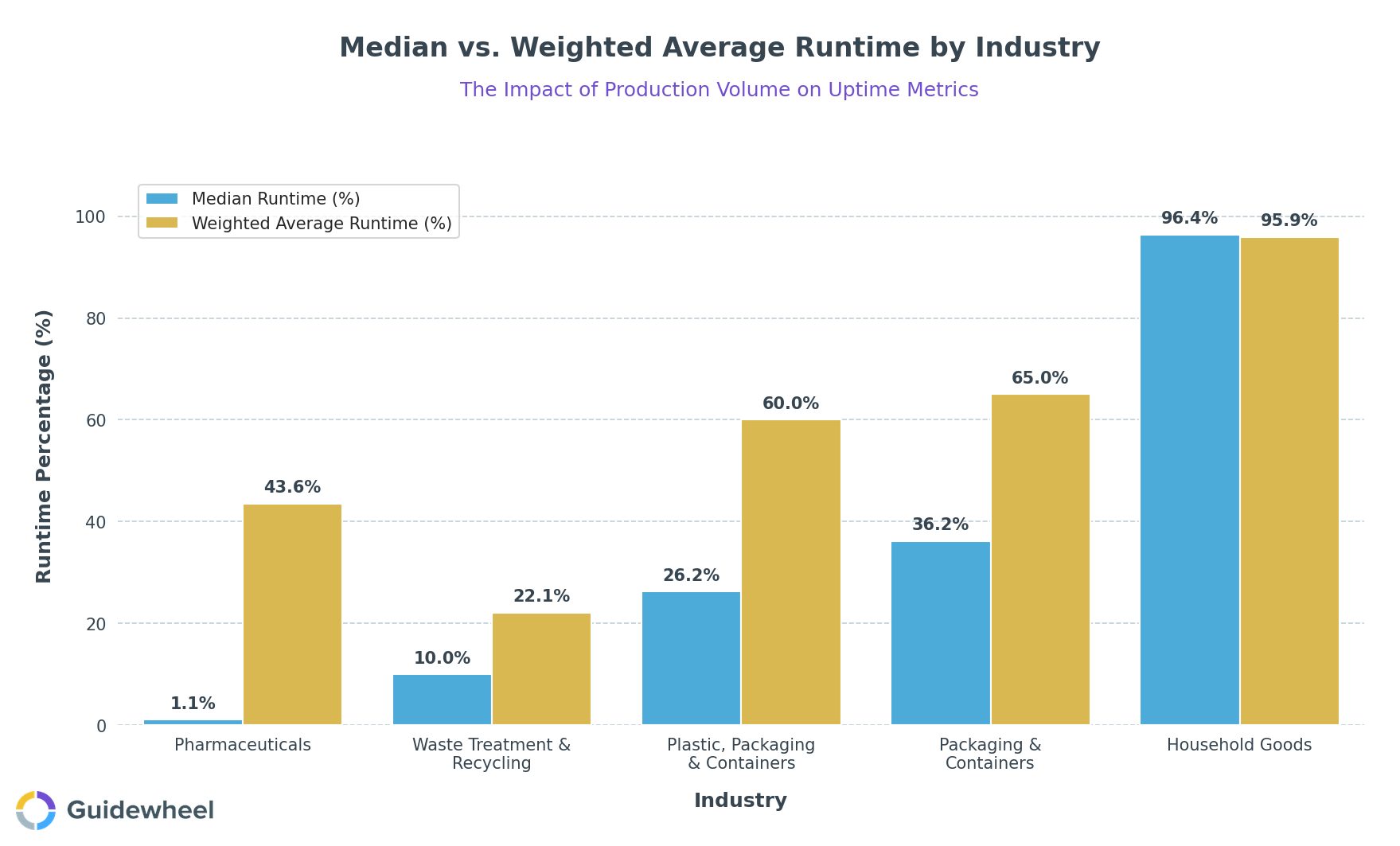
This chart illustrates the gap clearly. In pharmaceuticals, the unweighted median runtime is just 1%, but the volume-weighted average is 44% (Source: Guidewheel Performance Analysis). That tells you a small number of high-volume machines produce almost all the output, and benchmarking against the median would dramatically understate what your top assets actually achieve.
The takeaway: when you're calculating OEE ROI or building a business case, always weight your data by production volume. Your bottleneck line running three shifts matters far more than an idle backup machine when it comes to financial impact.
Benchmark ranges to calibrate your expectations
Use these benchmarks as reference points, not universal targets. Optimal performance varies significantly by facility, product complexity, and operational maturity.
Environment |
Typical baseline OEE |
Realistic improvement |
Typical downtime reduction |
|---|---|---|---|
CNC / machine tools |
40–60% |
+10 to +20 points |
20–30% |
Packaging / bottling |
50–70% |
+10 to +15 points |
15–25% |
Assembly lines |
45–65% |
+10 to +20 points |
15–25% |
Molding / stamping / converting |
50–65% |
+8 to +15 points |
15–25% |
Plants that already run strong lean and TPM programs may see smaller incremental gains from monitoring, but they often discover that the consistency and standardization benefits across shifts and sites justify the investment by themselves. Meanwhile, facilities earlier in their continuous improvement journey frequently uncover the largest financial returns.
Your implementation playbook: pilot, prove, scale
Building a successful production monitoring business case isn't about committing to a plant-wide rollout on day one. It's about proving value fast on a focused scope, then expanding based on evidence.
Pick your bottleneck. Choose 1–2 lines or cells where downtime has the highest financial impact. These are your best candidates for a quick, visible win.
Instrument in days, not months. Non-invasive sensor approaches can be installed during a planned changeover or maintenance window, often in under a week.
Baseline for 2–4 weeks. Let the system collect data without changes. This creates your "before" picture and often reveals surprises.
Act on the Pareto. Use the ranked list of loss drivers to tackle the top 2–3 issues. Target a 10–20% reduction in unplanned downtime as your first milestone.
Report results in financial terms. Translate recovered hours into dollars using the formula above. This is what gets executive support for a broader rollout.
Scale with confidence. Apply lessons learned, standardize your OEE definitions, and expand to additional lines and sites.
This phased approach reduces risk, builds internal credibility, and avoids the "nightmare project" trap that gives digital initiatives a bad name.
Turn your production data into your strongest budget argument
If you've read this far, you already know that your plant has untapped capacity hiding in plain sight. The question isn't whether production monitoring pays for itself. It's how quickly you start capturing those gains.
The framework above gives you the formulas, benchmarks, and implementation steps to build a business case that makes sense to both your operations team and your finance partners. And the payback math tends to be straightforward: focus on your highest-impact assets first, prove value in weeks, and let the data make the case for scaling.
With Guidewheel, we now get key metrics like production, downtime, downtime codes, scrap, and cycle time automatically and accurately. Our team no longer takes time to track manually and has been able to instead invest that time in improvements.
Edgar Yerena, Custom Engineered Wheels
Ready to see what your hidden factory looks like in real numbers? Book a Demo and start building your ROI case with actual machine data from your own floor.
💡
Frequently asked questions
How do you calculate ROI for a production monitoring system?
Start by calculating your downtime cost per hour: Throughput Rate × Contribution Margin per Unit. Then estimate the percentage of unplanned downtime you can realistically recover, typically 15–30% in the first year. Multiply recovered hours by your downtime cost per hour to get your primary benefit stream. Layer in secondary benefits like throughput gains from improved OEE, scrap reduction, and maintenance savings. Divide your total investment (hardware, software, implementation) by the annual net benefit to get your payback period.
What is a realistic payback period for machine monitoring?
For well-targeted deployments focused on bottleneck assets or high-volume lines, payback periods of 6 to 12 months are common. Plants that start with their highest-cost downtime assets tend to see the fastest returns. Multi-line or multi-plant rollouts may take slightly longer in absolute terms, but the compounding benefits across assets typically strengthen the overall ROI.
How do OEE improvements translate into financial outcomes?
Each percentage point of OEE improvement represents additional good units produced at full speed within scheduled production time — units that would otherwise have been lost to downtime, slowdowns, or defects. If your line has a theoretical annual capacity of 10 million units and you improve OEE by 10 points, that's 1 million additional units. Multiply by your contribution margin per unit, and you have the financial value of the gain. Whether that shows up as additional revenue, reduced overtime, or deferred capital spending depends on your demand situation.
What data do I need to collect for accurate OEE and ROI calculations?
At minimum, you need machine state data (running, idle, down) with timestamps, production counts (total and good units), and ideal cycle times for each product. Adding shift identifiers, operator context, and downtime reason codes dramatically increases the diagnostic value. The key is starting with automated state detection so you capture micro-stops and speed losses that manual tracking misses.
Can production monitoring work on older, legacy equipment?
Yes. Non-invasive approaches like clip-on current sensors, stack light readers, and photo-eye counters can instrument virtually any machine regardless of age or brand. You don't need to modify PLC logic or install network cards. This makes it possible to create one performance view across your entire floor, from older presses to newer CNC centers, without disrupting existing controls.
About the author
Lauren Dunford is the CEO and Co-Founder of Guidewheel, a FactoryOps platform that empowers factories to reach a sustainable peak of performance. A graduate of Stanford, she is a JOURNEY Fellow and World Economic Forum Tech Pioneer. Watch her TED Talk—the future isn't just coded, it's built.