No items found.
blog
How Teknor Apex Uses One Source of Truth, Digitization, and Visual Management to Raise Factory Performance
By: Guidewheel
Updated:
March 6, 2026
6 min read
How Teknor Apex uses one source of truth, digitization, and visual management to raise factory performance
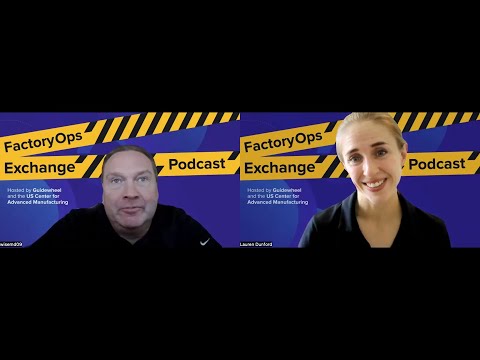
In this episode of the FactoryOps Exchange, Don Wiseman (CEO, Teknor Apex) joins Lauren Dunford, CEO and Co-Founder of Guidewheel, to discuss building followership, digitizing tribal knowledge, and using real-time data to reduce variation on the factory floor.
Top 5 takeaways
💡
Here are the key insights from Don Wiseman on raising factory performance at Teknor Apex:
- Establish one source of truth first. Eliminate data debates by ensuring every team and function works from the same numbers before pursuing any digitization initiative.
- Digitize tribal knowledge before it walks out the door. Process mapping and knowledge management prevent decades of expertise from disappearing when experienced operators retire or move on.
- Show operators what good looks like in real time. Visual standards and historical run data empower frontline teams to self-correct, reduce variation, and improve quality without constant management oversight.
- Make original mistakes, not repeated ones. Run experiments, fail fast, and learn. Waiting for perfect information is a bigger risk than acting on directionally correct data.
- Consistency and caring leadership compound over time. The further decisions travel from the center, the more variation amplifies. Consistent leadership reduces organizational noise.
Best practices and key learnings
Kill the data fight: one source of truth as the foundation
Every manufacturer has lived through the Monday morning data fight. Two departments walk into a meeting with two different sets of numbers. The first 30 minutes are spent arguing about whose spreadsheet is right. No decisions get made.
Don Wiseman made eliminating this dynamic a non-negotiable early priority at Teknor Apex. Before pursuing any advanced digitization or AI data analytics initiative, his team locked down a single, trusted data source across the organization.
"You start with one source of truth. You got to have real data. Don't come in to have a discussion if you start with 'oh just ignore that chart up on the left. The numbers aren't right. Let me tell you what they really are.'"
Don Wiseman, CEO, Teknor Apex
This is foundational work. It is not glamorous. But without it, every downstream investment in industrial AI, ai monitoring, or advanced analytics is built on sand. The team at Teknor Apex pushed through what Wiseman calls the "storming" phase, where people resist giving up their own versions of the numbers, and reached a point where trusted data became the default starting point for every conversation.
The practical lesson: do not layer enterprise AI tools on top of conflicting data sources. Fix the foundation first. Get every function, every plant, every shift looking at the same numbers. Then the real work can begin.
Digitize what experts know before they leave
Teknor Apex is over 100 years old. Many of its operators have been with the company for 20, 30, even 40 years. That is an extraordinary asset, but it is also an extraordinary risk. When those people retire, their knowledge retires with them.
Wiseman's team built an internal tool called "connected operator" that addresses this directly. When an operator badges into a line, the system shows them what they are running, the product history, and how their peers have run the same job. At the end of the week, each operator gets a private report card comparing their performance to historical benchmarks.
This is not surveillance. It is skill-building. The report card is for the operator alone, not for management grading. The goal is to give people the information they need to improve on their own terms.
"The more we standardize, the less variation, the less variation, the better things work for our customers."
Don Wiseman, CEO, Teknor Apex
This approach turns ai in manufacturing from an abstract concept into something tangible on the factory floor. Instead of relying on one veteran operator's memory of how a product should run, the system captures that expertise and makes it available to every operator on every shift. That is how you scale expert intuition across an entire operation.
Speed beats perfection: adjusting your risk profile
The pace of manufacturing has changed fundamentally. Wiseman points out that regional pricing differences that used to hold for months now collapse in hours. Customer preferences shift faster. Supply chains move faster. The competitive window for decisions has compressed dramatically.
His advice is direct: if you wait for 100% of the data before making a decision, you are already behind. The question is no longer "do I have all the data?" It is "do I have the right data, and do I have enough of it to act?"
This is where real-time ai monitoring and factory floor visibility become operational necessities rather than nice-to-haves. When operators and managers can see machine performance minute by minute, they do not need to wait for a weekly report to course-correct. They adjust in real time.
Wiseman's cultural mantra reinforces this: "Go do the experiment. Make original mistakes." The emphasis on "original" is important. Repeating known mistakes is waste. Running new experiments, even when some fail, is how organizations learn and improve faster than competitors.
The biggest levers for factory performance
"Well, first is communication, right? It's what does good look like? But then the vision of what good looks like, coaching, development, training, and always the more visual we can make things, right?"
How to put these insights into practice
The principles Wiseman describes are not theoretical. They are executable steps that any manufacturer can start this week.
Step 1: Audit your data sources. Walk into your next production meeting and count how many different spreadsheets, dashboards, or manual logs people reference. If the answer is more than one, that is your first problem to solve. Consolidate to a single source of truth before investing in anything else.
Step 2: Identify your highest-risk knowledge holders. List the operators and engineers whose retirement would create the biggest knowledge gaps. Start documenting their processes, run parameters, and decision-making logic now. Do not wait for a formal knowledge management initiative. Start with one product line and one experienced operator.
Step 3: Make performance visible on the floor. Post visual standards at the machine. Show operators what a good run looks like and what a bad run looks like. If you have the data, show them how their runs compare to historical benchmarks. The goal is not to create pressure. It is to give people the feedback loop they need to improve.
✅
When building a data-driven experimentation culture on the factory floor, remember these principles:
- Define the hypothesis first. Before running any experiment, clearly state what you expect to happen and how you will measure success — this prevents ambiguous results and wasted effort.
- Start with your most critical bottleneck. Getting real-time data flowing on the machine that constrains your throughput delivers the fastest ROI and builds organizational confidence in the approach.
- Document every outcome. Whether an experiment succeeds or fails, capturing the result ensures the organization learns collectively — turning individual insights into institutional knowledge.
Step 4: Run one experiment this month. Pick a process that your team suspects could be improved. Define the hypothesis, set the parameters, run the test, and measure the result. If it fails, document what you learned and move on. If it works, standardize it. Either way, you are building the muscle of data-driven experimentation.
Step 5: Shift from firefighting to proactive management. Real-time visibility through ai monitoring and factory floor sensors lets managers see problems as they happen, not days later in a report. Start with your most critical bottleneck machine. Get real-time data flowing. Use it to catch downtime early and act before small issues become shift-killing problems.
Building a factory that learns faster than it forgets
The thread running through everything Don Wiseman shared is this: people are the competitive advantage, and technology's job is to make those people faster, more informed, and more consistent. Not to replace them. Not to surveil them. To support them.
That is exactly the kind of manufacturing future worth building. One source of truth. Knowledge that outlives any individual. Operators who know whether they are winning or losing in real time. Leaders who are consistent enough that the organization does not amplify noise the further it gets from the center.
The tools to do this exist today. They do not require ripping out existing systems, months of IT integration, or production downtime. They require the willingness to start, run the experiment, and make your mistakes original.
If you are ready to bring real-time visibility to your factory floor and start turning tribal knowledge into a scalable system, Book a Demo to see how Guidewheel can help you get there.
Watch and listen
Watch the full conversation now: