No items found.
blog
10 proven strategies to reduce manufacturing downtime
By: Guidewheel
Updated:
May 3, 2026
9 min read

Every plant manager knows the feeling: you're reviewing yesterday's production numbers and the gap between what you planned and what you actually shipped is, once again, larger than it should be. The culprit is almost always the same: downtime you didn't see coming, couldn't quantify in the moment, and couldn't fully explain after the fact.
Plain and simple: most manufacturers operate somewhere between 60% and 75% OEE, which means roughly a quarter to nearly half of scheduled production time is lost to avoidable stoppages (Source: Lean Enterprise Institute). That's not a failure of effort. It's a failure of visibility. And visibility is exactly where these 10 strategies start.
This article walks through 10 practical approaches to reduce manufacturing downtime, organized from quick wins you can deploy in weeks to foundational investments that compound over months. No rip-and-replace project required.
Key terms before we dive in
If your team debates the definition of OEE every Monday morning, you're not alone. Let's level-set on the basics.
OEE (Overall Equipment Effectiveness) measures how productively your equipment runs during planned production time. The formula:
OEE = Availability x Performance x Quality
OEE component | What it measures | Common loss examples |
|---|---|---|
Availability | Actual runtime vs. planned time | Breakdowns, changeovers, setup delays |
Performance | Actual speed vs. ideal cycle time | Minor stops, slow cycles, jams |
Quality | Good parts vs. total parts | Scrap, rework, first-piece rejects |
A quick example: if your line runs 85% of planned time, at 95% of target speed, with 98% good parts, your OEE is 79%. That's a reasonable starting point for many facilities, though optimal performance varies by equipment type, product mix, and operational context.
Production monitoring is the broader practice of tracking run/idle/down data, throughput, and losses in real time across your lines. Downtime software specifically captures stop events, reason codes, and durations so your team can act on the data, not just report it.
Where downtime actually hides
Before jumping into strategies, it helps to understand where your losses live. Industry data consistently shows that the top two or three downtime categories account for 60% to 80% of total losses (Source: ASQ). The trick is knowing which categories matter most at your facility.
Recent performance analysis across more than 3,000 machines and 14,700 downtime events (Source: Guidewheel Performance Analysis) reveals how different downtime types vary dramatically in both frequency and severity:
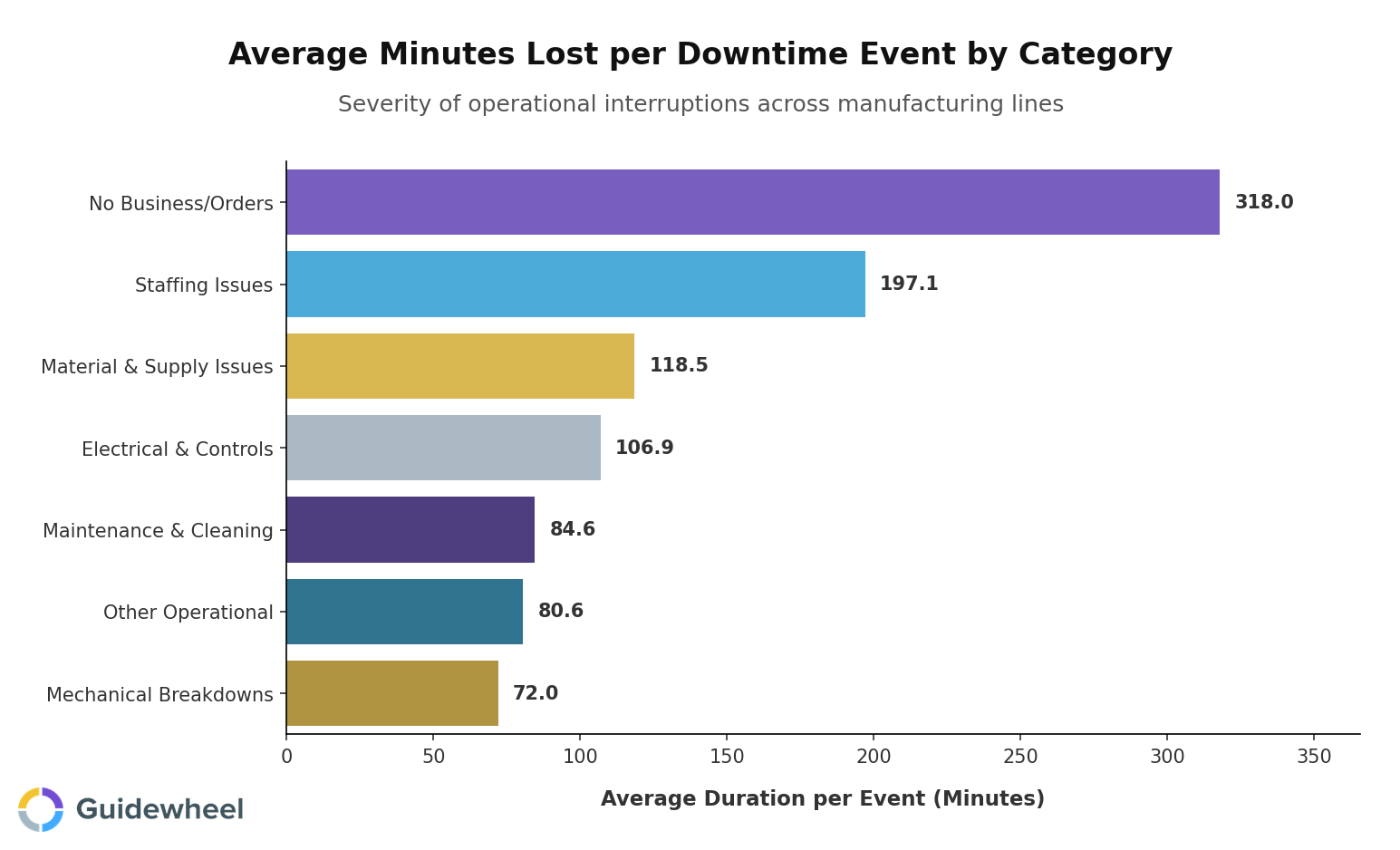
Notice that while demand-driven stoppages ("No Business/Orders") create the longest individual events at 318 minutes per incident, the categories you can actually control, like mechanical breakdowns (72 minutes), maintenance tasks (85 minutes), and staffing gaps (197 minutes), represent the most actionable improvement opportunities. These are the losses where your operational decisions directly move the needle.
The 10 strategies, ranked by speed to impact
Strategy 1: capture machine states automatically and classify downtime in real time
This is one of the highest-ROI moves you can make. When your machines report their own status (running, stopped, idle, in setup), you eliminate the guesswork of memory-based logging and delayed spreadsheet updates. Define 8 to 12 standardized reason codes across your plant and train operators to classify stops as they happen, not at shift end.
Expected gain: +2 to 5% availability within 4 to 8 weeks. One automotive supplier discovered that minor stops (jams, misfeeds) accounted for 40% of their downtime, not changeovers as they'd assumed (Source: Guidewheel Customer Research). Real-time classification made that visible in days.
This is also how you set up real-time downtime alerts for supervisors: when a stop exceeds a threshold (say, 5 minutes), the system flags it immediately so your team can respond in minutes instead of discovering the issue in tomorrow's report.
Strategy 2: analyze and reduce changeover time with SMED
Changeovers typically represent 15% to 25% of total downtime (Source: Shigeo Shingo, A Revolution in Manufacturing: The SMED System, 1985). Video-record a changeover, separate internal tasks (line must stop) from external tasks (can happen while running), and move everything possible outside the stop window.
A practical first target: reduce changeover duration by 20 to 30% in your initial pass. A medical device manufacturer cut their average changeover from 45 minutes to 18 minutes by pre-staging tooling and switching to quick-change collets (Source: Guidewheel Customer Research).
Strategy 3: build a predictive maintenance program from failure pattern data
Unplanned breakdowns eat 30% to 40% of total downtime and are inherently the most disruptive. The shift from reactive ("fix it when it breaks") to condition-based maintenance, tracking signals like vibration trends, temperature drift, or cycle time creep, can reduce unplanned failures by 25% to 50% (Source: ISO 13374, Condition Monitoring and Diagnostics).
Start by identifying the top 3 to 5 failure modes on your critical equipment and setting alert thresholds that trigger a work order during the next planned window.
✅
The 80/20 rule applies powerfully to downtime reduction: a handful of failure modes on your critical equipment typically drive the majority of unplanned stoppages. By analyzing 12–24 months of maintenance logs, stocking the top 20 parts consumed in unplanned repairs, and setting condition-based alert thresholds for your top 3–5 failure modes, you can dramatically cut both the frequency and duration of breakdowns. One CNC machining facility cut average MTTR from 3.5 hours to 1.2 hours simply by stocking six high-consumption parts permanently.
Strategy 4: optimize spare parts availability for your top failure modes
Breakdown recovery time splits between diagnosis and waiting for parts. Analyze 12 to 24 months of maintenance logs, identify the top 20 parts consumed in unplanned repairs, and stock them. The 80/20 rule applies: a handful of bearings, seals, and sensors usually covers the majority of events.
One CNC machining facility cut average MTTR from 3.5 hours to 1.2 hours simply by stocking six high-consumption parts permanently (Source: Guidewheel Customer Research).
Strategy 5: deploy shop floor dashboards and andon systems
Operators and supervisors respond faster to problems they can see. A wall-mounted display showing current machine state, today's OEE, and the top downtime cause creates transparency and accountability. Plants with active andon systems report 20% to 30% faster response times and lower repeat-incident rates (Source: Lean Enterprise Institute).
This also directly answers how to reduce microstops with better operator routines: when operators see minor stops accumulating on a live dashboard, they start catching jams and misfeeds before they cascade into full-line stoppages.
Strategy 6: establish a weekly root-cause analysis cadence
Downtime data only creates value when it drives action. A 30-minute weekly meeting where operations and maintenance review the top 3 to 5 loss events, run a quick 5 Why analysis, and assign corrective actions can yield +1 to 3% uptime per quarter through accumulated small wins.
The key is consistency: assign a facilitator, pull ranked data from your production monitoring system, and track closure of action items week over week.
Strategy 7: invest in operator training and cross-training
Many minor stops and quality events trace back to operator technique or missed early warning signs. A sheet metal stamping plant found that 35% of minor stops came from feeder misadjustment during setup. A structured training program and quick-reference setup card cut those stops by 80% (Source: Guidewheel Customer Research).
Cross-training operators on 2 to 3 machines also reduces scheduling gaps during breaks or absences, directly addressing short stops your machine monitoring data might be missing because they're logged as "operator unavailable" rather than a machine issue.
Strategy 8: prioritize maintenance spending using OEE benchmarks
Not all machines deserve equal maintenance attention. Collect 8 to 12 weeks of OEE data by equipment type, identify outliers performing more than 5% below their peer group, and direct your capital and labor toward the highest-impact opportunities.
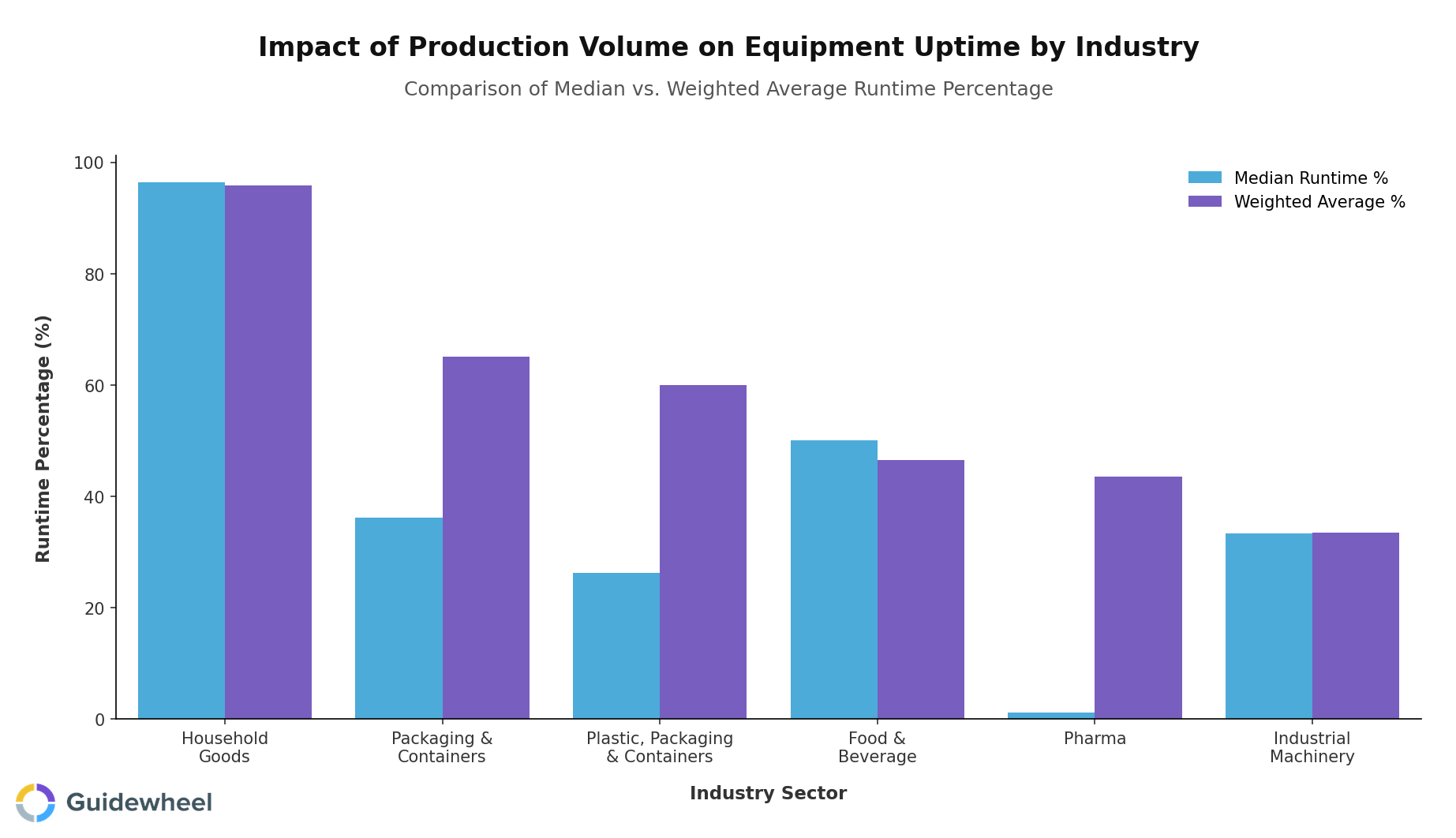
This chart illustrates why benchmarking matters: the gap between median machine performance and volume-weighted performance varies enormously by sector. These benchmarks serve as reference points for setting realistic targets, recognizing that each facility's product mix, material characteristics, and production goals influence what "good" looks like.
Strategy 9: reduce mean time to repair through smarter scheduling and dispatch
MTTR is determined by four things: response time, diagnostic time, repair time, and parts availability. Measure MTTR for your top failure modes and identify the bottleneck. A pharmaceutical facility found that 45% of MTTR was just response time (technician unavailable). Implementing a simple dispatch priority system cut their pump failure MTTR from 2.8 hours to 1.1 hours (Source: Guidewheel Customer Research).
This is also where tracking response time to machine stops pays off: when you can measure the gap between alert and technician arrival, you can staff and schedule maintenance coverage to close it.
Strategy 10: benchmark across lines and sites to drive best practice sharing
Standardize your OEE calculation, downtime codes, and planning assumptions across all lines and shifts. Then make performance visible. When one line sees that a sister line solved the same changeover problem with a simple process change, best practices replicate fast.
An appliance manufacturer with three plants rolled out a standardized monthly dashboard and gained 4 percentage points of OEE within two months by replicating a single process improvement across sites (Source: Guidewheel Customer Research).
Start recovering hidden capacity this month
Downtime reduction isn't a long-term transformation project. It's an immediate opportunity. With automated machine state capture, standardized downtime reason codes, and a disciplined root-cause review cadence, your team can recover 2 to 5% uptime within 90 days. For most plants, that translates to tens or hundreds of thousands of dollars in recovered throughput, enough to fund the monitoring system, maintenance upgrades, and continuous improvement investments that keep compounding.
Ready to start recovering hidden factory capacity? Book a Demo and run a quick pilot on your highest-downtime line.
We had our best month of the year, increasing production from 26k-35k/month to 46k cases in March. I attribute this to Guidewheel. Being able to see downtime data and address downtime reasons directly correlates to higher production.
Michael Palmer, VP of Operations, Direct Pack.
💡
Frequently asked questions
What is OEE in manufacturing and why does it matter?
OEE (Overall Equipment Effectiveness) is a composite metric that multiplies Availability, Performance, and Quality to show how productively your equipment runs during planned production time. It matters because it gives you a single number that captures all major loss categories, from breakdowns and slow cycles to scrap, so you can prioritize improvements based on data rather than gut feel.
What is a good OEE score in manufacturing?
Industry benchmarks generally position 85% as a competitive target for discrete manufacturing, though many facilities operate in the 65% to 75% range as a starting point. What qualifies as "good" depends on your equipment type, product complexity, and production goals. The more useful question is whether your OEE is improving consistently over time rather than chasing a single benchmark number.
How can manufacturers reduce downtime using machine monitoring data?
Machine monitoring captures machine states (running, stopped, idle, setup) automatically and in real time. This eliminates the delays of manual spreadsheet tracking and gives your team immediate visibility into what's actually stopping production. When you pair that data with standardized reason codes and a weekly root-cause review, you can identify and fix the top 2 to 3 loss drivers that typically account for 60% to 80% of total downtime.
What features should I look for in OEE or production monitoring software?
Prioritize ease of deployment (live in 2 to 4 weeks), broad machine compatibility (legacy and new equipment), intuitive operator interfaces, configurable OEE calculations that match your planning definitions, and built-in alerting that notifies supervisors when downtime exceeds set thresholds. Integration with your CMMS or MES is valuable but shouldn't block your initial deployment.
What ROI should a plant expect from real-time production and downtime monitoring?
Most facilities see 2 to 5% uptime recovery within the first 90 days of automated monitoring, with typical first-year ROI ranging from 200% to 400% depending on machine value and utilization. A practical starting point: calculate the revenue your highest-downtime machine generates per hour, estimate a conservative 2% uptime gain, and compare that to the monitoring cost. For most operations, payback happens within the first one to three months.
About the author
Lauren Dunford is the CEO and Co-Founder of Guidewheel, a FactoryOps platform that empowers factories to reach a sustainable peak of performance. A graduate of Stanford, she is a JOURNEY Fellow and World Economic Forum Tech Pioneer. Watch her TED Talk—the future isn't just coded, it's built.