No items found.
blog
Reducing changeover times with real-time data: a practical SMED playbook
By: Guidewheel
Updated:
May 2, 2026
8 min read

Every plant runs changeovers. The question is whether you actually know how long they take, or you're relying on the number your lead operator remembers from last Tuesday. If your changeover data lives in a spreadsheet that gets updated sometime before Monday's production meeting, you're making improvement decisions on stale, rounded, and often optimistic numbers.
Here's the practical reality: in mixed-product manufacturing, changeovers can eat 5–15% of your available production time. That's not a rounding error. That's the difference between hitting your delivery targets and scrambling for overtime. The good news? Changeover time is one of the most controllable losses on your floor, and you don't need a massive automation project to start cutting it. You need a proven methodology (SMED), combined with data you can actually trust.
This playbook walks through how to pair Single-Minute Exchange of Dies (SMED) with production monitoring to shrink changeover times, shift by shift, without a rip-and-replace project.
Key terms before we dive in
If these metrics are already part of your daily work, skip ahead. For everyone else, here's a quick grounding:
Term | Plain-english definition |
|---|---|
OEE (Overall Equipment Effectiveness) | Availability × Performance × Quality. The single number that tells you how much of your planned production time is actually productive. An 85% OEE is widely recognized as world-class by the Automotive Industry Action Group (AIAG). |
Availability | The percentage of planned production time the machine is actually running, not stopped for changeovers, breakdowns, or material waits. |
Cycle time | Time from the start of one unit to the start of the next. Your ideal cycle time is the theoretical minimum; actual cycle time includes all the little slowdowns and micro-stoppages. |
Changeover time | Total elapsed time from the last good part of one product to the first good part of the next. This is where SMED focuses. |
SMED (Single-Minute Exchange of Dies) | A systematic methodology, pioneered by Shigeo Shingo, for reducing changeover times by separating what must happen while the machine is stopped from what can happen while it's still running. |
Six Big Losses | The TPM framework that categorizes all production losses: equipment failure, setup/changeover, idling/minor stops, reduced speed, quality defects, and startup losses. |
Why changeover time deserves your attention first
When you break down OEE losses on a mixed-product line, changeover and setup often represent 10–30% of total losses, depending on your product mix and line complexity. Unlike equipment failures, which are unpredictable, changeovers are repeatable and predictable, which makes them the ideal target for structured improvement.
Consider a straightforward example: a line running 10 changeovers per day at 30 minutes each loses 5 hours daily to setups. Cut each changeover by just 9 minutes, and you recover 90 minutes of production time per day. At a margin of $80/unit with a 2-minute cycle time, that's roughly $900K in annual recovered capacity on a single line.
So why does OEE sometimes look acceptable while output stays flat? Often, changeover losses hide inside your availability number. If your team logs a 15-minute changeover but the machine was actually idle for 22 minutes (waiting for materials, searching for tooling), your spreadsheet says you're fine while your throughput says otherwise.
The five-phase SMED playbook
Phase 1: capture your baseline with real data
Pick 2–3 representative changeovers on a high-volume line. Not the most complex, not the easiest. Record 5–10 consecutive changeovers of the same product transition, across shifts if possible. For each one, capture:
Changeover start time (last good part of previous product)
Each intermediate step (tooling swap, material load, parameter entry, first-piece verification)
Changeover end time (first good part of new product)
Any delays or quality checks that extended the event
Here's the thing: plants that move from manual logs to automated timestamps consistently discover their changeovers are 10–25% longer than what operators recorded. That initial "bad news" is actually the most important finding, because it reveals the true size of the opportunity.
Phase 2: separate internal from external activities
This is the core of SMED. Map every task in your changeover and classify it:
Task example | Duration | Internal or external? | Opportunity |
|---|---|---|---|
Notify material handler | 1 min | External | Pre-notify before stoppage |
Stop machine, clear | 2 min | Internal | Standard procedure |
Remove old die | 3 min | Internal | Quick-release mechanism? |
Transport new die from staging | 2 min | External | Pre-stage at machine |
Install new die | 4 min | Internal | Quick-change fixture |
Enter parameters | 2 min | Internal | Pre-load via recipe recall |
First-piece inspection | 3 min | Internal/External | Run while line starts? |
In typical changeovers, 30–50% of internal time can be converted to external work through better pre-staging and parallel preparation.
Phase 3: convert internal to external
This is where you unlock the biggest gains without spending capital. The tactics that consistently deliver results:
Pre-staging and kitting: Materials, tooling, and fixtures ready at the machine before the last part runs. Typical savings: 3–5 minutes.
Parameter pre-loading: Load product recipes via barcode scan or preset buttons instead of manual keyboard entry. Typical savings: 1–2 minutes.
Parallel operator tasks: If a second team member can stage materials during the final production run, installation and verification are all that remain. Typical savings: 2–4 minutes.
✅
The three highest-impact SMED tactics — pre-staging and kitting, parameter pre-loading, and parallel operator tasks — are all process changes, not capital projects. Combined, they can recover 6–11 minutes per changeover. On a line running 10 changeovers per day, that's over an hour of production time recovered daily without purchasing any new equipment.
Phase 4: streamline what's left
Once you've externalized everything possible, optimize the remaining internal steps:
Replace hand-clamping with quick-release or hydraulic clamps
Organize tools using 5S methodology, eliminating search time
Cross-train operators so parallel tasks happen simultaneously
Replace manual parameter entry with barcode-triggered recipe downloads
Phase 5: standardize, monitor, and keep improving
Document the new procedure step by step with time targets. Create a visual standard at the machine. Then, critically, track performance against that standard shift by shift. This is where production monitoring proves its value.
A real-time OEE dashboard or downtime tracking software that shows live changeover progress versus target lets supervisors intervene in the moment, not in Monday's meeting. When changeovers exceed the target by 10% or more, an alert flags the issue while there's still time to fix it today.
What the data says about changeover variability
Here's where many plants get surprised. According to Guidewheel Performance Analysis data across 3,000+ tracked machines, the median changeover duration is 44 minutes, but the average of median changeover times jumps to 141 minutes, because certain machine types and industries experience drastically longer setups. The more revealing number is changeover variability, which sits at a median of 56.6%.
That variability number matters more than the baseline duration. It tells you that shift-to-shift inconsistency in changeover execution is often a bigger problem than the changeover itself. Standardization, not speed, is the first win.

The chart above shows cross-industry uptime benchmarks. The overall weighted average runtime sits at roughly 55%, which means nearly half of planned production time is lost to some combination of downtime categories. These benchmarks serve as reference points, recognizing that each facility's product mix, equipment age, and operational goals will shape what "good" looks like for your plant.
Where changeover losses fit among your other downtime drivers
Before investing heavily in SMED, confirm that changeovers are actually your biggest controllable loss. In many plants, they compete with other downtime categories for priority.
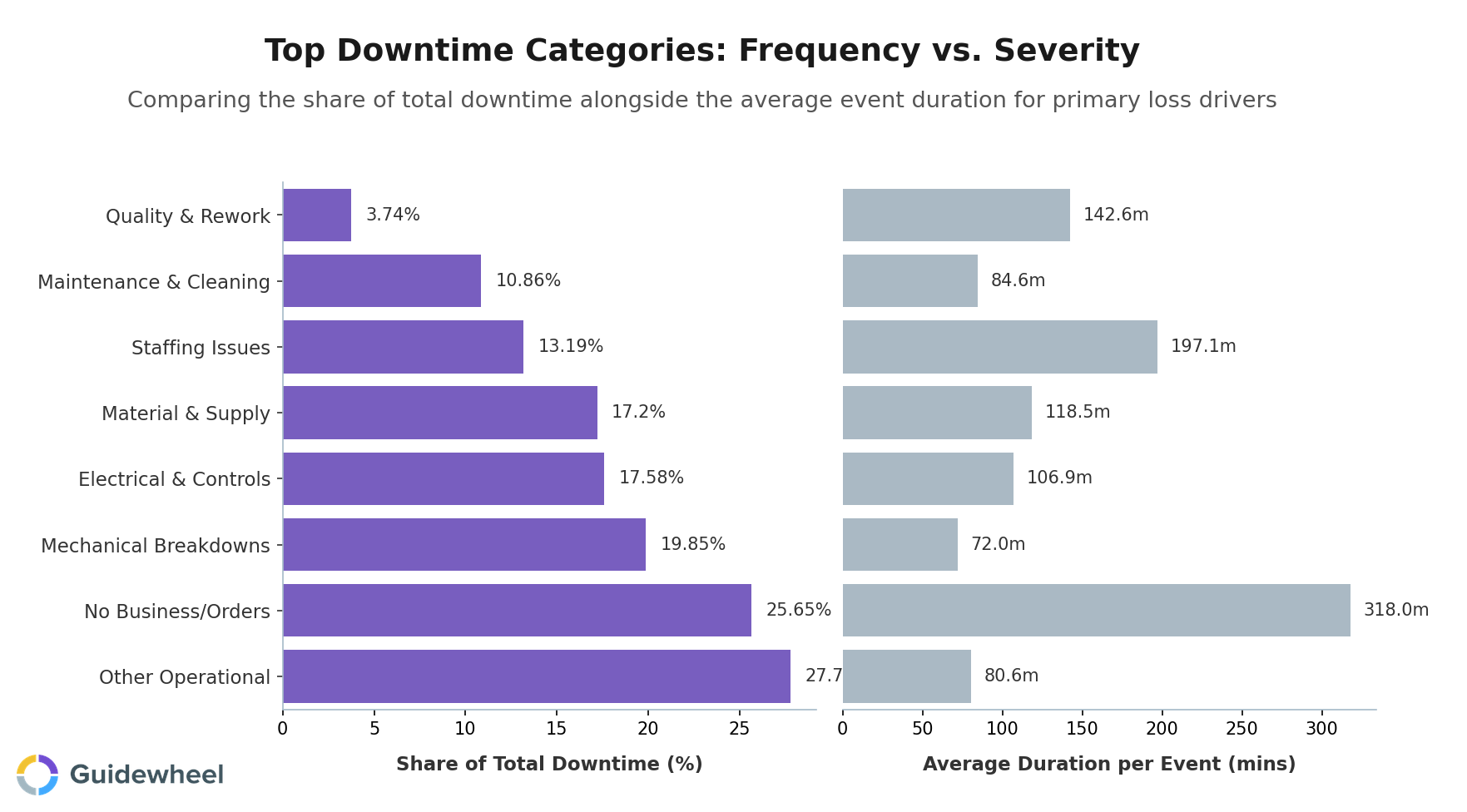
This breakdown of actionable downtime categories reveals that mechanical breakdowns (averaging 72 minutes per event), maintenance and cleaning (85 minutes), staffing issues (197 minutes), and material and supply problems (119 minutes) all compete for your improvement team's attention (Source: Guidewheel Performance Analysis).
The key insight? Changeover reduction through SMED is high-ROI because changeovers are predictable and repeatable. But your OEE data collection and downtime tracking software should give you a clear Pareto view of all loss drivers so you target the 20% of problems causing 80% of delay. Guidewheel's FactoryOps platform captures this data automatically, giving you the baseline you need with no PLC programming required, no IT project needed.
When does Excel stop being enough?
For many operations, Excel is where tracking starts, and that's a reasonable place to begin. A structured spreadsheet with standardized reason codes is infinitely better than no tracking at all. The tipping point comes when:
Signal | What it means |
|---|---|
Data arrives 1–2 days after events | You're reacting to problems that already cost you production |
Accuracy sits at 60–75% | Operators round times, merge activities, or skip entries |
Cross-shift comparisons spark debates | No single source of truth to settle "my shift was faster" |
You're spending 4+ hours/week consolidating data | That's labor cost hiding in your overhead |
Scaling to multiple lines or sites feels impossible | Manual methods don't transfer or compare |
Guidewheel's automated data capture delivers 95–99% timestamp accuracy, available within minutes rather than days. Plants that make the switch often achieve payback in 4–9 months on a 5–10 machine deployment (Source: Guidewheel's Customer Research).
Proving ROI to your leadership team
For the CFO, frame it in margin terms: "We'll recover X minutes per changeover across Y changeovers per day, translating to Z additional units at $W margin. Payback is under 3 months."
For the operations leader: "We'll replace post-shift Excel debates with shift-by-shift changeover data that shows exactly where time is lost, by product, shift, and operator experience level."
For the plant floor: "Your best technician's changeover method becomes the standard. Data proves it works, and everyone gets trained on the same process."
Start cutting changeover time this quarter
You don't need to overhaul your floor to start seeing results. Pick one high-volume line. Run 10 observed changeovers. Map internal versus external activities. Move the obvious external work out, standardize the procedure, and track it. That's your pilot. Most plants see 20–30% changeover reduction within 8–12 weeks using this approach (Source: Guidewheel's Customer Research).
If you want to stop leaving hidden factory capacity on the table, Book a Demo. Guidewheel's FactoryOps platform deploys in days, not months — no PLC programming, no IT project, no added complexity.
We had our best month of the year, increasing production from 26k-35k/month to 46k cases in March. I attribute this to Guidewheel. Being able to see downtime data and address downtime reasons directly correlates to higher production.
Michael Palmer, VP of Operations, Direct Pack
💡
Frequently asked questions
How is OEE calculated in production, and where do changeovers fit?
OEE equals Availability multiplied by Performance multiplied by Quality. Changeover time directly reduces your Availability component. If your line is planned for 16 hours but loses 2 hours to changeovers, your Availability drops to 87.5% before Performance and Quality even factor in. Tracking changeover duration separately from other downtime lets you isolate this specific loss and target it with SMED.
What are the most effective ways to reduce changeover time without a big automation project?
Start with SMED phases 1 through 3: document your current changeover, separate internal from external tasks, and pre-stage everything possible before the machine stops. These steps are process changes, not capital projects. Most facilities recover 30–50% of their internal changeover time through better pre-staging and parallel preparation alone, often within weeks (Source: Guidewheel's Customer Research).
How should manufacturers capture OEE data, manually or automatically?
Both work, depending on your maturity and budget. Manual tracking with standardized reason codes is a legitimate starting point. The limitation is accuracy (typically 60–75%) and time delay. Automated data capture from sensors or machine interfaces delivers 95%+ accuracy in near real-time, which accelerates your ability to act on trends. Many plants start manual and graduate to automated systems once they've proven the value of tracking.
How do I benchmark changeover performance across shifts and sites?
Consistent data collection is the prerequisite. When all shifts and sites use the same reason codes and measurement method, you can compare directly. Product-specific changeover targets work better than a single plant-wide number, since a simple product transition and a complex one shouldn't share the same goal. Multi-site benchmarking reveals which facilities have cracked specific changeover challenges, enabling knowledge transfer at zero cost.
What ROI should I expect from investing in downtime tracking software?
The math is straightforward — and conservative. Multiply your changeover time savings (minutes) by the number of daily changeovers, your unit margin, and working days per year. For many mid-sized plants, even a modest 20% reduction in changeover time across a handful of lines translates to $500K+ in annual recovered capacity. Software investments of $15K–$40K for 5–10 machines typically achieve payback within 4–9 months.
About the author
Lauren Dunford is the CEO and Co-Founder of Guidewheel, a FactoryOps platform that empowers factories to reach a sustainable peak of performance. A graduate of Stanford, she is a JOURNEY Fellow and World Economic Forum Tech Pioneer. Watch her TED Talk—the future isn't just coded, it's built.