No items found.
blog
Predictive maintenance without PLCs: a practical guide for older equipment
By: Guidewheel
Updated:
May 3, 2026
9 min read

If you manage a plant with equipment from the 1990s or early 2000s, you've probably heard this before: "You need PLCs to do predictive maintenance." It sounds reasonable. PLCs collect data, data feeds algorithms, algorithms predict failures. Looks neat on a whiteboard.
But here's the reality on most factory floors: half your machines don't have programmable logic controllers. Or the PLCs are so old they can't export data. Or nobody has the ladder logic documentation anymore. Does that mean your aging assets are stuck in reactive mode? No.
Predictive maintenance without PLCs is not only possible, it's often the fastest, lowest-risk path to reducing unplanned downtime on older equipment.
This guide walks through the practical how, starting with what sensors actually work on legacy machines, which assets to prioritize, and how to build a business case your finance team will approve.
Understanding the basics before you start
Before diving into sensor options and implementation steps, let's align on a few terms that often get tangled together in manufacturing conversations.
Term |
What it answers |
Typical data sources |
|---|---|---|
Machine monitoring |
Is the machine running? At what speed? |
Current sensors, proximity sensors, PLC outputs |
Condition monitoring |
Is the machine healthy? What's degrading? |
Vibration, temperature, acoustics, oil analysis |
Machine health monitoring |
How close is this asset to failure? |
Combined condition data plus trend analysis |
Predictive maintenance |
When should we intervene, based on actual condition? |
All of the above, processed through analytics or AI |
Machine performance monitoring |
Are we hitting throughput and OEE targets? |
Runtime, cycle time, production counts, quality data |
The practical takeaway: machine monitoring and condition monitoring are complementary layers, not competing investments.
One tells you the machine stopped. The other tells you why it's about to (Source: IBM). Together, they form the shared language between operations and maintenance teams.
The real problem with PLC-dependent approaches
Most industrial equipment monitoring systems assume your machines already have embedded sensors, network connectivity, and a PLC that speaks a standard protocol like OPC-UA or Modbus.
That's a fair assumption for a brand-new injection molder or CNC cell. It's a bad assumption for the hydraulic press your plant bought in 1997 or the air compressor that's been running longer than your newest technician has been on the team.
The traditional path, retrofitting PLCs into legacy equipment, is expensive, risky, and slow. It means rewiring control panels, writing new logic, validating safety circuits, and taking the machine offline for days. For a maintenance team already stretched thin, that's a nightmare project nobody wants to champion.
The good news is you don't need to touch the machine's internals at all.
How current sensing works on older machines (and why it's your best starting point)
Every production machine draws electrical power. That power draw acts like the machine's heartbeat, changing with load, cycle state, and developing mechanical problems.
A clip-on current sensor wraps around a motor lead without interrupting power or modifying any wiring. It reads the electrical current flowing through the conductor and transmits that signal to an edge gateway or wireless node. No PLC required. No production downtime for installation.
Here's what a current signature reveals:
Current behavior |
What it likely indicates |
|---|---|
Higher-than-normal draw at steady speed |
Developing mechanical resistance, bearing friction, or misalignment |
Erratic current spikes during cycles |
Jam conditions, material feed inconsistencies, or worn tooling |
Gradual upward trend over weeks |
Progressive component degradation worth investigating |
Sudden current drop |
Loss of load, broken belt, or coupling failure |
For plants asking "What tools can monitor machine health using electrical current only?" the answer is straightforward: a current clamp, an edge device with cellular or WiFi connectivity, and analytics software that can establish a baseline for normal behavior and flag anomalies.
✅
When prioritizing which legacy machines to monitor first, focus on the 5–10 assets with the highest unplanned stoppage frequency and longest repair times. Start with non-invasive current clamps for broad coverage across your fleet, then layer in vibration and temperature sensors on your most critical rotating equipment. This phased approach lets you validate ROI quickly without large upfront capital commitments or production disruptions.
Guidewheel's FactoryOps platform uses simple clip-on sensors that work on any equipment — from decades-old legacy machines to brand-new lines — and applies proprietary algorithms that turn raw current data into actionable health signals. The platform runs on cellular connections — no plant Wi-Fi required — so any facility can get started regardless of network infrastructure.
When to go beyond current: sensor options for critical rotating assets
Current sensing gives you broad coverage fast. But for your most critical rotating equipment — pumps, compressors, motors, and fans — deeper condition monitoring pays for itself quickly.
Sensor type |
Best for |
Installation complexity |
|---|---|---|
Vibration accelerometers |
Bearing wear, imbalance, misalignment, looseness |
Magnetic or adhesive mount on bearing housing |
Temperature probes |
Overheating bearings, insulation breakdown, cooling failures |
Clamp-on or contact probe, no wiring changes |
Ultrasonic acoustic sensors |
Early-stage bearing spall, valve leakage, cavitation in pumps |
Positioned near asset, no physical modification |
Infrared thermal imaging |
Hot spot detection across multiple assets during walkdowns |
Handheld or fixed camera, zero installation |
For rotating equipment condition monitoring specifically, vibration analysis remains the gold standard. The four most common failure modes in rotating assets, imbalance, misalignment, looseness, and bearing wear, each produce distinct vibration patterns (Source: Pruftechnik).
Motor bearings alone account for roughly 60% of motor failures in electric motors (Source: IEMCO), making bearing health the single highest-value monitoring target for any motor-driven asset.
So what's better for older machines, vibration sensors or current sensors? The honest answer: start with current for broad coverage, then add vibration on the 5–10 assets where unplanned failure causes the most pain.
What the downtime data actually tells us
If you're building a maintenance ROI case from downtime data, you need to understand where your hours are actually going.
Recent performance analysis from Guidewheel's dataset of 3,000+ machines across multiple manufacturing sectors reveals that the most actionable downtime categories are the ones plant teams can directly control.
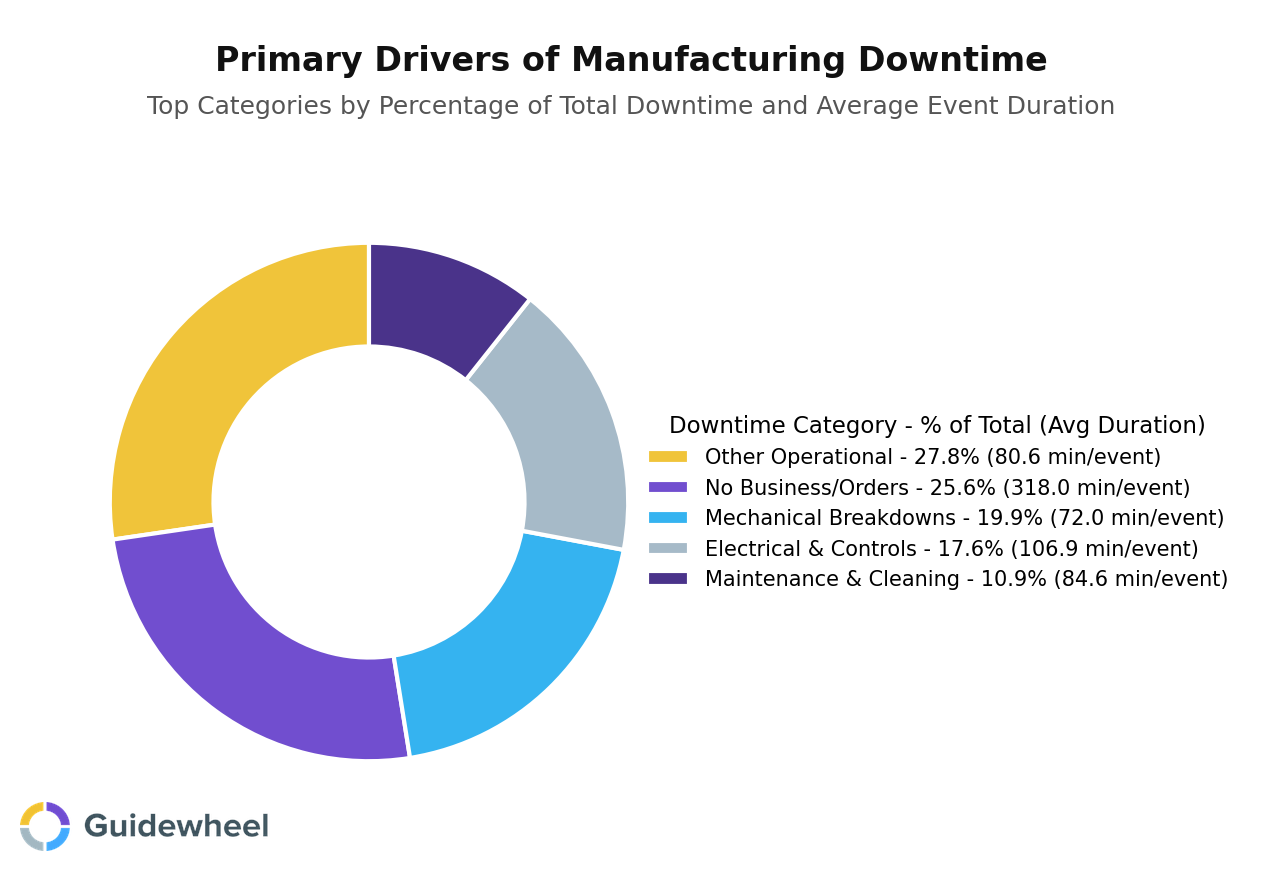
While factors like lack of orders may dominate total downtime hours, the categories you can actually fix through better monitoring tell a compelling story (remaining 23% includes categories such as lack of orders and other non-actionable downtime; full breakdown available in Guidewheel Performance Analysis):
Downtime category |
Share of total downtime |
Avg. duration per event |
Lost hours per year per line |
|---|---|---|---|
Other operational |
28% |
81 min |
266 hrs |
Mechanical breakdowns |
20% |
72 min |
91 hrs |
Electrical and controls |
18% |
107 min |
190 hrs |
Maintenance and cleaning |
11% |
85 min |
136 hrs |
(Source: Guidewheel Performance Analysis)
Mechanical breakdowns are highly frequent but relatively short per event, averaging 72 minutes. That's the pattern predictive maintenance is designed to break: catching those frequent, compounding stoppages before they cascade into bigger production losses.
For context, industry estimates suggest predictive maintenance programs typically reduce unplanned downtime by 30–50%, with some mature programs reaching 70–75% reductions (Source: OxMaint, referencing U.S. Department of Energy data).
How runtime benchmarks vary across manufacturing sectors
Understanding where your utilization sits relative to peers helps justify investment and set realistic targets. Every facility is different — treat these as reference points, not targets you're obligated to hit.

High-volume production environments consistently operate at higher utilization rates than the broader median. For example, CNC machines in high-volume settings should target 75–85% utilization, while job-shop CNC operations may reasonably land at 50–65% given inherent changeover demands (Source: Unio24). Assembly lines typically target 80–90%.
The gap between your current runtime and these reference points represents hidden capacity that already exists inside your facility, no capital expansion needed.
Start seeing what your older machines are telling you
The machines on your floor are already generating signals about their health. Every vibration pattern, every current fluctuation, and every temperature trend tells you something useful. You don't need to rip out controls or install PLCs to listen.
The manufacturers getting the best results aren't the ones chasing the fanciest sensors. They're the ones who started with a clear problem, deployed a practical solution on their highest-pain assets, and built from there.
If you're ready to move from reactive crisis management to condition-based maintenance on your legacy equipment, Book a Demo to see how much hidden capacity is already sitting inside your existing machines — and how fast you can start capturing it.
With Guidewheel, we now get key metrics like production, downtime, downtime codes, scrap, and cycle time automatically and accurately. Our team no longer takes time to track manually and has been able to instead invest that time in improvements. Everybody knows when we're winning or losing. Each teammate understands how their work drives the success of the organization, and that every decision they make has a direct impact on the business.
Edgar Yerena, Custom Engineered Wheels
💡
Frequently asked questions
How do I start predictive maintenance without adding PLCs?
The simplest entry point is clip-on current sensors installed around motor power leads. These require no wiring changes, no production downtime, and no PLC integration. The sensors connect to an edge gateway that transmits data via cellular or WiFi to a cloud analytics platform. You can be collecting baseline data within hours of installation, and most facilities start seeing actionable patterns within 2–4 weeks.
What is the difference between machine monitoring, condition monitoring, and machine health monitoring?
Machine monitoring tracks whether equipment is running and at what utilization. Condition monitoring goes deeper, tracking physical indicators like vibration, temperature, and acoustics to detect degradation before failure. Machine health monitoring combines condition data with trend analysis to estimate how close an asset is to needing intervention. In practice, these layers work together: machine monitoring provides operational context, while condition monitoring provides the early warning signals that feed predictive maintenance decisions.
Which assets should be monitored first: all machines or only critical rotating equipment?
Start with the assets causing the most measurable pain. Review your downtime logs and maintenance records to identify the 5–10 machines with the highest unplanned stoppage frequency, longest repair times, or greatest downstream production impact. For most facilities, this includes critical rotating equipment like motors, pumps, and compressors, but it may also include older production lines that fail frequently. Broad current-based monitoring can cover many assets quickly, while deeper vibration and temperature monitoring should be reserved for your highest-impact rotating assets.
How much does a machine monitoring system typically cost, and what ROI can I expect?
Individual retrofit sensors range from $200 to $2,000 per asset depending on type and capability. Industry-wide, software licensing for condition monitoring platforms varies from $50,000 to $500,000 annually depending on fleet size and analytics depth. Guidewheel's FactoryOps platform is designed to be accessible at a fraction of that range — contact us for current pricing based on your fleet size. A focused pilot covering 20–30 critical assets might involve first-year costs of $100,000 to $300,000. Most manufacturers report payback within 12–36 months, with critical assets often recovering the investment after a single avoided major failure (Source: OxMaint). Your results will depend on your asset mix, how bad your current downtime is, and how disciplined your team is about acting on alerts. The range is wide — but the direction is consistent.
What is the best approach for mixed fleets and legacy equipment with limited connectivity?
A modular, phased approach works best. Start with non-invasive sensors (current clamps, acoustic monitors, thermal imaging) that require no modification to the machine's internal systems. Connect these through edge gateways with cellular connectivity so you're not dependent on plant network infrastructure. This external monitoring layer operates independently of the machine's controls. If the monitoring system needs updates or maintenance, production equipment is completely unaffected. As you validate results, selectively add deeper condition monitoring sensors on your most critical assets.
About the author
Lauren Dunford is the CEO and Co-Founder of Guidewheel, a FactoryOps platform that empowers factories to reach a sustainable peak of performance. A graduate of Stanford, she is a JOURNEY Fellow and World Economic Forum Tech Pioneer. Watch her TED Talk—the future isn't just coded, it's built.