No items found.
blog
Vibration sensors vs. current sensors for legacy machine monitoring - what actually works
By: Guidewheel
Updated:
March 17, 2026
9 min read
If you run a plant full of legacy equipment, you've probably been told that vibration sensors are the gold standard for condition monitoring. And in many cases, that's true. But vibration isn't the only signal worth tracking, and for some failure modes on older motors, it may not be the best place to start.
The real question isn't "vibration or current?" It's which signal catches which failure, and where you should start when budget, IT bandwidth, and time are all limited.
This guide breaks down what actually works for motor vibration monitoring and current-based monitoring on brownfield equipment, so you can make a practical decision and start seeing results in weeks.
Key terms you need to know before choosing sensors
Before we get into hardware, let's clear up a few terms. The industry uses these phrases inconsistently, and that slows decisions down.
Term |
What it means in plain English |
|---|---|
Preventive Maintenance (PM) |
Replace or service parts on a fixed schedule, whether they need it or not |
Condition Monitoring |
Watch asset health signals (vibration, temperature, current) continuously and act when something changes |
Condition-Based Maintenance (CBM) |
Trigger maintenance only when monitored data says it's time, not the calendar |
Predictive Maintenance |
Use analytics or ML models on sensor data to estimate remaining useful life and schedule service before failure |
The difference between condition monitoring and predictive maintenance trips people up constantly. Think of it this way: condition monitoring is the data layer. Predictive maintenance is the decision layer that sits on top.
You can't predict anything without monitoring first, and for most brownfield plants, condition-based maintenance is the pragmatic entry point that delivers ROI before you ever need an algorithm.
Why rotating assets are your highest-leverage starting point
Motors, pumps, fans, compressors, and gearboxes account for the majority of maintenance labor hours and spare parts spend in most plants. Bearing failures alone represent 40–50% of motor failures, and they typically show detectable degradation 6–12 weeks before seizure (Source: ISO 13373-1; SMRP research).
Why this matters: rotating equipment failures cascade. A worn bearing on a pump damages the seal, which floods the motor. What could have been a $500–$1,500 planned repair turns into a $5,000–$20,000+ emergency with secondary damage. That pattern plays out in plants everywhere.
If you're starting from zero monitoring, motors and pumps are where the math works fastest.
What vibration sensors actually detect on legacy machines
An industrial vibration sensor, typically a piezoelectric or MEMS accelerometer, measures how a machine shakes. Different failure modes produce different vibration signatures, and the detection windows are long enough to act on.
Failure type |
Vibration signature |
Detection window |
|---|---|---|
Bearing wear |
Impulsive peaks at defect frequencies |
4–12 weeks |
Misalignment |
Elevated 1X and 2X running speed |
8–16 weeks |
Mechanical looseness |
Broadband energy, irregular peaks |
6–12 weeks |
Unbalance |
High energy at 1X running speed |
4–8 weeks |
Lubrication starvation |
High-frequency friction noise |
2–6 weeks |
So when people ask, "Why do my vibration alarms trigger but nothing is actually wrong?" the answer is usually poor sensor placement or thresholds set too aggressively.
Sensors need to sit directly on bearing housings, not on general motor casings, and thresholds need to be baselined on each specific asset. A 100 hp motor and a 5 hp motor have very different "normal."
✅
Wireless magnet-mount accelerometers install in under five minutes per asset with no drilling, downtime, or wiring—making them ideal for brownfield pilots. Start with 5–10 of your highest-risk rotating assets this week, baseline their vibration profiles over 2–3 weeks, and then set asset-specific alert thresholds. This sequenced approach lets you prove ROI on a small scale before expanding, and avoids the false-alarm fatigue that comes from applying generic thresholds across different motor sizes.
For wireless vibration monitoring, magnet-mount accelerometers install in under five minutes per asset with no drilling, no downtime, and no wiring. That's the brownfield advantage: you can pilot on five critical machines this week and expand next month.
What current sensors catch that vibration misses
This is where current monitoring adds something vibration can't. Motor inrush current, the spike of electrical draw when a motor starts, reveals problems that vibration can't see early enough.
Current signal |
What it reveals |
Detection window |
|---|---|---|
Inrush current anomalies |
Bearing friction increase, rotor bar cracking |
2–8 weeks |
Running current deviation |
Increased load, efficiency loss |
Real-time trending |
Current harmonics (MCSA) |
Rotor bar fracture, stator winding faults |
4–12 weeks |
Phase imbalance |
Single-phasing, winding shorts |
1–4 weeks |
This matters because rotor bar cracking is invisible to vibration in its early stages, yet it shows clear sidebands in the current waveform. Studies indicate that rotor bar faults detected via motor current signature analysis (MCSA) allow 80–90% of cases to be scheduled for planned replacement rather than emergency response (Source: IEEE motor diagnostics research).
So why does your motor current spike at startup and flag false faults? Often it's because baseline thresholds weren't established properly. Every motor has a unique inrush profile. You need 10–20 starts logged to build a reliable baseline before setting alert boundaries.
If your plant already runs VFDs or soft starters, inrush data may already live in your drive logs, making current monitoring a zero-incremental-cost entry point.
Head-to-head: vibration vs. current for common failure modes
This is the comparison most people are actually searching for. Neither sensor type wins across the board.
Fault type |
Vibration |
Current |
Practical recommendation |
|---|---|---|---|
Bearing wear |
Excellent |
Limited |
Vibration first; current confirms severity |
Rotor bar cracking |
Limited |
Excellent |
Current detects; vibration shows mechanical impact later |
Misalignment |
Very good |
Moderate |
Vibration primary |
Looseness |
Excellent |
Limited |
Vibration dominant |
Stator winding fault |
Limited |
Very good |
Current primary |
Unbalance |
Excellent |
Limited |
Vibration precise |
The bottom line: for a plant starting condition monitoring, vibration monitoring delivers higher immediate ROI because it covers bearing wear, looseness, and alignment, which are the top three mechanical failure modes across rotating equipment.
Current monitoring becomes the valuable secondary layer for motor-specific electrical faults. You don't need to choose one forever; you sequence the investment.
Where downtime actually clusters in manufacturing
Before you buy any sensor, it helps to know what's actually eating your uptime. Guidewheel performance analysis across 10,500+ downtime events and 3,000+ machines reveals a distribution that should shape your prioritization.
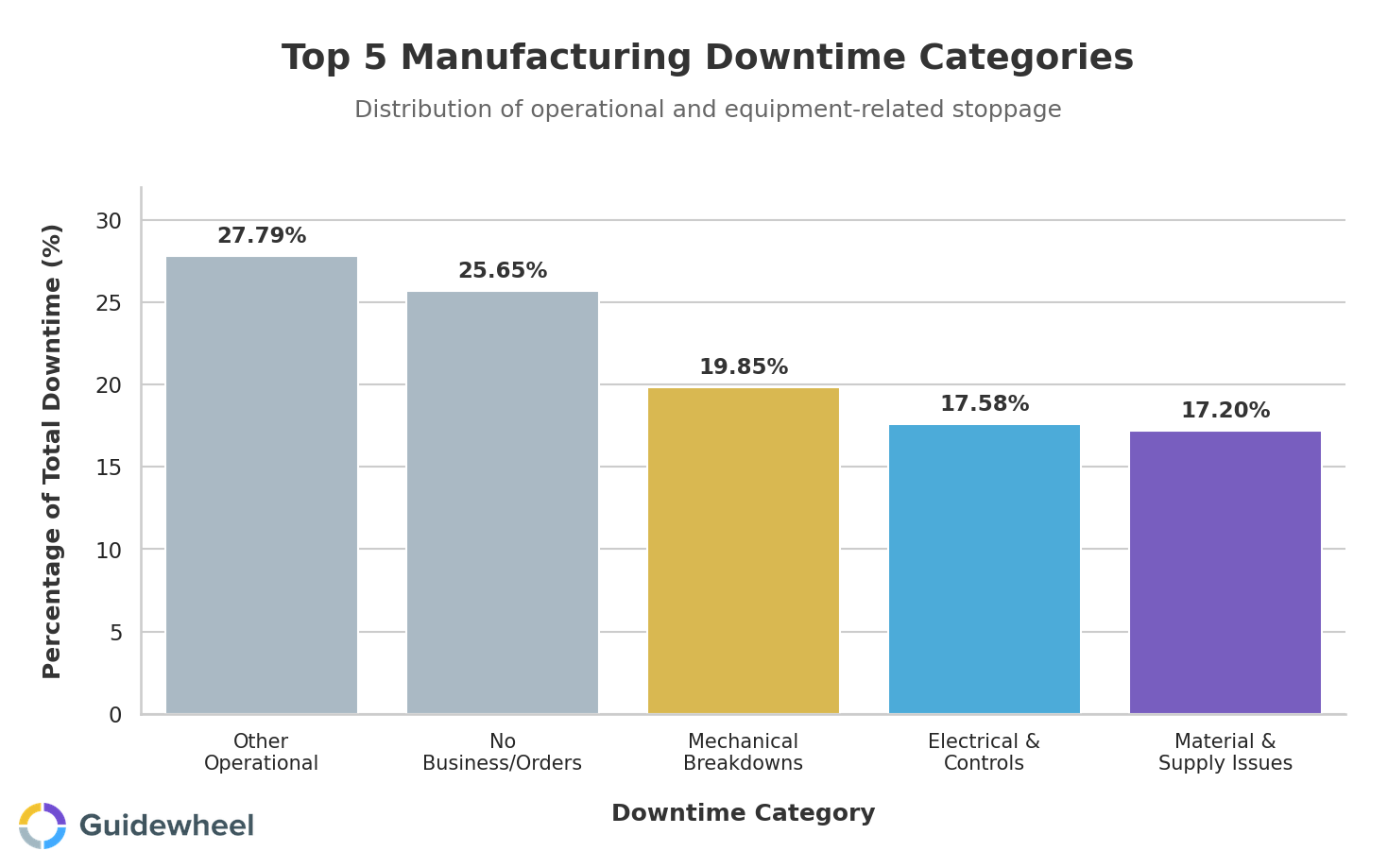
Mechanical Breakdowns (20% of total downtime) and Electrical & Controls (18%) together represent over 37% of all tracked downtime (Source: Guidewheel Performance Analysis). Those are exactly the categories that vibration and current sensors target.
But notice the other categories. "Other Operational" issues at 28% and "Maintenance & Cleaning" at 11% represent friction points that benefit from operational tracking, not just sensor hardware.
This is where a platform like Guidewheel can help: clip-on current sensors paired with algorithms can identify run/idle/down states, capture downtime reasons, and surface patterns across shifts, giving your team a full picture of where production hours are going without a complex IT project.
Each of these categories represents an equally actionable opportunity. Mechanical breakdowns average 91 lost hours per year per line, while electrical and controls issues average 190 lost hours due to longer event durations (Source: Guidewheel Performance Analysis).
Knowing which type of loss dominates your specific lines determines whether vibration sensors, current sensors, or better operational workflows should come first.
How baseline uptime varies by industry
Your ROI timeline depends heavily on where you're starting. These benchmarks serve as reference points; optimal performance varies by facility context, product mix, and operational goals.
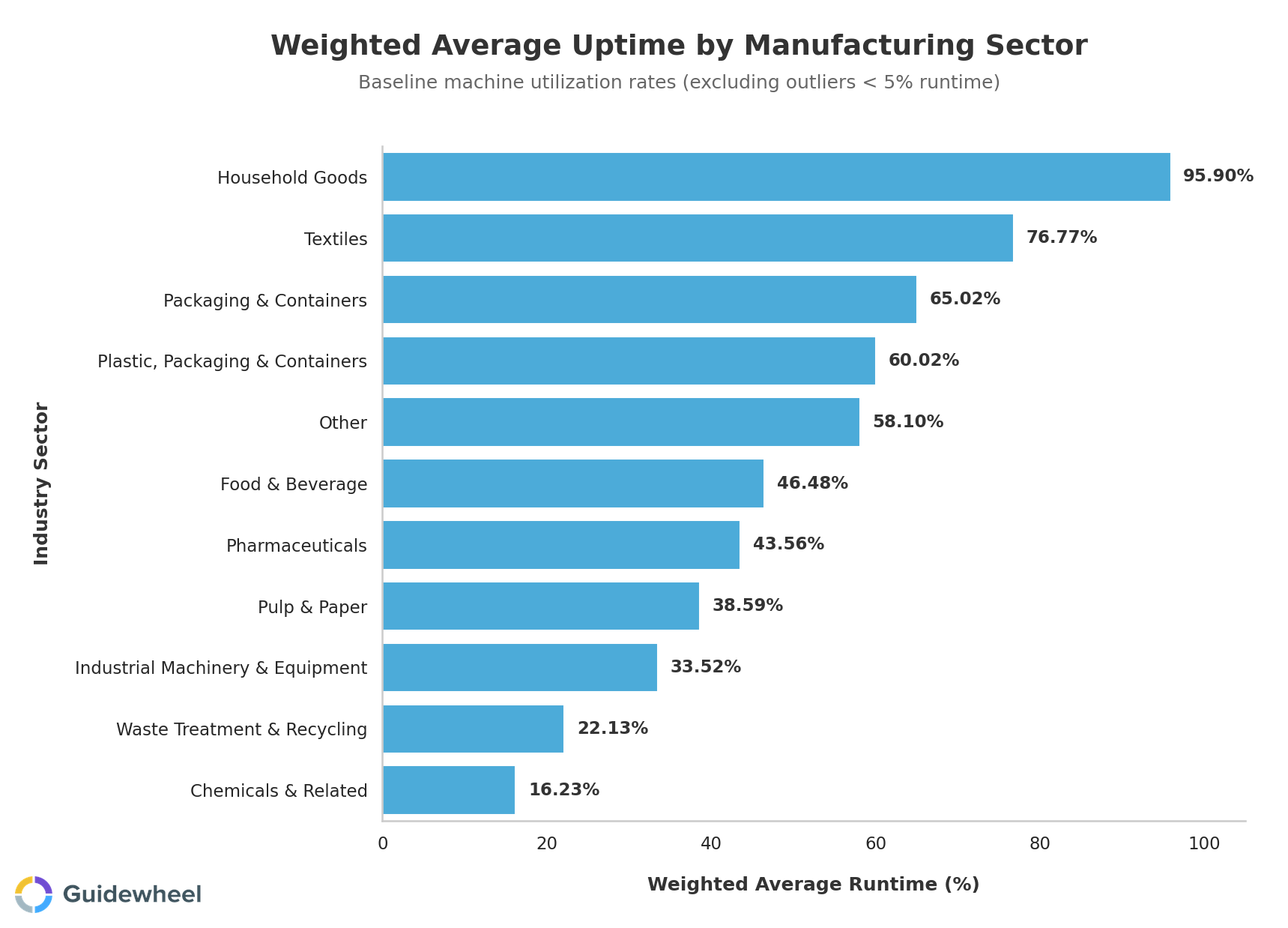
Plants operating at lower utilization rates often see the fastest payback from condition monitoring because even modest reductions in unplanned stops translate directly into recovered production capacity.
A facility running at 34% weighted average uptime, like the Industrial Machinery sector benchmark, has significant room to convert downtime into throughput (Source: Guidewheel Performance Analysis).
Start recovering lost production hours this quarter
The sensor debate, vibration vs. current, matters less than starting with the signals that solve your biggest problems first. Vibration covers your broadest mechanical failure modes. Current fills in the motor-specific electrical gaps.
Together, they give your maintenance team a standardized, repeatable signal that scales expert intuition across every shift and every plant.
You don't need a company-wide digital transformation. You need a simple starting point on your worst-performing assets and a platform that turns those signals into maintenance decisions your team will actually use.
Book a Demo to see how Guidewheel's clip-on sensors and FactoryOps platform can help your team move from reactive repairs to data-driven maintenance decisions.
We had our best month of the year, increasing production from 26k-35k/month to 46k cases in March. I attribute this to Guidewheel. Being able to see downtime data and address downtime reasons directly correlates to higher production.
Michael Palmer, VP of Operations, Direct Pack.
💡
Frequently asked questions
What's better for older machines: vibration sensors or current sensors?
For most legacy rotating equipment, vibration sensors deliver the broadest coverage. They detect bearing wear, looseness, misalignment, and unbalance, which are the most common mechanical failure modes on aging motors, pumps, and compressors.
Current sensors add value as a secondary layer when your facility has a history of rotor bar cracking or stator winding faults. The practical approach is to start with vibration on your highest-risk assets and layer in current monitoring on motors with known electrical issues.
How do wireless vibration monitoring systems work in industrial plants?
Wireless industrial vibration sensors, typically MEMS or piezoelectric accelerometers, attach to bearing housings via magnet mount. They sample vibration data at 10–20 kHz, compute spectral features on the sensor, and transmit summaries every 5–60 minutes to a gateway via WiFi, Bluetooth, or LoRa.
The gateway passes data to a cloud or on-premises analytics platform where trends, thresholds, and alerts are managed. Battery life on industrial-grade units is typically 2–5 years at standard sampling intervals.
What KPIs should I track to measure the impact of condition monitoring?
Focus on three categories. For uptime: unplanned downtime hours per month and equipment run-to-failure incidents.
For maintenance efficiency: ratio of planned vs. emergency repairs and spare parts carrying cost. For financial impact: cost-per-repair (planned vs. emergency) and maintenance cost per production unit. Many facilities target a 40–60% reduction in unplanned failures within the first 6–12 months of deploying condition monitoring.
How quickly can a plant expect ROI from wireless monitoring?
For plants with moderate unplanned downtime baselines, payback typically occurs within 3–6 months. The math is straightforward: a 10-sensor wireless deployment costs roughly $12,000 in the first year (hardware plus software).
Avoiding even one major emergency repair on a critical motor or pump, which can run $5,000–$20,000+ with secondary damage, often covers the investment. Results will vary based on your specific failure frequency and downtime costs.
Which machines should be prioritized first for condition monitoring?
Start with rotating assets that have the highest combination of failure frequency and production impact. Look at your maintenance records for the last 12–24 months and identify the 5–10 machines with the most unplanned stops or the longest repair durations.
In most plants, this means critical pump motors, compressor drives, large fan assemblies, and conveyor drive motors, particularly those older assets running past their original expected service life.
About the author
Lauren Dunford is the CEO and Co-Founder of Guidewheel, a FactoryOps platform that empowers factories to reach a sustainable peak of performance. A graduate of Stanford, she is a JOURNEY Fellow and World Economic Forum Tech Pioneer. Watch her TED Talk—the future isn't just coded, it's built.