No items found.
blog
Plug-and-play OEE software vs legacy MES: a total cost comparison
By: Guidewheel
Updated:
May 1, 2026
9 min read

If you run a plant with a mix of older machinery and newer lines, you already know the frustration: your MES was supposed to give you real-time OEE visibility, but the OEE module is years behind, locked behind IT change requests, and your supervisors still trust their Excel sheets more. Meanwhile, downtime keeps eating into throughput, and every month the same losses show up with no clear root cause.
Here's the real question: do you keep waiting for your legacy MES OEE module to catch up, or do you add a plug-and-play OEE software layer that goes live in weeks — without touching your existing systems? Let's look at the total cost side by side, so you can make the call with real numbers.
Understanding the basics before we compare
Before we compare costs, let's get clear on a few key terms.
Overall Equipment Effectiveness (OEE) measures three dimensions of production loss: Availability (is the machine running?), Performance (is it running at full speed?), and Quality (are the parts good?). Multiply all three, and you get your OEE score. It's defined in ISO 22400-1:2014 and widely adopted through TPM and Lean programs.
OEE component |
What it captures |
Formula |
|---|---|---|
Availability |
Unplanned stops, changeovers, material delays |
Run Time / Planned Production Time |
Performance |
Micro-stops, reduced speed, cycle degradation |
Actual Speed / Ideal Speed |
Quality |
Scrap, rework, first-pass yield losses |
Good Parts / Total Parts |
Downtime tracking software focuses specifically on categorizing and timing production stoppages, which is often where the fastest wins live. MES OEE software refers to the OEE module embedded within a larger Manufacturing Execution System, typically bundled with order management, quality, and scheduling.
That distinction matters because it affects what you're paying for, how fast you can get live, and whether operators will actually use it.
The real problem with legacy MES for OEE tracking
Most legacy MES platforms were deployed 7 to 15 years ago. The OEE module, if it was even activated, often reflects calculation logic and loss categories from the original implementation. Changing a downtime reason code or adjusting a dashboard? That's a formal change request, often with a $10K+ price tag and weeks of lead time.
Here's what plant leaders keep telling me: by the time you've approved a change to your OEE calculation in a legacy system, two quarters have passed and the improvement opportunity is cold.
The deeper issue is that traditional MES was built for control and compliance, not shop-floor agility. It excels at order tracking, batch records, and audit trails. But for the daily work of identifying why Line 3 lost 45 minutes on second shift, it's often too slow and too rigid.
And then there's the equipment gap. Your legacy machinery — the 20-year-old injection molder or the vintage CNC — often lacks native connectivity. Retrofitting each machine for MES integration requires hardwired counters or proximity switches, and that drives costs up fast.
What plug-and-play OEE monitoring software actually looks like
Modern OEE software solutions work differently. Instead of requiring months of integration work, they connect to your equipment through lightweight sensors, direct Ethernet, or even operator mobile apps.
Guidewheel's FactoryOps platform, for example, uses clip-on current sensors that read electrical current from any machine, whether it's brand new or decades old. Proprietary algorithms process that signal data and turn a basic current reading into actionable production intelligence. It runs on cellular connectivity — no plant Wi-Fi required — which means you don't need a plant-wide network overhaul to get started.
The result: real-time OEE dashboards, automated downtime categorization, and shift-level performance tracking, live in days, not months — typically 4 to 8 weeks for a full plant instead of 12 to 24 months.
The five-year total cost comparison
This is the section that matters most. Let's look at a mid-market plant with 200 to 300 employees, 25 to 50 production lines, and a typical mix of about 70% legacy and 30% newer equipment.
Cost category |
Manual (Excel) |
Legacy MES |
Plug-and-play OEE |
|---|---|---|---|
Upfront capital |
~$0 |
$395K |
$52K |
Year 1 ongoing |
$64K |
$140K |
$84K |
Years 2–5 (annual) |
$64K |
$137K |
$85K |
5-year TCO |
$319K (visible) |
$1.08M |
$476K |
Time to live data |
Day 1 (manual entry) |
6–12 months |
4–8 weeks |
Implementation risk |
Low |
High |
Low |
Operator adoption |
Poor |
Moderate to poor |
Strong |
A few things jump out. First, plug-and-play OEE tracking software delivers roughly 55 to 60% TCO savings versus MES over five years. Second, the MES upfront burden of nearly $400K includes system integration, hardware, data mapping, and 6+ months of implementation services. Third, manual tracking looks cheap on paper, but when you factor in $150K to $300K in opportunity losses from reactive operations and missed improvement cycles, the real economic cost climbs to $800K or more over five years.
✅
Wireless sensors cost $2K to $5K per machine and typically pay for themselves within 4 to 8 weeks of downtime reduction. The labor savings alone from eliminating manual data entry — which consumes 2 to 8 hours per week per shift supervisor — often justify the investment before factoring in recovered production capacity. For a mid-market plant, the total 5-year TCO of plug-and-play OEE software ($476K) is roughly half that of a legacy MES approach ($1.08M).
The business case for adding sensors instead of continuing with manual OEE logs comes down to this: wireless sensors cost $2K to $5K per machine and typically pay for themselves within 4 to 8 weeks of downtime reduction. The labor savings alone from eliminating manual data entry, which consumes 2 to 8 hours per week per shift supervisor, make the math straightforward.
Where downtime visibility drives the fastest ROI
Availability is the largest lever for OEE improvement in most operations. Fixing a recurring 2-hour daily downtime event saves 10+ hours per week and drives OEE improvements of 5 to 10 points faster than optimizing speed or quality alone.
Recent data from Guidewheel Performance Analysis (n=3,000+ machines) reveals which downtime categories consume the most production hours per year, per line:

What's critical here: while market-driven factors like "no business/orders" may dominate statistically, the categories you can actually control, like mechanical breakdowns (91 lost hours/year per line), maintenance and cleaning (136 hours), staffing misalignments (161 hours), and material supply issues (334 hours), are where teams can act fast and see measurable payback.
Controllable downtime driver |
Avg. lost hours/year per line |
Industries affected |
Why it's actionable |
|---|---|---|---|
Material & supply issues |
334 |
8 |
Scheduling and planning coordination |
Electrical & controls |
190 |
7 |
Condition monitoring and preventive action |
Staffing issues |
161 |
7 |
Remote monitoring and shift optimization |
Maintenance & cleaning |
136 |
8 |
Planned maintenance windows |
Mechanical breakdowns |
91 |
11 |
Pattern detection and predictive scheduling |
Each of these categories represents a concrete area where real-time OEE monitoring software exposes patterns that manual logs simply miss. When your system alerts a shift lead that Press A has stopped three times this week at 2 PM, that's a maintenance investigation you can launch today, not a trend you'll notice in next month's spreadsheet review.
The visibility gap most plants don't realize they have
One more data point worth seeing. When you compare weighted average runtime (which favors high-volume machines) against median runtime (which treats all machines equally), the gap is striking:
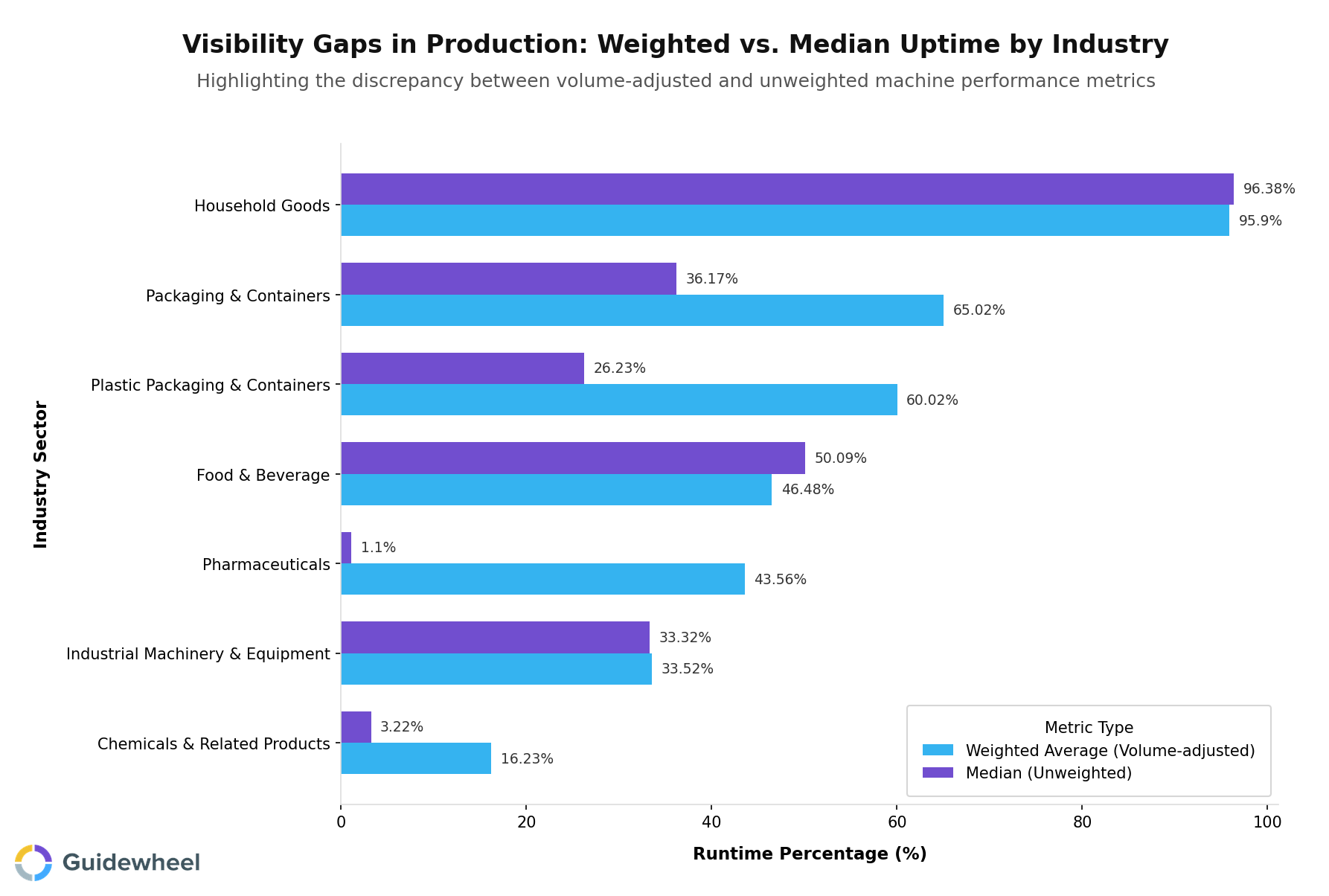
(Source: Guidewheel Performance Analysis, n=2,800+ machines)
This matters because many legacy MES implementations only track primary production lines. The "long tail" of secondary and older equipment runs unmeasured. Plug-and-play OEE tracking software for manufacturing solves this by making it economically viable to monitor every asset, not just the flagship lines.
A practical deployment playbook for mixed equipment fleets
Here's how the phased rollout typically works when moving from manual tracking to automated production monitoring software:
Phase |
Timeline |
What happens |
Investment |
|---|---|---|---|
Phase 1: Quick wins |
Weeks 1–4 |
Deploy on 10 modern machines via Ethernet; pilot operator app on 5 legacy machines |
~$5K |
Phase 2: Sensor expansion |
Weeks 5–12 |
Install wireless sensors on 15 highest-downtime legacy machines |
~$35K |
Phase 3: Integration |
Months 3–4 |
Connect to ERP for costing; establish daily huddle reports; train supervisors |
~$15K |
Total investment: approximately $55K to $100K for full-plant coverage. Compare that to an MES retrofit at $200K to $400K with far longer timelines.
For multi-plant rollouts, the scalability advantage is significant. Adding a new facility to a plug-and-play OEE management software platform means duplicating configurations through the UI, not launching another IT project.
The coexistence model works well too: keep your MES for order management and scheduling where it's stable, then run your OEE platform alongside it for operational visibility. Over time, you migrate modules at your own pace, no rip-and-replace required.
Realistic OEE benchmarks to guide your targets
These benchmarks serve as reference points, recognizing that each facility's equipment age, product mix, and operational priorities shape what "good" looks like:
OEE range |
General interpretation |
Suggested focus |
|---|---|---|
Below 60% |
Significant improvement opportunity |
Availability audit, maintenance review |
60–75% |
Common starting point for many plants |
Target top downtime drivers |
75–85% |
Aligned with industry median for discrete manufacturing |
Performance and micro-stop reduction |
85–92% |
Above median, showing operational discipline |
Quality optimization and changeover refinement |
Above 92% |
Top-quartile territory |
Knowledge transfer and process innovation |
The most useful comparison isn't your plant versus an industry average. It's your Line A versus Line B, your first shift versus third shift, and this quarter versus last. That's where manufacturing teams using OEE software actually find actionable improvement opportunities.
Start seeing what your production lines are really doing
The math on this comparison is clear: plug-and-play OEE solutions cost roughly half what a legacy MES costs over five years, deploy in weeks instead of months, and generate ROI that's measurable within the first quarter. The risk is lower, operator adoption is stronger, and you don't need to tear out existing systems to get started.
If you're still relying on spreadsheets or wrestling with an outdated MES OEE module, the fastest path to clarity is a focused pilot on your highest-loss lines. Prove value in 8 to 12 weeks, then scale with confidence.
We had our best month of the year, increasing production from 26k-35k/month to 46k cases in March. I attribute this to Guidewheel. Being able to see downtime data and address downtime reasons directly correlates to higher production.
Michael Palmer, VP of Operations, Direct Pack. Source: Guidewheel Customer Research.
Ready to see where your hidden capacity lives? Book a Demo and start getting live production data in days, not months.
💡
Frequently asked questions
What is OEE software and how is it different from a general production monitoring system?
OEE software specifically measures and tracks the three pillars of equipment effectiveness: availability, performance, and quality. While general production monitoring might track output counts or basic machine status, dedicated OEE tracking software categorizes every minute of lost production, ties it to a root cause, and benchmarks performance across shifts, lines, and time periods. It's the difference between knowing "we made 400 parts today" and understanding exactly why you didn't make 500.
Is OEE part of MES, or should it be a standalone system?
Many MES platforms include an OEE module, but these modules are often outdated and difficult to modify without costly vendor support. A standalone, plug-and-play OEE monitoring system can run alongside your existing MES, handling real-time downtime tracking and shift-level dashboards while your MES continues managing orders and scheduling. This coexistence approach avoids disruptive rip-and-replace projects and lets you modernize incrementally.
How quickly can OEE software be implemented on legacy equipment?
With modern plug-and-play solutions using wireless sensors or clip-on current sensors, deployment on legacy equipment typically takes 4 to 8 weeks for a full plant. You don't need to modify machine controls or install hardwired counters. Many plants start with a mobile operator app on a handful of machines and add sensors in a second phase, proving ROI before expanding.
What ROI should manufacturers expect from real-time OEE and downtime visibility?
Results vary based on your operational context and starting point, but plants in Guidewheel's customer base regularly report payback within 4 to 12 weeks of going live (Guidewheel Customer Research). The primary driver is downtime reduction through pattern identification: catching recurring stoppages, reducing changeover variability, and addressing material delays before they compound. Some facilities see $40K or more per month in recovered capacity during the first quarter of deployment (Guidewheel Customer Research).
When is Excel enough, and when should a plant move to automated OEE software?
Excel works as a starting point for understanding your loss categories and building OEE awareness. But once you need cross-shift consistency, same-day root-cause investigation, or trend analysis across multiple lines, manual tracking becomes a bottleneck. The tipping point usually comes when supervisor time spent on data entry and reconciliation exceeds the cost of automated tracking, which for most plants happens sooner than expected.
About the author
Lauren Dunford is the CEO and Co-Founder of Guidewheel, a FactoryOps platform that empowers factories to reach a sustainable peak of performance. A graduate of Stanford, she is a JOURNEY Fellow and World Economic Forum Tech Pioneer. Watch her TED Talk—the future isn't just coded, it's built.