No items found.
blog
Lean manufacturing meets real-time analytics: eliminating the 8 wastes
By: Guidewheel
Updated:
May 4, 2026
8 min read

Every plant manager I've talked to in the last year knows the 8 wastes by heart: defects, overproduction, waiting, non-value-added motion, transportation, inventory, over-processing, and underutilized talent.
Lean training hammered those concepts home. But here's what keeps coming up in hallway conversations: knowing the wastes and actually measuring them in real time are two very different things.
The gap between Lean theory and what actually happens on the floor is where most improvement programs stall.
You run a kaizen event, post the results on the whiteboard, and three weeks later you're back to guessing why second shift ran 12% slower than first.
The missing link isn't more training. It's live machine data, translated into the metrics that actually drive waste elimination: OEE, cycle time, and takt time.
This article walks through exactly how those metrics connect to each of the 8 wastes, what "good" looks like as a reference point for your operation, and a practical playbook for getting started without a disruptive IT project.
Key terms every improvement team should align on
Before diving into the waste-elimination playbook, let's get the core manufacturing KPIs defined in plain language.
These three metrics form the backbone of any production monitoring strategy.
OEE (overall equipment effectiveness)
OEE in manufacturing answers one question: of the time you planned to run, how much good product did you actually make at full speed?
The OEE formula multiplies three components:
OEE = Availability × Performance × QualityComponent |
What it measures |
Common loss examples |
|---|---|---|
Availability |
Was the machine running? |
Breakdowns, changeovers, material waits |
Performance |
Was it running at full speed? |
Microstops, slow cycles, operator hesitation |
Quality |
Did it make good parts? |
Startup rejects, scrap, rework |
Here's a quick example: if your line has 92% availability, 80% performance, and 98% quality, your OEE calculation comes to roughly 72%.
That means you're losing about 28% of your planned capacity every shift.
Cycle time vs. takt time
Cycle time is straightforward: the actual time to produce one unit.
Measure it, don't estimate it.
Takt time is demand-driven: available production time divided by customer demand.
It tells you the pace you need to hit.
The takt time vs cycle time comparison is your capacity reality check:
Scenario |
What it means |
Action needed |
|---|---|---|
Cycle time < takt time |
You can meet demand |
Watch for overproduction waste |
Cycle time = takt time |
Balanced production |
Maintain discipline, reduce variability |
Cycle time > takt time |
Can't meet demand |
Improve speed, reduce changeovers, or add capacity |
When cycle time exceeds takt time by even 10-15%, you're either running overtime or missing deliveries.
Production monitoring makes this gap visible in real time, not at the end of the month.
How the 8 wastes map to live machine data
This is where Lean thinking meets day-to-day execution.
Each waste ties directly to something a machine monitoring system can track, quantify, and flag.
Lean waste |
OEE component |
What live data reveals |
|---|---|---|
Defects |
Quality |
Startup reject rates, in-process scrap spikes |
Overproduction |
Takt time alignment |
Cycle time running faster than takt; inventory building |
Waiting |
Availability |
Material delays, maintenance holds, operator absence |
Motion |
Performance |
Slow operator movements, inefficient material feed patterns |
Transportation |
Flow metrics |
Excess WIP movement between stations |
Inventory |
Takt/OEE variability |
Unpredictable OEE forces larger safety stock buffers |
Over-processing |
Cycle time definition |
Unnecessary adjustment steps during changeovers |
Underutilized talent |
Operator engagement |
Teams stuck in reactive mode instead of problem-solving |
Here's the practical takeaway: when you automate OEE data collection, you're not just tracking a number.
You're building the measurement backbone for every waste category Lean identifies.
The data gives everyone the same numbers to work from.
The hidden problem: manual tracking misses the wastes that matter most
Most plants I work with started their OEE journey on spreadsheets.
Operators fill out shift reports, supervisors consolidate them the next day, and by Wednesday you're debating what actually happened on Sunday's night shift.
Industry research consistently finds that manual downtime reports capture only 40-60% of actual loss events.
Microstops under five minutes, brief material waits, and subtle speed losses get rounded away or simply forgotten.
That's not a criticism of operators. They're busy running production, not logging data.
✅
Manual downtime reports typically capture only 40-60% of actual loss events, meaning your OEE may appear to be around 75% when it's actually closer to 62-65%. That 10-13 point gap represents hidden capacity on your existing lines. To close it, make reason code entry fast—two or three taps on a tablet with pre-populated choices—and show operators that their input drives real decisions in the daily huddle.
The result? Your OEE software shows a comfortable 75%, but an automated audit reveals you're actually closer to 62-65%.
That 10-13 point gap represents hidden capacity sitting right on your existing lines.
This is exactly why operators sometimes ignore the downtime screen after a few weeks: if the data entry feels burdensome and nobody acts on the information, it becomes just another task.
The fix is making reason code entry fast—two or three taps on a tablet with pre-populated choices—and, critically, showing operators that their input drives real decisions in the daily huddle.
How automated production monitoring closes the gap
A real-time production monitoring system doesn't require ripping out your PLCs or replacing legacy equipment.
Retrofit approaches, including clip-on current sensors that read a machine's electrical signature—think of it as the machine's "heartbeat"—can capture run/idle/down data on everything from decades-old mechanical presses to brand-new CNC centers.
Guidewheel's FactoryOps platform, for example, clips onto the power line of any machine, interprets the current signal, and works over cellular connectivity — so you don't even need plant Wi-Fi to get started.
That kind of low-risk deployment is what makes it practical to start small without disrupting production.
Once data flows, your OEE dashboard updates continuously rather than in daily batches.
Changeover start and end times get timestamped automatically based on the machine's electrical state transitions, eliminating the guesswork of manual logs.
Supervisors see shift-to-shift performance side by side.
And when cycle time drifts 5% above baseline, an alert fires before the problem compounds.
What the benchmarks actually look like across industries
So what's a "good" OEE score?
The honest answer: it depends on your equipment, product mix, and operational context.
But benchmarks provide useful reference points for understanding where opportunities might exist.
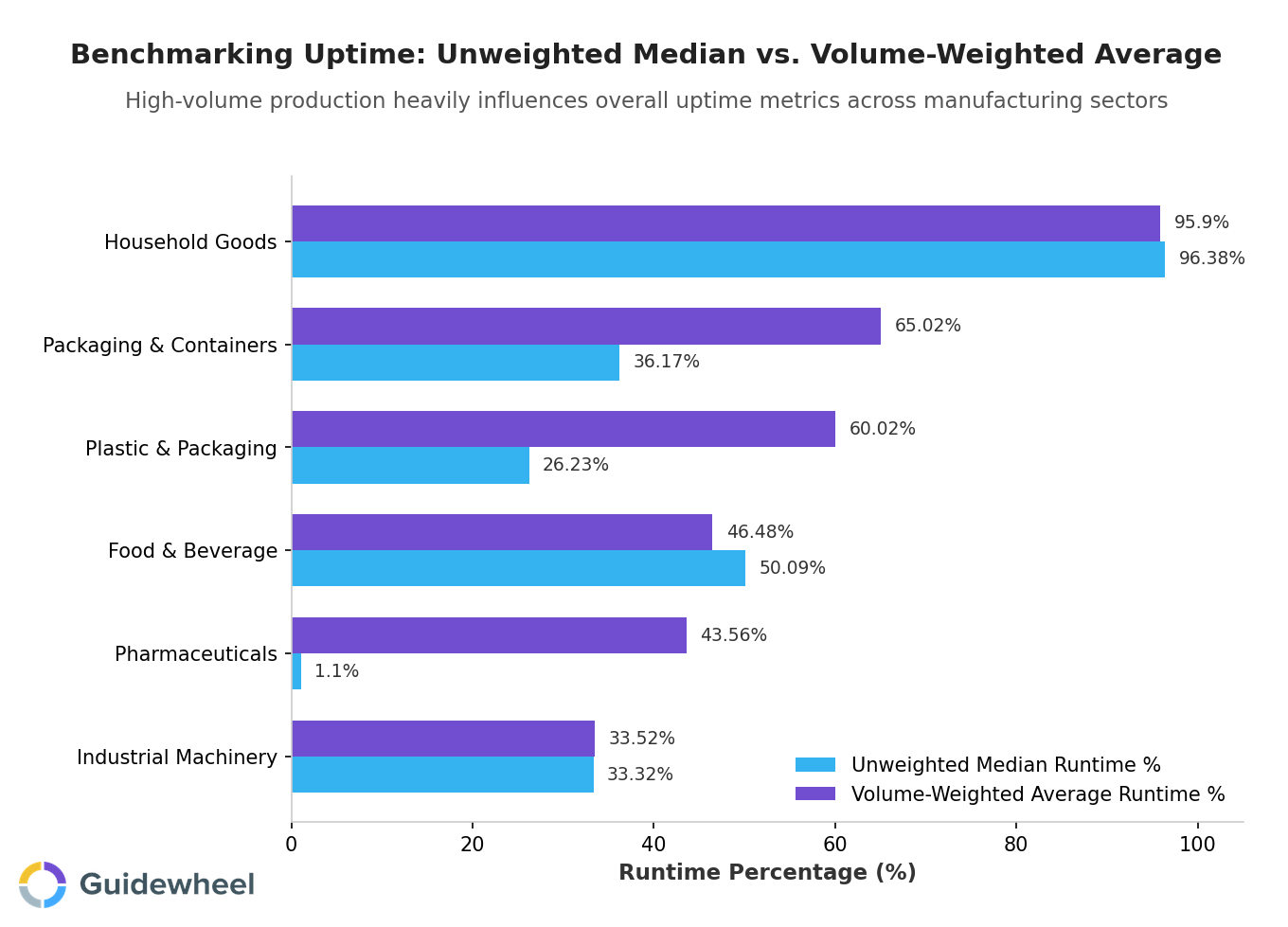
According to analysis from Guidewheel's Performance Data (n=3,000+ machines), the gap between how individual machines perform and how high-volume production lines perform tells a revealing story:

The volume-weighted average runtime across all tracked machines sits at roughly 55%, while the unweighted median is closer to 32% (Source: Guidewheel Performance Analysis).
High-volume lines pull the average up significantly.
This means if you're comparing your plant to a simple industry average, you may be benchmarking against a number that doesn't reflect your equipment mix.
Industry-standard targets from the Shingo Institute and practitioners like Vorne Industries suggest these general ranges:
Performance band |
OEE range |
What it typically indicates |
|---|---|---|
World-class |
85%+ |
Systematic maintenance, changeover discipline, quality systems |
Competitive |
75-85% |
Solid fundamentals with targeted improvement opportunities |
Improvement priority |
50-75% |
Structural losses in availability or performance |
Critical intervention |
Below 50% |
Significant equipment, process, or scheduling challenges |
These serve as reference points.
Your targets should reflect your product mix, equipment age, and customer requirements.
Where to focus first: the downtime categories you can actually control
Here's a question I hear constantly: "We know we have downtime, but where do we start?"
Start by separating what you can control from what you can't, then work the highest-frequency, most-actionable categories first.
While "No Business/Orders" creates the longest individual stops (averaging 318 minutes per event), the categories your team can directly address tell a different story (Source: Guidewheel Performance Analysis, n=13,900+ events):
Downtime category |
Avg events per shift |
Avg duration (min) |
Why it's actionable |
|---|---|---|---|
Other operational |
0.17 |
81 |
Highest frequency; process discipline and SOP improvements |
Mechanical breakdowns |
0.10 |
72 |
Predictive maintenance and spare parts stocking |
Material & supply |
0.09 |
119 |
Staging improvements and supplier coordination |
Maintenance & cleaning |
0.09 |
85 |
Schedule optimization and parallel task execution |
Staffing issues |
0.05 |
197 |
Cross-training, remote monitoring, and shift planning |
Mechanical breakdowns and operational stops happen frequently enough that targeted interventions compound gains quickly.
A plant that reduces mechanical breakdown duration by even 15 minutes per event across 3 events per week recovers nearly 40 hours of production annually per line.
This also explains a common frustration: OEE improving but throughput staying flat.
If your availability gains are offset by worsening performance (speed losses, microstops) or you're recovering uptime on a line that isn't the bottleneck, the throughput needle won't move.
Always tie OEE improvements back to the constraint line and validate that recovered time converts to saleable output.
Start finding hidden capacity on your existing lines
The 8 wastes aren't abstract concepts when you can see them accumulating in real time on every line, every shift.
The path from Lean theory to measurable execution starts with reliable machine data — not a capital project.
It starts with reliable machine monitoring, a clear understanding of your OEE components, and the discipline to act on what the data reveals.
The manufacturers who gain ground fastest are the ones who start small, prove value in weeks, and scale from there.
We had our best month of the year, increasing production from 26k-35k/month to 46k cases in March. I attribute this to Guidewheel. Being able to see downtime data and address downtime reasons directly correlates to higher production.
Michael Palmer, VP of Operations, Direct Pack via Guidewheel's Customer Research
Ready to see what your machines are actually doing, shift by shift? Book a Demo to start uncovering the hidden losses your shift reports are missing.
💡
Frequently asked questions
What is OEE in manufacturing and why does it matter?
OEE stands for overall equipment effectiveness.
It combines three factors—availability, performance, and quality—into a single percentage that tells you how much of your planned production time actually produced good parts at full speed.
It matters because it exposes where capacity is hiding on your existing lines without requiring new equipment purchases.
What is considered a good OEE score?
Industry benchmarks from the Shingo Institute and manufacturing practitioners generally consider 85%+ world-class, 75-85% competitive, and below 75% an improvement opportunity.
However, these are reference points.
Your target should reflect your specific equipment mix, product complexity, and operational goals.
Some facilities with high changeover frequency may find 70% represents excellent discipline.
How should manufacturers collect OEE data: manually or automatically?
Manual collection works for single-line operations but typically captures only 40-60% of actual loss events.
Automated OEE data collection using sensors or PLC integration captures the vast majority of events and updates in real time.
The biggest advantage of automation is revealing microstops and speed losses that operators simply don't have time to log during production.
What is the difference between takt time and cycle time?
Takt time is demand-driven: it's the pace you need to produce at to satisfy customer orders (available time divided by demand).
Cycle time is process-driven: it's the actual time your line takes to produce one unit.
When cycle time exceeds takt time, you can't meet demand without overtime or added capacity.
When cycle time is well below takt time, watch for overproduction waste.
Can OEE ever exceed 100%?
No. Correctly calculated OEE tops out at 100%.
If your calculation shows a number above that, the most common culprit is using a recent average cycle time as "ideal" rather than the equipment manufacturer's specification.
Real-time OEE software eliminates this by hard-coding the theoretical ideal cycle time from equipment documentation, keeping your Performance component honest.
About the author
Lauren Dunford is the CEO and Co-Founder of Guidewheel, a FactoryOps platform that empowers factories to reach a sustainable peak of performance. A graduate of Stanford, she is a JOURNEY Fellow and World Economic Forum Tech Pioneer. Watch her TED Talk—the future isn't just coded, it's built.