No items found.
blog
MES vs IIoT platform: which does your manufacturing plant actually need?
By: Guidewheel
Updated:
April 20, 2026
8 min read

If you're researching MES vs IIoT, you're probably staring at a familiar problem: machines running, data scattered across clipboards and spreadsheets, and no single source of truth for what's actually happening on your lines. The pressure to increase throughput and reduce unplanned downtime is real, but so is the fear of launching a multi-year IT project that stalls after month six.
Here's the real question: it's not "MES or IIoT?" It's "What's the fastest, lowest-risk path to better uptime and better decisions on the floor?" Let's break it down.
Understanding the basics: key terms in plain English
Before we compare anything, let's get the vocabulary straight. These terms get tossed around interchangeably, and that confusion is half the reason buying decisions stall.
Term |
What it actually does |
Think of it as... |
|---|---|---|
IoT |
Connects devices to the internet for data exchange |
The broad category (includes your smart thermostat) |
IIoT (Industrial Internet of Things) |
IoT built for harsh, mission-critical manufacturing environments |
IoT with steel-toed boots |
MES (Manufacturing Execution System) |
Manages work orders, recipes, scheduling, compliance, and traceability |
The production planner's command center |
SCADA |
Controls and monitors machines in real time via PLCs |
The machine operator's direct interface |
A composite metric: Availability x Performance x Quality |
Your plant's batting average |
The critical distinction: MES manages what should happen. An IIoT platform reveals what is happening, right now, on every machine. SCADA sits below both, controlling the equipment itself. OEE is the scorecard that all three can feed.
So when people ask about MES OEE software, the real question is: where should OEE data come from? If your MES calculates OEE from manually entered shift reports, you're working with stale numbers. If an industrial IoT platform feeds OEE from live machine signals, you're seeing performance as it unfolds.
Why "IIoT vs MES" is the wrong framing
Here's where plant teams get stuck: treating these as competing categories instead of complementary layers.
An IIoT platform is a data collection and analytics layer. It connects to your machines, normalizes their signals, tracks uptime and downtime in real time, and feeds dashboards and alerts to your operations and maintenance teams.
An MES is a workflow and execution layer. It translates ERP demand into shop-floor work orders, manages recipes, handles resource allocation, and maintains compliance traceability for regulated environments.
They solve different problems. An MES without machine-level data is flying blind on execution status. An IIoT platform without workflow management won't schedule your next changeover. The practical question is: which layer do you need first?
The decision that actually matters: where to start
For most multi-line facilities running a mix of older and newer equipment, the fastest path to ROI is to start with IIoT solutions for machine-level data capture. Here's a simple decision framework:
Your situation |
Start with |
Why |
|---|---|---|
No MES, or MES is outdated/underused |
IIoT platform alone |
Prove value in weeks, not years; no workflow dependencies |
Primary pain is unplanned downtime and lack of visibility |
IIoT platform alone |
Real-time machine state data is the foundation |
Regulated environment requiring lot traceability |
IIoT + MES integration |
Compliance demands workflow automation |
Complex multi-product lines with frequent changeovers |
IIoT feeding MES |
MES handles scheduling; IIoT validates execution |
Need to prove ROI within one budget cycle |
IIoT platform alone |
8 to 12 week pilots show measurable results |
If your plant manages legacy equipment and competing priorities across production, maintenance, and continuous improvement, deploying an IIoT layer first lets you capture machine truth before committing to a larger system overhaul. You're not replacing anything; you're adding a data backbone underneath whatever you already have.
What downtime data actually reveals about your digital stack needs
This is where benchmarking gets practical. Understanding why machines stop tells you which technology layer will deliver the biggest impact.
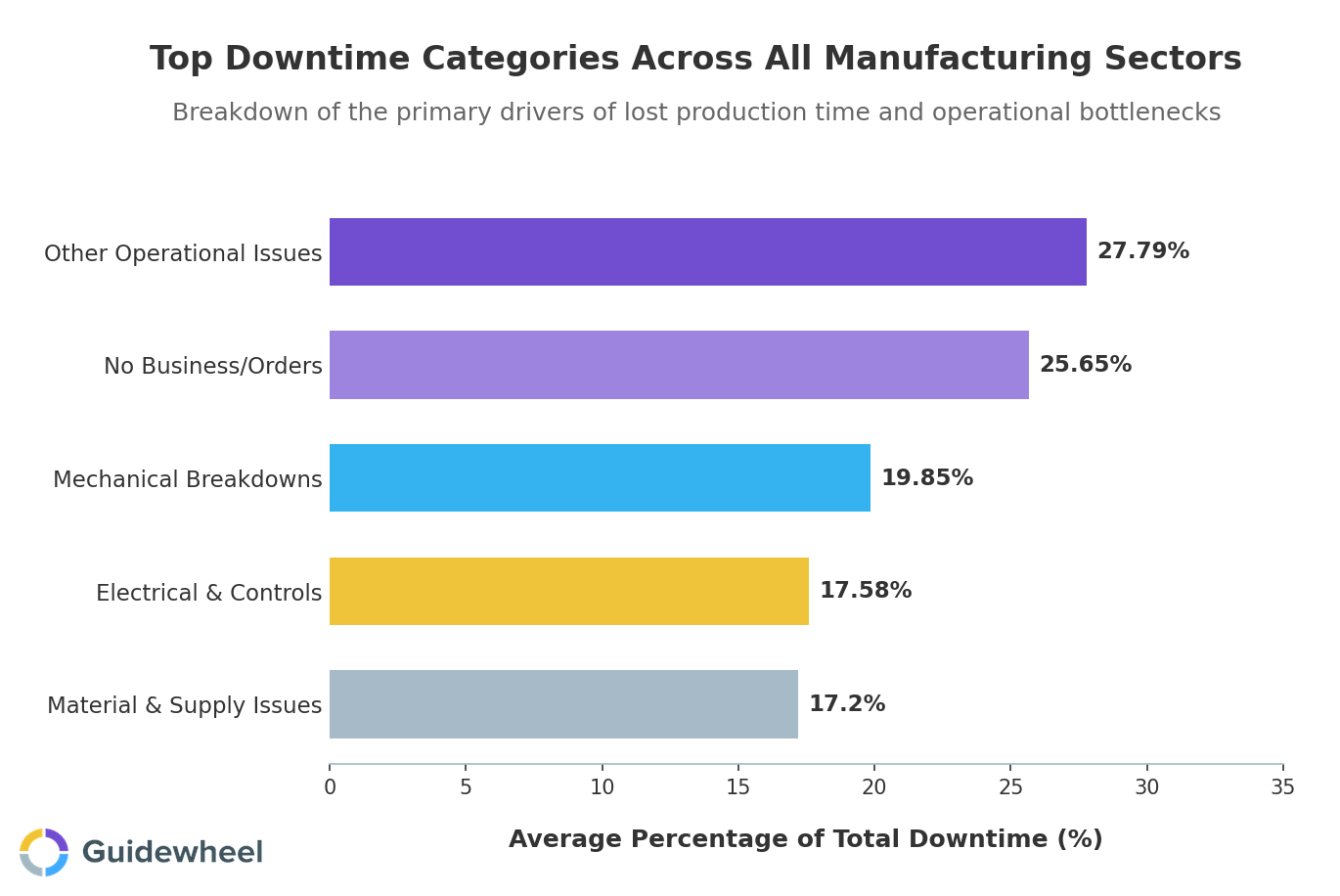
Recent performance analysis across manufacturing sectors (Source: Guidewheel Performance Analysis) shows that downtime categories split between planning deficits and direct operational failures, each demanding a different solution:
Downtime category |
% of total downtime |
Avg. duration per event |
What addresses it |
|---|---|---|---|
Other Operational |
28% |
81 min |
IIoT categorization + operator workflows |
No Business/Orders |
26% |
318 min |
ERP/MES scheduling |
Mechanical Breakdowns |
20% |
72 min |
IIoT condition monitoring + maintenance alerts |
Electrical & Controls |
18% |
107 min |
IIoT anomaly detection + predictive maintenance |
Material & Supply |
17% |
119 min |
MES material staging + IIoT queue monitoring |
The "No Business/Orders" category dominates event duration, but that's a demand-planning problem solved at the ERP or MES level. The categories that plant teams can directly control, such as mechanical breakdowns, electrical failures, and operational issues, account for roughly 65% of total downtime and are exactly where an industrial IoT platform delivers immediate value.
Secondary drivers like maintenance and cleaning (11% of downtime, averaging 85 minutes per event) and staffing issues (13%, averaging 197 minutes per event) represent high-priority targets too. These fall squarely within plant management's control and respond well to digital workflow standardization and proactive alerting.
Why facility averages hide your real performance gap
One of the biggest traps in evaluating IoT in manufacturing is relying on blended facility metrics. When you average performance across all machines, high-volume lines mask underperformers.

This visibility gap, where median machine runtime can differ from volume-weighted averages by 20+ percentage points in some sectors, is precisely why granular, machine-level data collection matters more than facility-wide dashboards. Your constraint machine might be running at 25% while your blended average looks like 55%. These benchmarks serve as reference points; your specific targets should reflect your product mix, equipment age, and operational priorities.
✅
Non-invasive clip-on sensors that read electrical current can be installed on any machine—regardless of age, brand, or connectivity—in just one to two hours without stopping production. These sensors communicate over cellular connections (no plant Wi-Fi required), and proprietary algorithms translate current data into run, idle, and down states. This means you can achieve machine-level visibility across your entire fleet, including decades-old equipment, without touching a single PLC or launching an IT project.
A FactoryOps solution like Guidewheel solves this with simple clip-on sensors that read electrical current from any machine, whether it's a decades-old hydraulic press or a brand-new packaging line. The sensors work over cellular connections (no plant Wi-Fi required), and proprietary algorithms translate that current data into run, idle, and down states. This approach means you can get machine-level visibility across your entire fleet without touching a single PLC.
Connecting legacy machines without a nightmare project
The number one concern I hear: "Our machines are old. They don't have sensors or connectivity. How does this even work?"
Here are the most common IoT integration patterns, ranked from lowest to highest risk:
Non-invasive sensor retrofit: Clip-on current sensors, vibration monitors, or temperature probes installed in hours with zero production disruption. Works on any machine regardless of age or documentation. Typical cost: $2K to $5K per machine.
OPC-UA gateway to existing historian: If you already have SCADA and PLCs, an edge gateway reads data from your existing infrastructure and forwards it to your IIoT platform. No PLC logic changes. Deploys in 2 to 4 weeks.
Lightweight edge node for multi-machine lines: A ruggedized device polls multiple machines via standard protocols (Modbus, Ethernet/IP, MQTT) and processes signals locally before sending events to the cloud. Cost: $8K to $20K for a multi-machine setup.
Direct machine API: Newer equipment with built-in connectivity (MTConnect, REST APIs) can stream data directly. Highest fidelity, but only works with modern assets.
For most plants managing a mixed fleet, option one or two gets you producing actionable data within weeks. The key is starting without disrupting production, proving value, and then scaling.
A practical 12-week pilot playbook
Rather than planning an 18-month transformation, consider this phased approach:
Phase |
Timeline |
What you do |
What you prove |
|---|---|---|---|
Foundation |
Weeks 1–4 |
Deploy sensors on 2–3 representative machines or one complete line |
Real-time uptime and downtime visibility is possible |
Categorize |
Weeks 4–8 |
Establish downtime taxonomy; train operators on reason codes |
Downtime categorization accuracy exceeds 90% |
Optimize |
Weeks 8–12 |
Analyze patterns; implement targeted fixes on top loss drivers |
First 3 to 5% uptime improvement without capital spend |
After 12 weeks, you'll have the data to make a confident decision: scale the IIoT deployment across all lines, integrate with your existing MES for workflow automation, or both. Industry experience suggests that pragmatic IIoT deployments typically achieve payback within 18 to 30 months, with the primary benefit coming from downtime reduction and faster troubleshooting.
Results will vary based on your unique operational context, but the pattern is consistent: visibility first, then process improvement, then system integration.
Start seeing your factory's real performance
Every plant has hidden capacity. The question is whether you can see it. If your machines run but you're still guessing at utilization, still reconciling shift logs the morning after, still debating whether the bottleneck is on Line 3 or Line 7, the fastest fix isn't a two-year MES overhaul. It's putting eyes on every machine, starting this month.
We had our best month of the year, increasing production from 26k-35k/month to 46k cases in March. I attribute this to Guidewheel. Being able to see downtime data and address downtime reasons directly correlates to higher production.
Michael Palmer, VP of Operations, Direct Pack via Guidewheel's Customer Research
Guidewheel's FactoryOps platform clips onto any machine, connects over cellular, and starts delivering run/idle/down data within days, not months. No PLC programming. No IT project. Just the machine-level truth your teams need to act fast.
Ready to see what your machines are actually doing? Book a Demo and start with your toughest line.
💡
Frequently asked questions
What is the difference between IoT and IIoT in a manufacturing environment?
IoT is the broad category of internet-connected devices, including consumer products like smart speakers and thermostats. IIoT, or the Industrial Internet of Things, is specifically engineered for manufacturing and industrial environments. IIoT devices must tolerate harsh conditions such as extreme temperatures, vibration, and electromagnetic interference. They require higher reliability standards, often 99%+ uptime, tighter security isolation to protect production networks, and lower data latency for real-time downtime detection. In short, IIoT is IoT built for the factory floor.
Do manufacturers need both an MES and an IIoT platform?
It depends on your operational complexity. If your primary pain point is lack of machine visibility, unplanned downtime, or inconsistent KPI tracking, an IIoT platform alone can deliver measurable ROI within months. If you operate in a regulated environment requiring lot traceability, recipe management, or complex work order scheduling, you'll eventually want MES capabilities too. The practical approach is to deploy IIoT first as the data backbone, prove value, and layer in MES workflows when your operations demand them.
How is OEE calculated, and should the data come from MES or IIoT?
OEE equals Availability multiplied by Performance multiplied by Quality. Availability requires accurate, real-time downtime tracking. Performance requires cycle time and production rate data. Quality requires defect counts tied to production runs. While some MES platforms include OEE modules, they often rely on manually entered data that arrives hours or days late. An IIoT platform feeding OEE from live machine signals means you see performance as it happens, enabling operators and maintenance teams to react during the shift rather than reviewing stale reports the next morning.
How can plants connect legacy machines that have no built-in sensors or networking?
Non-invasive sensor retrofits are the most common approach. Clip-on current sensors, vibration monitors, and temperature probes can be installed on virtually any machine in one to two hours without stopping production or modifying machine controls. These sensors communicate through edge gateways to your IIoT platform. Typical cost runs $2K to $8K per machine for basic uptime and condition monitoring, and you can be collecting data within days of installation.
Why do IIoT pilots stall after the first few machines, and how can we prevent that?
Most stalled pilots suffer from unclear success criteria, scope creep, or failure to engage frontline teams from day one. To prevent this, define a single use case, such as reducing unplanned downtime on Line 2, with measurable KPIs before deploying anything. Keep the initial scope tight: two to three machines over 12 weeks. Ensure operators and maintenance technicians are trained on the new dashboards and understand how the data helps them, not just management. When the pilot proves value with hard numbers, scaling becomes a straightforward budget conversation rather than a leap of faith.
About the author
Lauren Dunford is the CEO & Co-Founder of Guidewheel. Prior to Guidewheel, Lauren spent time at the Stanford Design School and worked on sustainability and operational strategy across industries. She is a World Economic Forum Technology Pioneer who believes manufacturing's next era is being built right now, one practical experiment at a time. Lauren is passionate about empowering the people closest to the work with the data and tools they need to unlock hidden factory capacity, proving that productivity and sustainability are the same goal.