No items found.
blog
Condition monitoring ROI: building the business case for your packaging line
By: Guidewheel
Updated:
May 3, 2026
9 min read

If you've ever tried to get budget approval for a monitoring project on your packaging line, you know the drill. Leadership wants hard numbers, not promises. They want to know exactly how much unplanned downtime is costing, what a condition monitoring system will recover, and how fast the investment pays for itself.
The good news: the math is straightforward, and the payback is faster than most capital projects. This article walks through how to build that business case, step by step, using industry benchmarks, real downtime data, and a practical implementation path that proves value in weeks, not years.
Key terms to know before building your case
Before diving into the numbers, let's align on a few terms that often get used interchangeably but mean slightly different things:
Term |
What it measures |
Primary audience |
|---|---|---|
Condition monitoring |
Physical equipment health (vibration, temperature, current) |
Maintenance and reliability teams |
Machine health monitoring |
Diagnostics and early fault detection on specific assets |
Maintenance engineers |
Equipment performance monitoring |
KPIs like OEE, availability, utilization |
Operations and plant leadership |
Line-level throughput, schedule attainment, downtime causes |
Production managers and supervisors |
|
Machine monitoring |
Run/idle/down state plus cycle and output data |
All of the above |
The most effective programs don't pick just one. They start with simple machine monitoring to establish operational visibility, then layer in condition diagnostics on critical assets. That progression is what makes the ROI case so compelling: you start small, prove value fast, and scale with confidence.
The real cost of unplanned downtime on your packaging line
Let's start with the problem. A 2025 survey by Fluke Corporation covering 3,600 senior decision-makers found that over 61% of manufacturers experienced unplanned downtime events in the past year, collectively costing the sector up to $852 million every week (Source: Fluke Reliability).
That's the macro picture. Here's how it hits your packaging floor specifically.
A mid-sized operation running five packaging lines at roughly 8% unplanned downtime with a gross margin of $800 per line-hour is leaving approximately $640,000 on the table annually, just in lost throughput. That doesn't include overtime labor, rush parts, or customer penalties for late shipments.
Just as important, reactive repairs on that same equipment cost 3 to 5 times more than the same intervention performed as planned preventive maintenance (Source: Oxmaint). Emergency labor premiums, expedited freight for spare parts, and secondary damage from cascading failures all stack up fast.
So the question isn't whether downtime is expensive. It's which downtime categories you should target first.
Where your packaging line downtime actually hides
This is where most business cases fall apart: they treat all downtime as one bucket. But when you break it down by category, the priorities get much clearer.
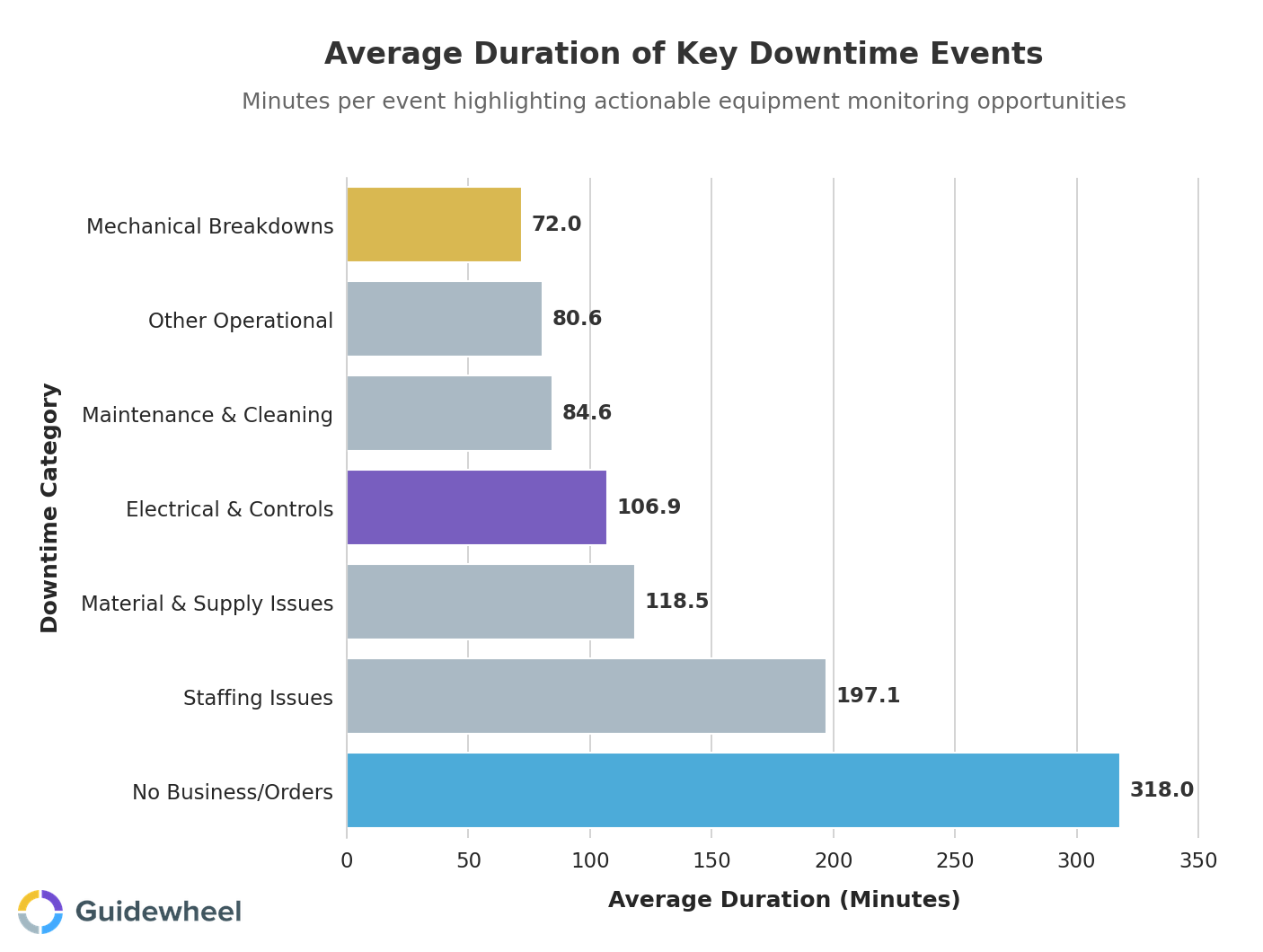
Analysis across 14,000+ downtime events and 3,000+ machines (Source: Guidewheel Performance Analysis) reveals a critical distinction: while "No Business/Orders" events are the longest at 318 minutes per event, they reflect demand constraints, not operational failures. You can't fix those with better maintenance.
The actionable targets are the categories your team directly controls:
Downtime category |
Avg. duration per event |
Why it matters |
|---|---|---|
Electrical & Controls |
107 min |
Longest resolution time among controllable categories; often requires specialized expertise |
Maintenance & Cleaning |
85 min |
Scheduling and standardization can compress these significantly |
Other Operational |
81 min |
Process jams, changeover issues, and material staging problems |
Mechanical Breakdowns |
72 min |
Classic condition monitoring targets: bearings, motors, drives |
Mechanical breakdowns may average the shortest duration per event, but they account for roughly 20% of total downtime across manufacturing environments (Source: Guidewheel Performance Analysis) and often trigger secondary damage that extends repairs. Electrical and controls issues take nearly 50% longer to resolve per event, making them high-value targets for early detection through current signature analysis and temperature trending.
The bottom line: your business case should prioritize these controllable categories, not the aggregate downtime number.
How current sensing turns packaging equipment into a data source
Here's where it gets practical. You don't need to rip out PLCs or install complex sensor arrays to start getting value from equipment monitoring on your packaging lines.
The simplest entry point is non-invasive power measurement. Clip-on current sensors attach to the electrical supply feeding your fillers, cappers, conveyors, and case packers. By reading that current draw, the platform's algorithms determine whether each machine is running, idle, in setup, or down — and flag anomalies in the electrical signature that indicate developing mechanical or electrical faults.
Think of it as reading the machine's condition through its power draw.
✅
Non-invasive clip-on current sensors work on virtually any electrically powered equipment — from decades-old legacy lines to brand-new installations — without requiring PLC programming, IT projects, firmware updates, or control system access. Deployment takes days, not months, and you can collect baseline data within the first week to validate your ROI assumptions against actual performance before requesting a larger capital allocation.
This approach works on virtually any electrically powered equipment, from decades-old legacy lines to brand-new installations. No PLC programming required. No IT project. No firmware updates or control system access needed. Guidewheel's FactoryOps platform uses this clip-on sensor approach with proprietary algorithms that process current data into actionable machine state and condition signals and operates over cellular connections where factory Wi-Fi isn't available.
The advantage for your business case: deployment takes days, not months, and you're collecting baseline data within the first week. That means you can validate your ROI assumptions against actual performance data before requesting a larger capital allocation.
What "good" actually looks like: packaging line runtime benchmarks
One of the hardest parts of building a business case is answering the question: "What should our uptime be?" Without benchmarks, every target feels arbitrary.
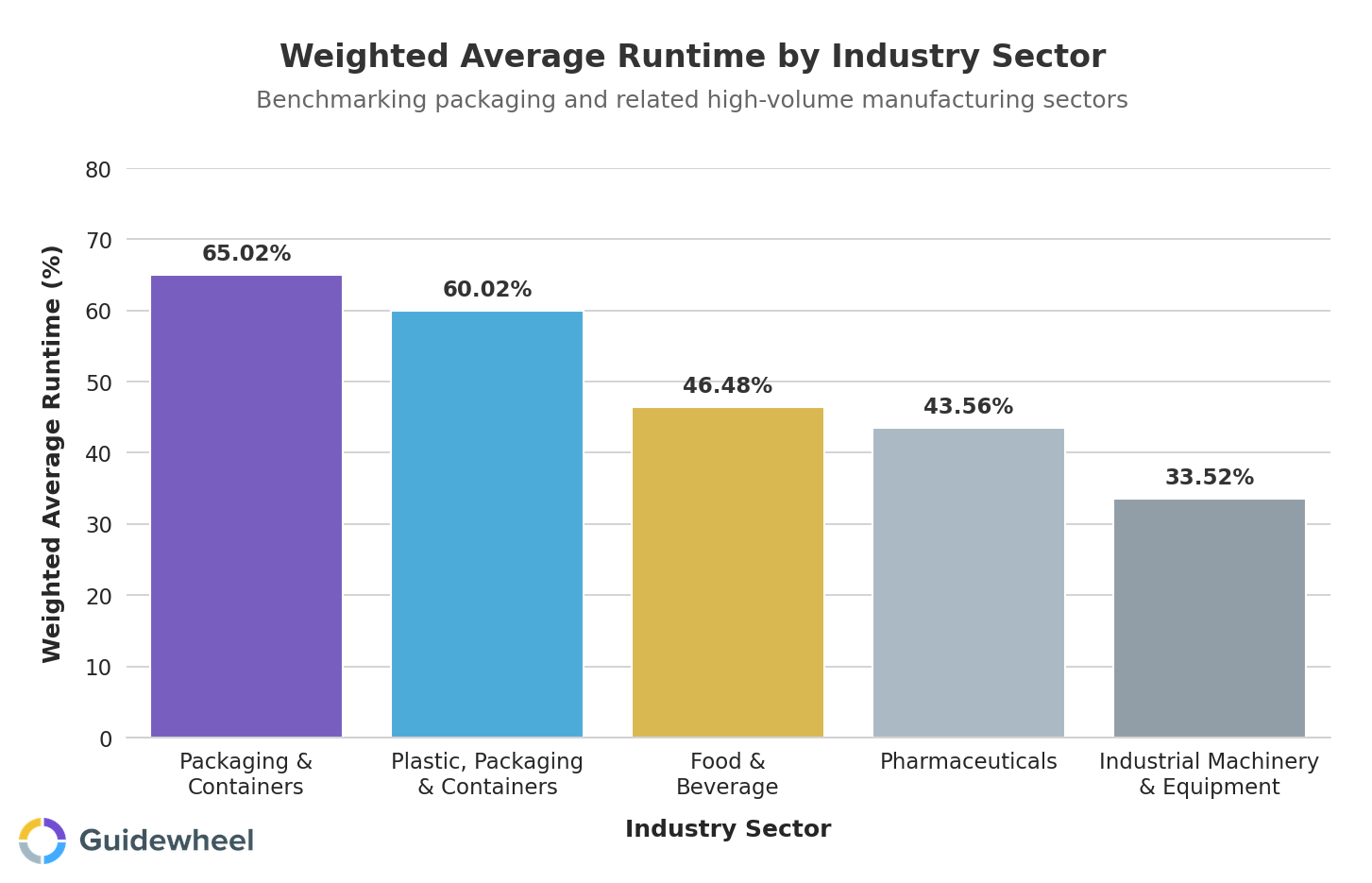
Data from 2,500+ machines and 53 million+ machine-minutes (Source: Guidewheel Performance Analysis) shows that Packaging & Containers facilities run at a weighted average of roughly 65% runtime, while related sectors like Plastics run around 60% and Food & Beverage sits closer to 46%.
These benchmarks serve as reference points rather than universal targets. Your specific product mix, changeover frequency, and cleaning requirements all influence what optimal performance looks like for your facility. But they do answer a critical question for your leadership team: there's meaningful room between where most packaging lines operate today and world-class OEE targets of 85%.
At $800 per line-hour and 7,000 scheduled hours per line annually, each percentage point of availability improvement across five lines represents approximately $280,000 in annual margin recovery. That's the kind of number that helps make the case clearly.
Building the ROI math your CFO will approve
Here's a conservative calculation template you can adapt to your own operation:
ROI component |
Conservative estimate |
Your facility |
|---|---|---|
Annual scheduled hours (all lines) |
40,000 hrs |
_______ |
Current unplanned downtime |
10% |
_______ |
Gross margin per line-hour |
$900 |
_______ |
Current annual downtime cost |
$3.6M |
_______ |
Recovery rate from monitoring |
40% |
_______ |
Annual margin recovered |
$1.44M |
_______ |
Year 1 investment (hardware + software + training) |
$40K–$80K |
_______ |
Payback period |
~3 weeks |
_______ |
Industry research supports the 30–50% unplanned downtime reduction range for manufacturers transitioning from reactive to condition-based maintenance (Source: TMA Solutions). The 40% figure above is deliberately conservative.
Beyond downtime recovery, additional savings come from:
Maintenance cost reduction of 18–25% through shifting emergency repairs to planned interventions
Spare parts optimization of 10–12% by ordering at normal lead times instead of paying rush freight (Source: Fabrico)
Asset lifecycle extension of 20–40% by catching degradation before it causes secondary damage (Source: IBM)
Your actual recovery will depend on your current downtime rate, line count, and throughput value — but even at half these estimates, the payback case holds.
Start recovering hidden margin on your packaging lines
The business case for condition monitoring on packaging lines is built on real operational data, and the implementation path is designed to prove value before you commit to a large-scale rollout.
If you're ready to find out how much hidden capacity is sitting in your packaging lines, Book a Demo to see how Guidewheel's FactoryOps platform delivers baseline data in your first week — starting with your toughest line.
With Guidewheel, we now get key metrics like production, downtime, downtime codes, scrap, and cycle time automatically and accurately. Our team no longer takes time to track manually and has been able to instead invest that time in improvements. Everybody knows when we're winning or losing. Each teammate understands how their work drives the success of the organization, and that every decision they make has a direct impact on the business.
Edgar Yerena, Custom Engineered Wheels.
💡
Frequently asked questions
What's the ROI of adding condition monitoring on a packaging line?
Most packaging operations see payback within 3 to 9 months using conservative estimates. A five-line facility running at 10% unplanned downtime with $900 per line-hour gross margin can recover approximately $1.44M annually by preventing 40% of that downtime, against a Year 1 investment of $40K to $80K. Your specific numbers will depend on line count, throughput value, and current downtime rates, but even facilities with lower margins typically achieve payback inside the first year.
What is the difference between condition monitoring and production monitoring software?
Condition monitoring focuses on detecting physical changes in equipment health, such as vibration patterns, temperature trends, and current signatures, that indicate developing faults. Production monitoring software tracks line-level output, schedule attainment, and downtime causes across entire operations. The most effective programs combine both: condition signals tell you what's degrading, while production data tells you how that degradation impacts throughput and delivery.
Which machines on my packaging line should I monitor first?
Start with your bottleneck assets, the machines where a failure causes the most schedule disruption and margin loss. On most packaging lines, that's the filler, primary conveyor drives, or case packer. Pull three months of downtime records and rank equipment by total downtime hours and repair cost. Focus your first pilot on the top 3 to 5 assets. You can expand from there once you've validated the data.
How do I monitor legacy packaging equipment that doesn't have network connectivity?
Non-invasive power measurement is the simplest approach. Clip-on current sensors attach to the electrical supply feeding your equipment without requiring PLC integration, firmware updates, or control system access. This works on any electrically powered machine regardless of age. Some solutions also support cellular connectivity, eliminating the need for factory Wi-Fi infrastructure entirely.
How do monitoring systems integrate with our existing CMMS?
Most modern monitoring platforms can push condition-based alerts directly into your CMMS as prioritized work orders, prepopulated with asset details, maintenance history, and recommended corrective actions. This integration eliminates manual work order creation and ensures that early warnings from sensors translate into scheduled interventions before failures impact production. The specific integration method varies by platform, but standard protocols like REST APIs and MQTT make connecting most CMMS systems straightforward.
About the author
Lauren Dunford is the CEO and Co-Founder of Guidewheel, a FactoryOps platform that empowers factories to reach a sustainable peak of performance. A graduate of Stanford, she is a JOURNEY Fellow and World Economic Forum Tech Pioneer. Watch her TED Talk—the future isn't just coded, it's built.