No items found.
blog
Why Systems, Automation, and Diversification Matter More Than Ever in Glass Manufacturing
By: Guidewheel
Updated:
March 10, 2026
7 min read
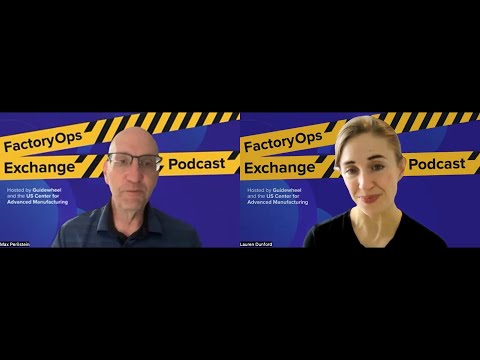
Why systems, automation, and diversification matter more than ever in glass manufacturing
In this webinar, Max Perilstein (Founder, Sole Source Consultants and creator of From the Fabricator) joins Lauren Dunford, CEO and Co-Founder of Guidewheel, to discuss growth, culture, and modernization in the glass industry.
Top 5 takeaways
💡Here are the top five takeaways from this conversation on growth, culture, and modernization in the glass industry:
- Systems must come before growth. Without operational fundamentals in place, unexpected demand spikes can collapse lead times and break your team. Get organized before you scale.
- Stop stepping over dollars for dimes on equipment. Choosing cheap labor over advanced machinery costs more long-term in efficiency, quality, safety, and retention.
- Most diversification can happen on existing assets. Roughly 75% of new product lines in glass can run on current equipment, unlocking revenue without major capital expenditure.
- Scaling beyond three or four plants dilutes talent without systems. Quality and expertise get "watered down" with each new location unless you standardize processes and capture knowledge.
- Automation should move humans from physical danger to process control. The goal is not lights-out factories but empowered operators overseeing more with better tools and less physical risk.
Best practices and key learnings
Build operational systems before you need them
Max shared a story that every manufacturer should hear. In the early 1990s, his family's glass business went from a three-day lead time to 11 weeks practically overnight. The plant manager, overwhelmed, retreated to the mezzanine trying to solve it alone. The company had to shut down for several days just to figure out where things stood.
The lesson was permanent. They brought in a consultant, made proactive calls to every customer, and built the systems they should have had before the surge hit. Within a month and a half, they dug out and never let it happen again.
"No matter the size of the business that I'm in or consulting with or working with, the organization, the blocking and tackling come first. Whether they're doing two SKUs a day or a billion, it doesn't matter. You got to have that fundamental."
Max Perilstein, Founder, Sole Source Consultants
This is exactly the gap that real-time visibility fills. When demand spikes or a key leader goes down (Max's brother broke his neck during this same period), you cannot rely on tribal knowledge and heroics. You need a real-time operating layer that shows true capacity, current status, and where bottlenecks are forming before they cascade. Platforms built for AI monitoring and machine learning in manufacturing exist precisely to close this gap, giving every shift the same situational awareness that your best operator carries in their head.
The practical takeaway: if your plant would struggle to absorb a 2x demand spike today, your systems are not ready. Start by getting visibility into what your machines are actually doing right now.
Invest in automation and stop subsidizing inefficiency with labor
Max identified one of the most common and costly mistakes in the glass industry: manufacturers who refuse to invest in advanced machinery because of the upfront price tag, then hire ten people to run a process that two people could handle on better equipment.
"I call it stepover dollars for dimes. They could put in advanced machinery, but they look at the initial price tag and they say, 'Well, I'll put in this piece and I'll just find 10 people to run it instead of the higher level piece that takes two people to run it and is better in the long run.'"
Max Perilstein, Founder, Sole Source Consultants
This pattern is not unique to glass. It shows up across plastics, packaging, consumer goods, and every sector where labor markets are tight and operators are competing with fast food restaurants for the same talent pool. Max pointed out that floor workers know when you have not invested in quality equipment. They feel it every shift. And conversely, when you bring in advanced machinery, it signals respect, improves job quality, and often directly improves retention.
But here is the critical nuance: before you sign the PO on new equipment, you need to know what your current machines are actually capable of. Many manufacturers assume they need to buy their way to more capacity, only to discover - once they have real-time visibility into their lines - that their existing equipment had significant unplanned downtime and untapped capacity all along. The machine was not the bottleneck. The lack of visibility was.
✅
Before committing to new equipment purchases, install real-time AI monitoring on your existing machines first. Many manufacturers discover 30–40% more usable capacity hidden behind unplanned downtime, slow changeovers, and micro-stops they couldn't previously see. Plug-and-play platforms can go live in hours — giving you utilization rates, micro-stops, changeover times, and energy consumption per part — so you can make investment decisions from data, not gut feel. Sometimes the right move is optimizing what you have, not buying something new.
This is where AI in manufacturing changes the decision-making process entirely. Visibility is step one, not step two. When you install an AI monitoring platform on your existing equipment, you get utilization rates, micro-stops, changeover times, and energy consumption per part. Sometimes that data reveals you had 30 or 40 percent more usable capacity than you thought, and the right move is to optimize what you have, not buy something new. Other times, the data shows a specific machine is breaking down so frequently that the maintenance costs and lost production clearly justify a replacement. Either way, you are making the decision from data, not gut feel. Plug-and-play platforms can be live on old and new machines alike, often in hours, giving you the evidence you need before you spend.
Max's family business leaned into this early, buying machinery from Finland and the US that nobody else had. It blazed trails. But today, the companies that are winning are not just the ones buying the newest equipment. They are the ones who understand what every machine on their floor is actually doing, and then making smart investment decisions from there.
Diversify product lines on the equipment you already own
One of the most actionable insights from the conversation was Max's estimate that 75% of product diversification in glass can happen on existing equipment. This reframes diversification from a scary capital project into a smart utilization play.
Consider the examples he shared:
Laminated glass lines originally built for basic safety applications can produce bullet-resistant and forced-entry glass by changing the internal makeup, not the machinery.
Bird-friendly glass, one of the hottest product categories in the industry, can be produced through existing lamination processes by incorporating UV coatings or laser-etched markings into the interlayer.
Decorative glass now runs through printers that operate on the same principles as an office printer, opening up architectural and design markets.
Shower door installers can pivot into wine closet installations using the same hardware, skill set, and process with minor design adjustments.
The key enabler for this kind of diversification is knowing what your existing assets are truly capable of. This is where machine learning in manufacturing becomes practical: when you have second-by-second data on what every machine is doing, you can identify unused capacity, test new product runs during off-peak windows, and validate whether a new product line is actually profitable before scaling it.
In a tariff-heavy, recession-cautious environment, diversification on existing equipment is one of the lowest-risk, highest-return moves a manufacturer can make. And glass companies have a built-in advantage: flat glass is produced domestically, it does not ship well internationally, and fabrication happens locally. The demand is there. The question is whether you are positioned to capture it.
When the pressure hits: why your business needs systems
"And at that point it dawned on me and it dawned on all of us that, we're now not this little family business anymore. We have to have systems."
How to put these insights into practice
The themes from this conversation point to a clear, sequential playbook. Here is how to act on them.
1. Audit your operational readiness for a demand spike. Ask yourself: if orders doubled next month, would your team know exactly where capacity exists and where bottlenecks would form? If the answer depends on one or two experienced people, you have a tribal knowledge problem. Start by getting real-time visibility into machine status across every line. Plug-and-play AI monitoring solutions can be live in hours, not months, with no IT involvement or production downtime.
2. Identify your "stepover dollars for dimes" decisions. Start by getting real-time visibility into your existing equipment. You may find that machines you thought were maxed out actually have significant available capacity hidden behind unplanned downtime, slow changeovers, or micro-stops you could not see before. Once you have that baseline, walk the floor and list every process where you are using manual labor to compensate for underinvested equipment. Calculate the fully loaded cost of that labor (wages, benefits, turnover, training, injury risk) against the cost of automation or better machinery. Present the business case in terms of throughput per labor dollar, not just sticker price, and let your production data guide whether the answer is a new machine or better utilization of what you already own.
3. Map diversification opportunities on existing equipment. Catalog every machine and its capabilities. Then look at adjacent product categories where demand is growing, whether that is safety glazing, decorative applications, or energy-efficient retrofits. Run small test batches during available capacity windows. Use production data to validate margins before committing to a full product launch.
4. Standardize before you scale locations. If you are considering a second, third, or fourth facility, first ensure that your operational playbook is documented, measurable, and transferable. Industrial AI platforms that capture machine behavior and operator best practices can prevent the "photocopy of a photocopy" problem Max described. Every new plant should launch with the same data foundation and performance benchmarks as your best one.
5. Reframe automation as a safety and retention strategy. Glass is heavy and dangerous. So are many materials across manufacturing. Position automation investments not just as efficiency plays but as commitments to workforce health and job quality. When operators see that you are removing the most physically punishing tasks and giving them supervisory control over more of the process, retention follows.
The path forward for glass and beyond
The glass industry sits at a familiar crossroads. Family-owned businesses are weighing tradition against modernization. Private equity-backed companies are pushing for speed, sometimes at the expense of operational depth. And across both camps, the workforce is aging, demand is shifting, and the manufacturers who win will be the ones who build systems that do not depend on any single person's knowledge.
Max's vision for the industry is clear: more automation, smarter use of existing assets, and a culture that respects the people doing the work by giving them better tools. That vision is not unique to glass. It applies to every manufacturer navigating tariffs, labor shortages, and the pressure to do more with what they have.
The good news is that modernizing does not have to mean disruption. It can start with one machine, one shift, one plant. Real-time visibility, practical AI, and a commitment to blocking and tackling will take you further than any grand transformation plan.
Ready to see what your machines are actually doing? Book a Demo and find out how quickly real-time visibility can change how your team operates.
Watch and listen
Watch the webinar now: