No items found.
blog
Rotational Molding Monitoring Platforms: Best Options Compared for Rotational Molding Facilities
By: Guidewheel
Updated:
December 18, 2025
9 min read
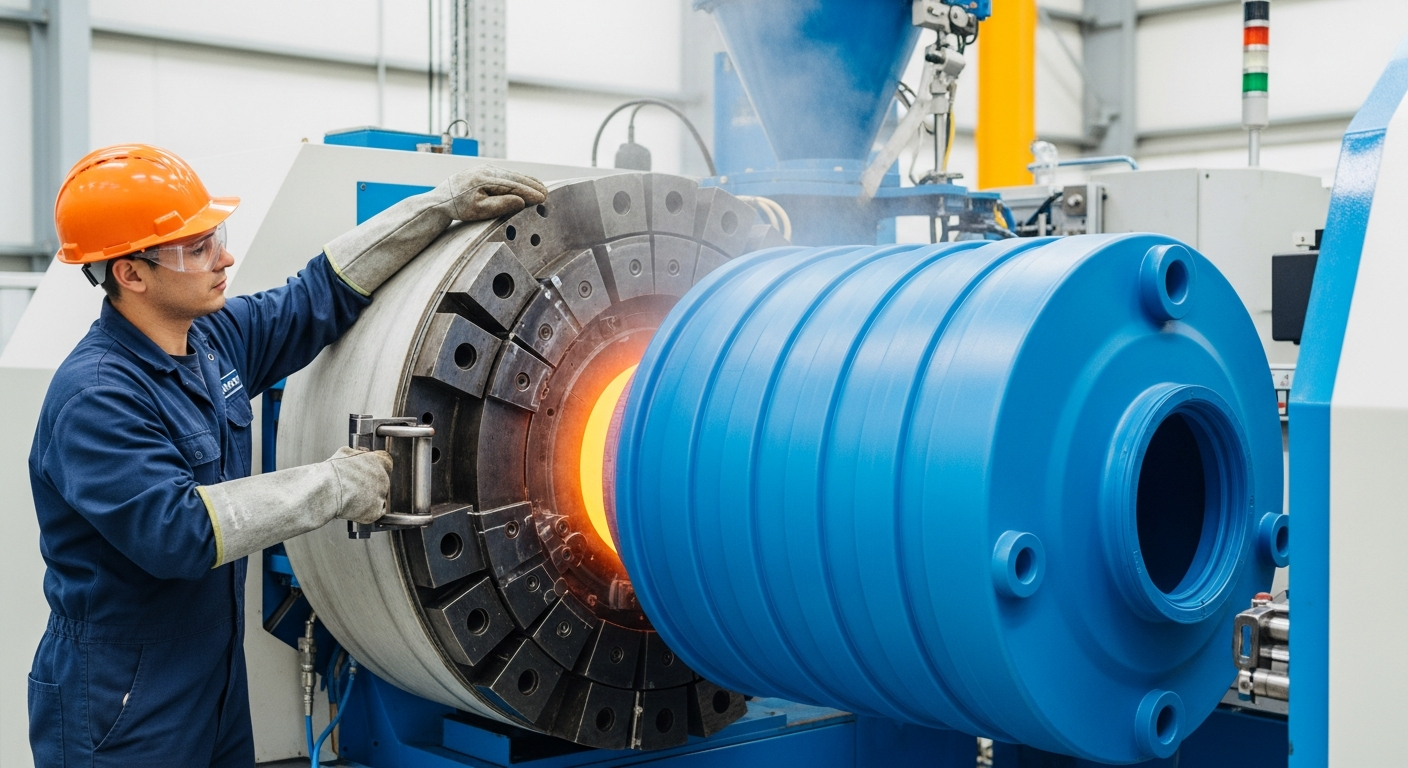
The reality of modern rotational molding is brutal but simple: a lengthy cycle time means a mistake costs you significantly more than a rejected shot in injection molding. If you are running a rotational molding plant, you aren't just making parts; you are managing thermal dynamics, massive equipment, and manual demolding processes that introduce variability at every step.
For the plant manager focused on eliminating unplanned downtime, warped parts, and cooling system failures, relying on clipboard-based, non–real-time monitoring is no longer enough. You cannot manage what you do not measure, and in rotational molding, the latency between a process drift and a discovered defect is often where the profit margin dies.
This article cuts through the vendor noise. We aren't here to use "digital transformation" buzzwords. We are here to look at the hard operational reality of rotational molding and compare the rotational molding monitoring tools that actually work on the floor. We will break down the options, from heavy SCADA systems to agile FactoryOps platforms, so you can move from reactive problem-solving to proactive optimization.
Guidewheel: The FactoryOps approach
Guidewheel positions itself differently from traditional MES (Manufacturing Execution Systems). Instead of a top-down, heavy IT implementation, it uses a "FactoryOps" approach focused on immediate visibility and operator empowerment.
How it works in Rotomolding
Guidewheel utilizes a non-intrusive sensor technology that clips directly onto the power supply of any machine—regardless of age or brand—but on gas-fired equipment this monitors mechanical activity (rotation/fans), not thermal energy consumption. This is a critical differentiator for rotational molding plants with mixed fleets of Ferry, Rotoline, or custom-built arms.
Universal Compatibility: By reading electrical draw, the system works on everything from legacy ovens to modern automated lines. Algorithms analyze the resulting electrical heartbeat to identify real operating states, ensuring the focus is on production behavior rather than energy usage.
No Facility Internet Dependency: A key architectural advantage is that the system does not require a facility's internal Wi-Fi or Ethernet to populate dashboards. The hubs can use cellular connectivity to push data to the cloud, bypassing strict IT firewalls and unreliable plant internet.
Cycle Analysis: On independent-arm carousel machines, sensors must be applied to individual arm drives or station motors to distinguish simultaneous cycles. The 'single clip' method described is primarily effective for Shuttle machines or total machine utilization, not per-arm cycle phase tracking without sub-metering.
Limitations: Guidewheel excels at machine state and cycle tracking, but it won't replace deep vibration analysis for bearing diagnostics or provide the infinite customization of a full SCADA build. It's built for speed and clarity, not complexity.
Solving the reactive management problem
For the plant manager looking to shift from reactive to proactive operations, this visibility changes the game. You can see exactly when an arm stopped, for how long, and—with operator input via the app at the service station—why.
...I mean, the results have just been astronomically great... our efficiencies have just taken us to another level. So that's a very encouraging thing you know, I was on a call with a CEO yesterday and he just said, it's just the heavy lifting that you guys did. It is just amazing"
Executive VP, Operations via Guidewheel's Customer Research.
This isn't about policing operators; it's about removing the friction that causes downtime.
No longer are we questioning why we are down or questioning when we were down because it is so easily accessible. Down times have lessened. Productivity has increased, what more can i company ask for?
Automation Technician, Materials via Guidewheel's Customer Research.
Rotational molding monitoring platforms: analyzing the competitive landscape
While Guidewheel offers a distinct "clip-and-go" advantage, the market is full of monitoring platforms ranging from deep vibration analysis to comprehensive workforce management. Here is how they stack up for rotational molding monitoring.
Production monitoring and OEE software specialists
These platforms focus on the core metrics of manufacturing: Are we running? How fast? Why did we stop?
Vorne
Strengths: It is a self-contained unit. You plug it in, and you get a scoreboard. It is very effective for single-line visibility.
Limitations: It can be rigid. If you want to scale data across a multi-site enterprise or do deep historical analysis, it often lacks the flexibility of cloud-native software.
Roto Context: Good for a single rotational molding machine where you want operators to see the target vs. actual count instantly.
MachineMetrics
Strengths: Deep integration with machine controls. If your rotational molding machines are brand new with modern controllers, MachineMetrics can pull rich data directly from the PLC.
Limitations: Implementation can be complex and expensive for legacy equipment that lacks modern controllers. It is often overkill for the simple "run/stop" and temperature tracking needed in basic rotational molding operations.
Amper
Strengths: Easy installation compared to PLC integration.
Limitations: Often focuses strictly on the electrical signal without the broader "FactoryOps" context of empowering the workforce and connecting the human element to the machine data.
Workforce and SCADA platforms
These tools are heavier lifts. They are either designed to manage people or to build a custom industrial operating system.
Redzone
Strengths: excellent for driving behavioral change and "huddles." It gamifies production to engage operators.
Limitations: It is a significant culture shift and financial investment. It focuses more on the people process than the raw machine health.
User Feedback:
at the moment, we can not search the line log which mean we have to scroll through pages of information. we can only view by attachments. i am also not able to upload a pre recorded video, i can only upload a live one.
Richard H., Area Manager, Capterra.
Inductive Automation (Ignition)
Strengths: Infinite customizability. If you have a controls engineer on staff, you can build exactly what you want.
Limitations: You need a controls engineer. For the plant manager working to minimize reactive operations, Ignition is a construction project, not a quick fix.
User Feedback:
The newer Perspective module can be cumbersome to work with, especially around formatting for resizable and different screen types
Nick D., Systems Engineer, G2.
Predictive maintenance and vibration specialists
These companies focus on Machine Health—listening to the bearings and motors to predict failure.
Augury, Asset Watch, Neuron Soundware, IPercept
Strengths: Incredible for preventing catastrophic failure of expensive motors or gearboxes. In roto, this saves the arm drive.
Limitations: They are niche. They tell you if the machine will break, but they don't necessarily tell you how efficiently you are producing or help you manage the daily production schedule.
Top rotational molding monitoring platforms: head-to-head comparison
The following table breaks down how these tools fit the specific needs of a rotational molding environment.
Feature | Guidewheel | Vorne | MachineMetrics | Redzone | Ignition |
|---|---|---|---|---|---|
Primary Focus | FactoryOps & OEE | Visual Scoreboard | Machine Data | Workforce Collaboration | SCADA / Custom Build |
Installation Speed | < 1 Day (Plug & Play) | Fast | Medium | Slow (Process change) | Slow (Engineering heavy) |
Legacy Compatible | Yes (Universal Sensors) | Yes (Inputs) | Difficult | N/A (Human focused) | Yes (Requires PLCs) |
Roto Fit | High (Tracks cycles/motor status) | Medium | Medium | High (For large teams) | High (If custom built) |
IT Requirement | Minimal (Cellular) | Low | High | Medium | High |
The Margin for Error in Rotational Molding is Shrinking
In rotational molding, the difference between a profitable shift and a loss is often hidden in the indexing delays during the arm exchange or the cooling phase. Because the process is inherently slower than injection molding, every minute of lost availability compounds. You cannot afford to wait until the end of a shift to realize that an oven burner was cycling inefficiently or that a manual demolding process took twice as long as scheduled.
The industry is moving away from the "run-to-failure" mentality that has plagued legacy rotational molding plants for decades. The most successful operators today are those who treat their twenty-year-old Ferry or Rotoline machines with the same data discipline as a modern CNC center. They understand that productivity and sustainability are the same goal: reducing scrap rates by even 1% saves thousands of pounds of resin and significant energy costs annually. The tools exist to make this visibility possible without ripping out your existing infrastructure. The only remaining barrier is the decision to stop guessing.
Turn Your Legacy Machines into Smart Assets
Unplanned downtime on roto lines rarely comes from one big issue—it hides in long cook cycles, slow cool-downs, and unpredictable demolding. Instead of a six-month SCADA project, you can start with simple, clip-on monitoring that turns your existing ovens and arms into real-time, data-generating assets. Guidewheel connects at the power supply and uses your run/idle/down and cycle data to visualize heat, cook, cool, and service phases, so you can quickly see where time and energy are being lost.
If you want practical, line-of-sight visibility you can roll out fast—without complex controls integration—Book a demo to see how real-time scoreboards, downtime tracking, and cycle visualization could fit into your lines.
About the Author
Lauren Dunford is the CEO and Co-Founder of Guidewheel, a FactoryOps platform that empowers factories to reach a sustainable peak of performance. A graduate of Stanford, she is a JOURNEY Fellow and World Economic Forum Tech Pioneer. Watch her TED Talk—the future isn’t just coded, it’s built.