No items found.
blog
Industry Report: Real-Time Monitoring for Thermoforming and FFS Operations in Consumer Goods (2026 Outlook)
By: Guidewheel
Updated:
December 19, 2025
9 min read
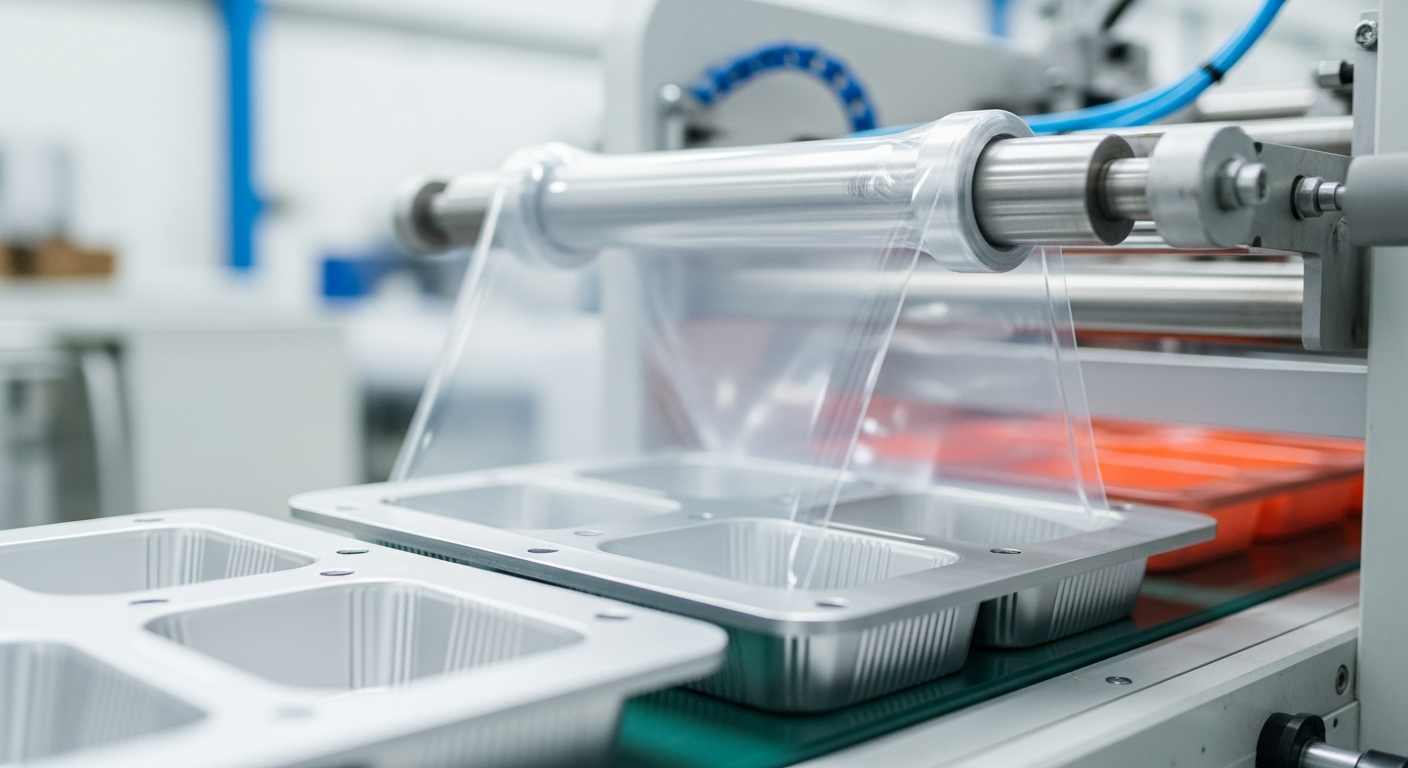
In the high-volume world of Consumer Goods manufacturing, the packaging line is often the heartbeat of the entire operation. Whether producing blister packs for household goods or intricate trays for food products, the thermoforming line dictates the pace of throughput and, ultimately, the facility's profitability. However, operational leaders frequently navigate a tension between aggressive production targets and the reality of unplanned downtime and efficiency losses.
Recent analysis suggests that while many facilities operate with a general sense of their efficiency, the specific drivers of lost capacity are often misunderstood. This report examines the current state of thermoforming performance, leveraging real-time sensor data to uncover where time is actually lost and how modern monitoring strategies can unlock hidden capacity.
Benchmarking Thermoforming Performance in Consumer Goods
When analyzing thermoforming operations, the data reveals a distinct bifurcation in performance based on the specific application. While the underlying mechanics of heating, forming, and trimming remain consistent, the operational realities between general plastics manufacturing and specialized Consumer Goods packaging differ significantly.
The Runtime Performance Gap
Data indicates that thermoforming lines dedicated to Packaging & Containers operate at a significantly higher intensity than their general industrial counterparts.
Packaging & Containers: The median runtime for thermoforming equipment in this sector is 94.1%, with top-quartile performers reaching an impressive 99.3% during planned time.
General Plastics & Packaging: In contrast, the broader sector shows a median runtime of 40.8%, with top-quartile performers at 83.5%.
(Source: Guidewheel Performance Analysis)
Operational Insight: This divergence suggests that Consumer Goods packaging lines are engineered and managed for high-velocity, continuous throughput. The high median runtime in packaging implies that these machines are not typically the bottleneck; they are reliable workhorses. However, the high utilization rate also means that any disruption—however minor—has an immediate and compounded impact on total plant output. When a machine is scheduled to run 94% of the time, there is zero buffer for error.
These benchmarks serve as reference points. Facilities operating below these medians may have significant opportunities to unlock capacity without capital investment, simply by tightening operational processes.
Industry Report: Real-Time Monitoring for Thermoforming Packaging Lines in Consumer Goods (2026)

Figure 1: Breakdown of downtime drivers for thermoforming operations in Consumer Goods. (Source: Guidewheel Performance Analysis, dataset includes hundreds of thermoforming and packaging machines, representing over 7 million machine-minutes)
Analyzing the Root Causes of Downtime
While "No Business" or schedule gaps are a factor in every plant, the data highlights that controllable operational issues are the primary thief of productivity in Consumer Goods thermoforming. By examining the breakdown of downtime drivers, plant managers can prioritize their continuous improvement efforts.
1. Other Operational Issues (32%)
The largest category of downtime outside of schedule constraints is "Other Operational Issues," accounting for 31.7% of recorded downtime events in the Packaging & Containers sector.
What this means: This category typically includes process interruptions that aren't catastrophic machine failures. Examples include jams, minor sensor faults, material feed issues, and upstream/downstream bottlenecks.
Sector variance: In the Food & Beverage sector, this category jumps to 62.7% of downtime, often driven by hygiene-related interruptions and non-allergen washdowns.
The Opportunity: These are often "micro-stops" or process inconsistencies that go unreported in manual logs. Because they are operational rather than mechanical, they are highly addressable through better operator training and real-time visibility.
(Source: Guidewheel Performance Analysis)
2. Mechanical Breakdowns (29%)
Mechanical failure remains a persistent challenge, representing 29.1% of downtime in Packaging & Containers.
Common Culprits: In thermoforming, this frequently involves trim press failures, extruder jams, and chain rail issues.
Impact: These events result in approximately 390 lost production hours per year per line for the median facility.
The Opportunity: Moving from reactive repairs to condition-based maintenance can significantly reduce this slice of the pie. Detecting increased vibration in a trim press motor before it fails allows for planned intervention.
(Source: Guidewheel Performance Analysis)
3. Maintenance & Cleaning (4% - 12%)
The impact of cleaning varies heavily by industry vertical. Packaging & Containers: Only 3.9% of downtime is attributed to maintenance and cleaning. Food & Beverage: This rises to 11.6%, reflecting the strict sanitation requirements inherent to food safety compliance.
(Source: Guidewheel Performance Analysis)
Operational Insight: For Food & Beverage thermoformers, optimizing the "Clean-in-Place" (CIP) cycle or reducing changeover sanitation time offers a high-value lever for increasing capacity.
The Hidden Cost of Changeovers
In the modern Consumer Goods landscape, SKU proliferation is the norm. The days of running the same blister pack for weeks are largely gone, replaced by shorter runs and frequent changeovers. The data reveals that changeover efficiency is a major differentiator between average and top-tier performance.
Thermoforming Changeover Duration:
Packaging & Containers (Specialized): Median duration of 37.0 minutes.
General Plastics: Median duration of 22.0 minutes.
(Source: Guidewheel Performance Analysis)
The Variability Problem: While the specialized packaging sector has longer median changeovers (likely due to complex mold and trim tool changes), the variability is the critical metric. The data shows a shift-to-shift spread of 139.4% in packaging. This means that one shift might complete a changeover in 20 minutes, while another takes 50 minutes for the same task.
This variability suggests an opportunity for standardized work. When "Process A" takes twice as long depending on who is performing it, the facility loses predictable capacity. Real-time monitoring helps identify these inconsistencies, allowing management to benchmark shifts against each other and establish best practices.
Leveraging Real-Time Monitoring for Operational Excellence
The data presented above—specifically the prevalence of "Other Operational Issues" and the variability in changeovers—points to a clear conclusion: the majority of lost time is not caused by catastrophic equipment failure, but by lack of visibility into daily operations.
To bridge the gap between current performance and potential capacity, Consumer Goods manufacturers are increasingly turning to real-time monitoring solutions. These systems provide the FactoryOps intelligence needed to transform raw data into actionable insights for the people closest to the work.
1. Universal Compatibility for Mixed Fleets
A common challenge in thermoforming is the mix of equipment ages. A facility might run a brand-new, high-speed thermoformer alongside a trusted 20-year-old machine. The Solution: Modern monitoring platforms like Guidewheel utilize non-invasive, clip-on sensors that function like a "Fitbit for the factory." These sensors clamp around the power cord of any machine—regardless of age, make, or model—to read the electrical current. Why it matters: This approach bypasses the need for complex PLC integrations or expensive "rip-and-replace" projects. It allows operations directors to see performance data for the entire fleet on a single dashboard, creating a unified source of truth.
2. Identifying Micro-Stops and Process Drift
As the data showed, 31.7% of downtime comes from operational issues. These often manifest as micro-stops that operators may not log manually. The Solution: By analyzing the machine's electrical "heartbeat" 12,000 times per second, the system detects the exact moment a machine stops or idles. Why it matters: This granularity allows teams to identify chronic issues (e.g., a specific mold jamming every 400 cycles) that would otherwise be invisible in aggregate reports.
3. Standardizing Changeovers
With a 139% spread in changeover times, standardizing this process is a quick win for capacity. The Solution: Real-time dashboards can automatically track changeover duration. When a machine enters "setup" mode, a timer begins. Why it matters: This gamifies the process for operators and provides objective data for managers. If Shift A consistently changes over 15 minutes faster than Shift B, the team can investigate Shift A's technique and train the rest of the workforce, raising the collective standard.
4. Connectivity Flexibility
Consumer Goods facilities often have strict IT policies or connectivity dead zones. The Solution: Leading solutions offer flexibility, operating via secure cellular connections to bypass complex internal networks, while also supporting internet connectivity where available.
Why it matters: This ensures rapid deployment—often in days rather than months—allowing facilities to begin capturing baseline data immediately.
Start Optimizing Your Operations
The path to higher throughput and reduced waste doesn't require a complete factory overhaul. By leveraging precise, real-time data, you can identify the hidden inefficiencies in your thermoforming lines and empower your team to address them.
Ready to unlock the hidden capacity in your facility? Book a Demo to see how Guidewheel can transform your operations.
About the Author
Lauren Dunford is the CEO and Co-Founder of Guidewheel, a FactoryOps platform that empowers factories to reach a sustainable peak of performance. A graduate of Stanford, she is a JOURNEY Fellow and World Economic Forum Tech Pioneer. Watch her TED Talk—the future isn’t just coded, it’s built.