No items found.
blog
Top Real-Time Monitoring Platforms for Packaging Line Efficiency in Plastics & Packaging Plants
By: Guidewheel
Updated:
December 18, 2025
9 min read
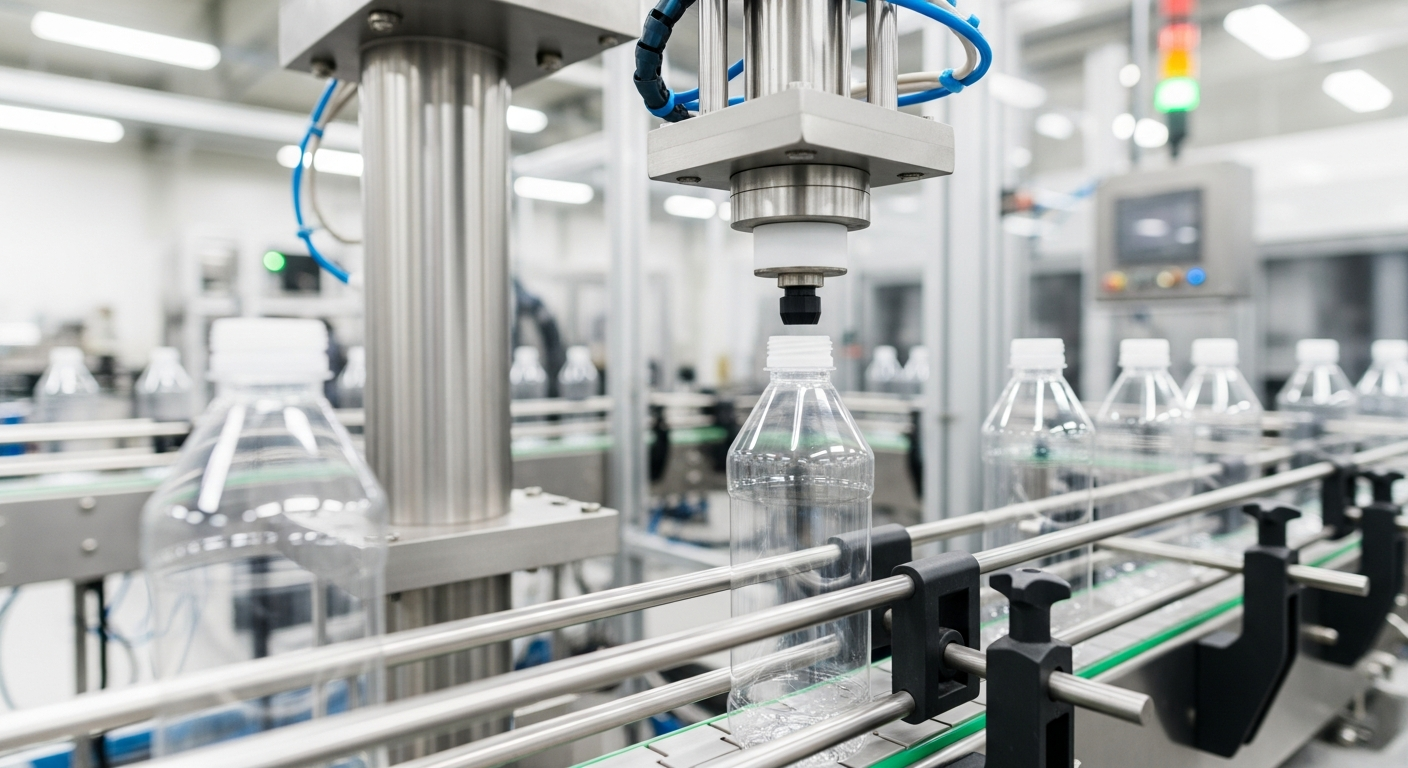
It is 2026. While the industry buzzes about Generative AI, the reality for most plastics and packaging manufacturers is far less glamorous but infinitely more critical: your line is likely operating with 15–20% lower capping line efficiency due to micro-stops that no one is tracking. For example, the capping station is a critical downstream asset that, if not maintained, can back up the Filler—the line's designed constraint—causing throughput loss. If the filler stops, the capper waits. If the labeler jams, the capper backs up. But often, the capper itself is the culprit—torque faults, missing caps in the chute, or misaligned bottles—with ripple effects up the line. This article focuses in on lines with frequent capping station issues, where leaders suspect the capping station is holding back overall line efficiency.
For the strategic operations executive—the person tasked with standardizing metrics across multiple plants—the challenge isn't a lack of technology. It's a lack of maturity in how that technology is applied. You have a fleet of mixed vintage equipment across your factories, meaning that Plant A might have a brand-new rotary capper, while Plant B has a 25-year-old inline capper. Legacy machines often lack Ethernet ports, and newer machines often require complex integration to expose their data. Trying to get unified, actionable data from these disparate assets often leads to "pilot purgatory," where complex integration projects go to die.
This article cuts through the hype. We aren't looking at theoretical "smart factory" concepts; we are looking at the pragmatic shortlist of capping line monitoring and OEE monitoring solutions that actually deliver scaled ROI in 2026.
The Shortlist: Capping Line Efficiency and Packaging Monitoring Platforms
We have categorized the top contenders for 2026 into three buckets: FactoryOps Platforms (Universal & Fast), Legacy/SCADA Heavyweights (Deep & Complex), and Asset Health Specialists (Vibration & Condition).
1. Guidewheel: The FactoryOps Platform
Best For: Rapid, standardized deployment across mixed equipment fleets without IT headaches.
Guidewheel takes a distinct "FactoryOps" approach. Rather than requiring complex integrations with PLCs (Programmable Logic Controllers), it uses non-invasive, clip-on sensors to measure the power draw of any machine—from a 1980s capper to a 2026 servo-driven unit. Algorithms interpret that electrical heartbeat to determine how the machine is running, giving visibility into true operating state rather than just energy use.
Why it stands out for Packaging Lines with Capping station issues:
Universal Compatibility: Because it measures power, it works on any equipment. You don’t need to call the OEM to unlock a controller password, and the system interprets the current signal to identify cycles, stops, and other behavior operators actually care about.
No Facility Internet Reliance: A critical differentiator is that Guidewheel's hubs do not require a connection to the facility's internal internet to populate dashboards. This bypasses the rigorous, slow IT security approvals that kill most factory digitization projects.
Micro-stop Detection: The high-frequency sampling captures the split-second drop in power when a capper jams and an operator clears it. This reveals the "hidden factory" losses that manual logs miss.
The Evidence:
In a survey of industrial users, customers reported a 76% increase in uptime on monitored machines (Source: UserEvidence Survey via Guidewheel Customer Research). For capping operations where margins are thin, this visibility allows teams to attack the root causes of downtime—typically changeovers and minor jams—rather than guessing.
It is a very good system and flexible so that you can use it in different manufacturing applications.
Juan Flores, Plant Manager, Leigh Fibers via Guidewheel's Customer Research
The Rub:
Power-based monitoring gives you machine state (running, idle, stopped) but not the granular alarm codes that a direct PLC connection would provide. For most capping stations, knowing that you stopped and how often is 90% of the value. But if you need to know the exact fault code from the servo controller, you will still need operator input or a complementary integration.
2. Vorne: The Hardware Specialist
Best For: Single-line visibility where a physical scoreboard is the priority.
Vorne is a staple in the industry, known for its XL Productivity Appliance. It combines a large LED scoreboard with a web-based interface.
Strengths:
Visual Management: The physical scoreboard is excellent for operator awareness on the floor.
Simplicity: It does one thing—OEE tracking—very well.
The Rub:
Scaling Vorne across multiple plants can become a hardware management challenge. It requires physical installation and wiring into sensors or relays for every single asset.
Upscaling for a large corporation can be tricky. We are fortunate to have a lot of talented people that can help implement and train on the Vorne system.
Aaron J., Global Seed Operations Center Leader, Capterra
For the "Standardizer," the requirement for talented local staff to manage the hardware at every site can be a bottleneck to rapid scale.
3. Redzone: The Workforce & Culture Platform
Best For: Organizations focusing on "culture change" and frontline communication over pure machine data.
Redzone focuses heavily on the "people" side of the People-Process-Technology triangle. It gamifies production and encourages collaboration via iPads on the floor.
Strengths:
Operator Engagement: Excellent for huddles and communication.
Compliance: Good for integrating quality checks with production data.
The Rub:
It is a heavy lift. It changes how people work, which is good but disruptive. Furthermore, user feedback suggests the UI can sometimes hinder rather than help flow.
Some of the data sheets are not super intuitive to use. Wish the timers on compliance checks were more visual...
Katharine, Software Advice
4. MachineMetrics: The High-Frequency Specialist
Best For: CNC and discrete manufacturing where millisecond-level data is required.
MachineMetrics originated in the CNC world. It excels at pulling high-frequency data directly from machine controls.
Strengths:
Deep Data: Can pull load, torque, and specific alarm codes directly from modern PLCs.
Diagnostics: Great for understanding why a servo failed.
The Rub:
For packaging lines and capping stations in particular, this level of granularity can be overkill and difficult to implement on legacy equipment and analog cappers. It often requires complex integration that slows down multi-site rollouts.
5. Inductive Automation (Ignition): The SCADA Giant
Best For: Engineering-heavy organizations that want to build a completely custom solution.
Ignition is a platform, not just a product. You can build anything with it.
Strengths:
Limitless Customization: If you can dream it, you can script it.
Licensing: Unlimited tag pricing model appeals to massive sites.
The Rub:
"Limitless customization" is often a euphemism for "limitless engineering hours." For an operations executive wanting standardized KPI reporting now, Ignition projects can easily turn into 18-month development cycles.
6. Amper: The Electrical Monitor
Best For: Simple machine utilization tracking.
Amper uses electrical monitoring to track machine activity. It is a viable alternative for basic tracking.
Strengths:
Non-invasive: It avoids PLC coding.
Focus: Strong focus on utilization metrics.
The Rub:
While effective for basic uptime, the depth of "FactoryOps"—connecting that data to financial outcomes and broader team workflows—is where differences in platform maturity often show.
7. The Asset Health Specialists: Augury, AssetWatch, Neuron Soundware, IPercept
Best For: Condition Monitoring (Predictive Maintenance), not OEE.
It is critical to distinguish these from the solutions above. Augury, AssetWatch, Neuron Soundware, and IPercept primarily use vibration and sound analysis to predict component failure (e.g., "This motor bearing will fail in 2 weeks").
Augury & AssetWatch: Excellent for protecting critical assets like the main drive motor of a high-speed capper.
Neuron Soundware & IPercept: Use audio/AI to detect anomalies.
The Verdict: These are complementary, not competitive, to OEE software. You buy these to prevent catastrophic failure; you buy Guidewheel or Vorne to improve daily flow and reduce micro-stops.
Feature Comparison: Evaluating Packaging Monitoring Platforms and Conveyor Monitoring Solutions
Feature | Guidewheel | Vorne | Redzone | MachineMetrics | Ignition |
|---|---|---|---|---|---|
Primary Data Source | Clip-on Sensors (Power) | Wired Sensors / Relays | Manual / Integrated | Direct PLC / I/O | Direct PLC / SCADA |
Deployment Speed | Days (Plug & Play) | Weeks (Wiring needed) | Months (Culture change) | Weeks/Months | Months/Years |
Legacy Compatibility | Universal (Any age) | High (Sensor based) | Variable | Low (Needs controls) | Variable |
Facility Internet Required? | No | Yes | Yes | Yes | Yes |
Best For | Scale & Speed | Visual Factory | Culture/Workforce | CNC/Deep Data | Custom Engineering |
The Future of Packaging Line Efficiency: Visibility at the Speed of Production
In the high-volume world of plastics and packaging, the margin for error is measured in seconds. A capping station that stutters due to micro-stops or jams isn't just a capping station performance problem; it is a direct leak in profitability. The reality for most manufacturers is a mixed fleet—legacy equipment running alongside modern machines—where data is trapped in silos or lost entirely to manual logs. You cannot optimize what you cannot see, and in a sector where throughput is king, invisibility is a risk you can no longer afford.
The shift required for 2026 is not about buying more expensive machinery; it is about improving packaging line efficiency with the assets you already have. It is about empowering the plant manager and the operator with the same truth. When you treat productivity and sustainability as a single goal—reducing the energy intensity per bottle by simply keeping the line running—you unlock a flywheel of efficiency. The technology to achieve this exists today, and it does not require a multi-year engineering project. It requires a pragmatic decision to turn the lights on across your entire operation.
Recover Lost Capacity on Your Capping Lines
You now have a clear view of what “good” monitoring looks like: real-time visibility into run/idle/down, clear downtime reasons, and a shared source of truth across lines and plants. The next step is to put it to work on your own capping room.
Guidewheel’s FactoryOps platform gives your teams that live view of OEE, downtime, and throughput, plus practical tools—scoreboards, alerts, and simple operator dashboards—to act on it in the moment. No overhaul, no long change-management program.
Book a demo to walk through your capping operations, see where capacity is hiding today, and build a low-risk rollout plan that fits your plants.
About the Author
Lauren Dunford is the CEO and Co-Founder of Guidewheel, a FactoryOps platform that empowers factories to reach a sustainable peak of performance. A graduate of Stanford, she is a JOURNEY Fellow and World Economic Forum Tech Pioneer. Watch her TED Talk—the future isn’t just coded, it’s built.