No items found.
blog
How Production Tracking Software Improves OEE for Industrial Mixers and Blenders in Consumer Goods Plants in 2026
By: Guidewheel
Updated:
December 19, 2025
8 min read

In the high-stakes environment of Consumer Goods manufacturing, the mixer often acts as the heartbeat of the production line. Whether blending ingredients for food products or compounding chemicals for household goods, the efficiency of this batch process dictates the rhythm for every downstream operation. However, recent data indicates a significant visibility gap in how these assets perform compared to the broader production floor.
While general household goods manufacturing lines demonstrate high continuity, mixing and blending equipment frequently operates with significant unmeasured capacity. For plant managers and operations directors, bridging this gap requires moving beyond manual logs to automated production tracking.
This analysis explores recent industry performance data to highlight specific opportunities for optimizing mixer OEE (Overall Equipment Effectiveness) using real-time insights.
How Production Tracking Software Improves OEE for Industrial Mixers and Blenders in Consumer Goods Plants in 2026
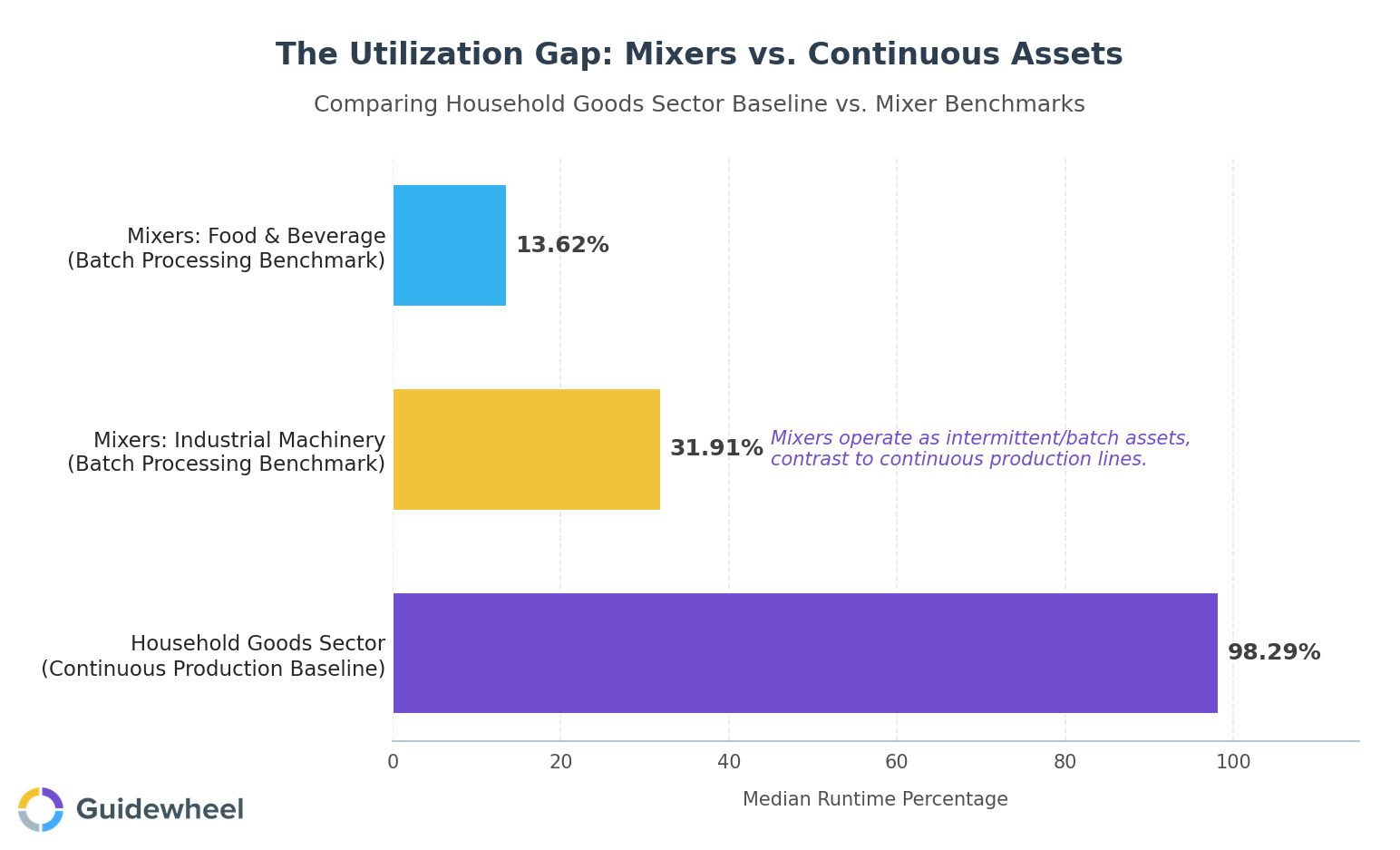
Figure 1: This visualization validates that Mixers typically operate as batch processing assets rather than continuous throughput machines. (Source: Guidewheel Performance Analysis, n= over 0.3 million machine-minutes).
The Utilization Gap: Continuous Lines vs. Batch Mixing
Recent performance data reveals a distinct operational contrast between general Consumer Goods production lines and mixing assets. In the Household Goods sector, the median runtime for general production assets is exceptionally high at 98%. This suggests that once the main lines are running, they are designed to stay running, minimizing disruption to meet high-volume demand (Source: Guidewheel Performance Analysis).
However, when analyzing Mixers and Blenders specifically, the utilization profile changes dramatically:
Industrial Machinery Mixers: Median runtime of 32%.
Food & Beverage Mixers: Median runtime of 14%.
Chemical Mixers: Median runtime near 0% (indicating frequent standby/idle status).
(Source: Guidewheel Performance Analysis)
This disparity highlights a critical operational reality: Mixers often function as "intermittent" assets in a continuous world. They run in batches, wait for loading, wait for quality checks, or sit idle while downstream packaging lines catch up.
For operations directors, this low utilization is not necessarily a failure, but it represents a "Hidden Factory" of potential capacity. If a mixer is only running 32% of the time, even small improvements in changeover efficiency or scheduling can unlock significant throughput without purchasing new equipment.
Analyzing Downtime Drivers in Mixing Operations
To improve OEE, plant leaders must understand why equipment stops. The data indicates that downtime characteristics differ significantly depending on the asset type.
1. High-Severity, Low-Frequency Events (General Assets)
In the broader Household Goods sector, the primary loss driver is Electrical & Controls issues.
Impact: These account for nearly 93% of total recorded downtime duration.
Duration: These events are long, averaging roughly 4.1 hours per incident.
Frequency: They occur infrequently (0.2 events per shift).
(Source: Guidewheel Performance Analysis)
This profile suggests that for general assets, the main threat to OEE is a significant control failure that takes hours to troubleshoot.
2. Cumulative Impact of Frequent Stops (Mixers & Blenders)
For Mixers, the data paints a different picture. The primary loss driver is often categorized as "Other" or "Operational."
Context: Unlike the clear electrical failures in general assets, mixers exhibit uncategorized operational downtime.
Operational Reality: This "Other" category typically hides process inefficiencies: waiting for raw materials, extended cleaning cycles between batches, or manual loading delays.
Duration: These events are often shorter but far more frequent. For example, "Other Operational" stops in household goods averaged just 25 minutes.
(Source: Guidewheel Performance Analysis)
This data underscores the necessity of Production Tracking Software. Manual logs rarely capture 25-minute operational delays accurately. Operators might record a "breakdown," but they rarely log "waiting 15 minutes for ingredients." Yet, in a low-utilization asset like a mixer, these micro-stops are exactly where OEE metrics are determined.
Addressing the "Hidden Factory" with Real-Time Monitoring
The data indicates that while main lines run continuously, mixers operate in bursts. This intermittent nature makes them difficult to monitor with traditional "clip-board" methods. Real-time monitoring bridges this gap by providing truthful, granular data on machine behavior.
From Reactive to Proactive Operations
The Performance Analysis reveals that electrical issues can take over 4 hours to resolve. Implementing condition monitoring can help detect current spikes or voltage irregularities before the hard failure occurs, potentially converting a 4-hour unplanned outage into a 30-minute planned maintenance event (Source: Guidewheel Performance Analysis).
Solving the "Other" Downtime Mystery
The high prevalence of "Other" downtime in mixing operations is a signal that process visibility is lacking. Production tracking software allows operators to categorize these stops in real-time. By tagging a stop as "Ingredient Wait" or "Quality Check" rather than leaving it uncategorized, management gains the Pareto chart needed to attack the true root causes of inefficiency.
Guidewheel: Purpose-Built for Consumer Goods Operations
For Consumer Goods manufacturers, the goal is not just to collect data but to empower the FactoryOps teams—the people closest to the work—to make better decisions. Guidewheel offers a monitoring solution specifically designed to address the intermittent, batch-heavy nature of mixing operations identified in the analysis.
1. Universal Compatibility for Diverse Fleets
As the data shows, mixing assets vary widely across sectors (Chemical, Food, Industrial). Guidewheel utilizes non-intrusive, clip-on sensors that work on any machine, regardless of age or manufacturer. This is critical for plants running legacy mixers alongside modern packaging lines. The sensors measure the "heartbeat" (current draw) of the machine, distinguishing between a mixer that is simply idling and one that is actively processing a batch.
2. Converting "Other" into Actionable Insight
The analysis highlighted that "Other" operational losses are a major drag on mixer performance (Source: Guidewheel Performance Analysis). Guidewheel’s interface allows operators to easily tag downtime reasons directly at the machine. This converts vague "operational loss" data into specific categories like "Cleaning," "Loading," or "Changeover," enabling targeted CI (Continuous Improvement) projects.
3. Support for Hybrid Connectivity
Recognizing that not every corner of a factory has perfect Wi-Fi, Guidewheel is designed to operate via cellular hubs where necessary, ensuring that even isolated mixing rooms can be connected to the central dashboard. This flexibility ensures no asset is left in a "blind spot."
4. Reducing the Electrical Downtime Impact
With electrical faults driving the longest downtime events (4+ hours) in the sector (Source: Guidewheel Performance Analysis), Guidewheel’s ability to monitor power characteristics provides an early warning system. By alerting maintenance teams to abnormal amperage draws, facilities can address developing motor or control issues before they result in line stoppages.
Getting Started: A Humble Approach to Optimization
The path to improved OEE begins with accurate baselining. The data suggests that while 98% runtime is possible for some assets, mixers often operate well below 40% (Source: Guidewheel Performance Analysis).
Operations leaders should view these benchmarks not as judgments, but as reference points. A mixer running at 32% utilization may be perfectly aligned with current demand, or it may be a massive bottleneck. The only way to know the difference—and to improve—is to track the reality of production in real-time.
Start Optimizing Your Operations
Transforming your mixing operations starts with visibility. By understanding exactly when and why your equipment stops, you can unlock hidden capacity without major capital expenditure.
"We had our best month of the year, increasing production [by 11K cases]. I attribute this to Guidewheel. Being able to see downtime data and address downtime reasons directly correlates to higher production."
Michael Palmer, VP of Operations, Direct Pack via Guidewheel's Customer Research
Take the first step toward data-driven manufacturing. Book a Demo to see how Guidewheel can work for your facility.
About the Author
Lauren Dunford is the CEO and Co-Founder of Guidewheel, a FactoryOps platform that empowers factories to reach a sustainable peak of performance. A graduate of Stanford, she is a JOURNEY Fellow and World Economic Forum Tech Pioneer. Watch her TED Talk—the future isn’t just coded, it’s built.