No items found.
blog
2026 Guide: How Press Brake Monitoring Systems Improve OEE and Downtime Tracking in Metal Fabrication
By: Guidewheel
Updated:
December 19, 2025
10 min read

The gap between perceived operational efficiency and actual machine performance is often the single largest reservoir of untapped value in steel and metals manufacturing. For plant managers and operations directors, bridging this gap requires moving beyond gut feeling to a strategy based on empirical evidence.
Recent performance data highlights a significant opportunity. Analysis based on Guidewheel's sensors over the last few months, between September and November 2025—covering a dataset of n=2.5 million machine-minutes within the Industrial Machinery sector—reveals that while the median runtime for press equipment sits at approximately 20%, top-quartile performers achieve utilization rates of over 52% (Source: Guidewheel Performance Analysis). This differential suggests that many facilities possess hidden capacity that can be unlocked without capital-intensive equipment purchases.
This guide analyzes current industry performance benchmarks, identifies the specific operational friction points unique to metal fabrication, and outlines how real-time monitoring systems turn raw data into actionable intelligence for press brake operations.
The Utilization Gap: Defining "Good" Performance
Benchmarking is critical for setting realistic targets. However, generic manufacturing benchmarks often fail to account for the high-mix, low-volume reality of many steel and metals operations. The recent data provides a specific look at press and bender performance within this sector.
2026 Guide: How CNC Press Brake Monitoring Systems Improve OEE and Downtime Tracking in Metal Fabrication
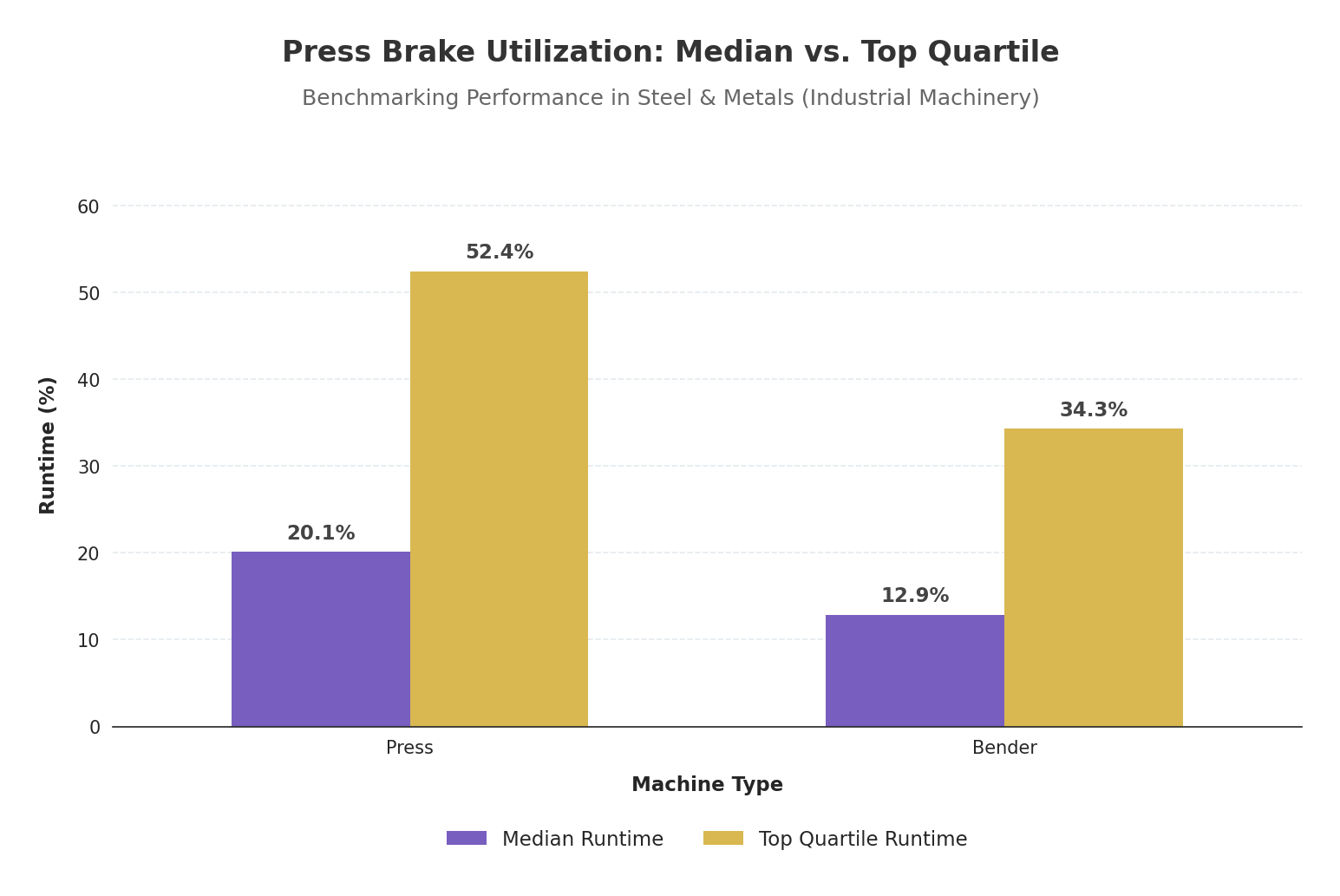
(Source: Guidewheel Performance Analysis, n=2.5 million machine-minutes)
The data reveals a distinct separation between average and top-tier performance:
- Stamping Press Operations: The median runtime is 20.1%, while top-quartile performers achieve 52.4%.
- Press Brake/Bending Operations: The median runtime is 12.9%, with top performers reaching 34.3%.
(Source: Guidewheel Performance Analysis)
These figures serve as crucial reference points. A facility operating at 25% utilization might feel inefficient compared to continuous process industries, but in the context of high-mix metal fabrication, they may be outperforming the median. However, the data also highlights that top performers are achieving more than double the runtime of the median. This gap represents "hidden capacity"—production potential that exists within current assets but is lost to unmeasured inefficiencies.
It is important to acknowledge that every facility operates under unique constraints. A job shop handling complex, bespoke prototypes will naturally have lower utilization than a contract manufacturer running high-volume brackets. These benchmarks should be viewed as directional indicators rather than universal mandates.
Where Does the Time Go? Analyzing Downtime Drivers
To close the gap between median and top-quartile performance, operations leaders must understand exactly where time is being lost. The data analysis breaks down the primary drivers of downtime in the sector.
1. Market-Driven Availability (No Business/Orders)
The largest single category for downtime is "No Business/Orders," accounting for approximately 49% of recorded downtime (Source: Guidewheel Performance Analysis). While often viewed negatively, this metric actually provides strategic clarity. It indicates that for many manufacturers, the challenge is not machine capability but rather market demand or scheduling alignment. It suggests that many facilities are carrying excess capacity, which allows for aggressive lead times but requires careful cost management.
2. Staffing Issues
This is a critical insight for press brake operations. "Staffing Issues" account for 19.5% of downtime across the sector (Source: Guidewheel Performance Analysis). Notably, for Benders specifically, this is the primary loss driver (Source: Guidewheel Performance Analysis).
- The Implication: Bending and forming operations are highly skill-dependent. When a skilled operator is unavailable, the machine often sits idle because cross-training for complex press brake work is difficult.
- The Opportunity: Remote monitoring tools can help supervisors identify when machines are idle due to staffing gaps immediately, allowing for dynamic reallocation of resources.
3. Other Operational Factors
Accounting for 8% of downtime, this category includes start-ups, feeding issues, and material handling delays (Source: Guidewheel Performance Analysis). These are often "micro-stops" that go unreported in manual logs but accumulate to significant lost time over a shift.
4. Maintenance and Mechanical Breakdowns
Combined, Maintenance (7.6%) and Mechanical Breakdowns (6.8%) account for roughly 14.4% of downtime (Source: Guidewheel Performance Analysis).
- Mechanical Breakdown Duration: These events average roughly 35 minutes, suggesting frequent, minor mechanical nuisances (jams, trips) rather than prolonged failures (Source: Guidewheel Performance Analysis).
- Strategy: Because these stops are frequent but short, they are prime candidates for predictive maintenance strategies that detect wear patterns before they force a stop.
Bridging the Gap with Real-Time Monitoring
The data presented—specifically the 322% variation in changeovers and the impact of staffing on bender uptime—highlights challenges that manual tracking cannot solve. Manual logs rarely capture the granularity of a 35-minute mechanical stop or the exact duration of a changeover spread. This is where modern monitoring solutions bridge the gap.
From Data to Actionable Strategy
Implementing a monitoring system like Guidewheel directly addresses the inefficiencies identified in the performance analysis. By utilizing simple, clip-on sensors that measure the current draw of the machine, the system bypasses the need for complex integration with legacy PLCs. This is particularly vital in Steel & Metals, where a facility might run a brand-new electric press brake alongside a hydraulic system from the 1990s.
Solving Specific Industry Challenges
- Standardizing Changeovers: By automatically tracking when a machine enters a changeover state and when it resumes production, management gains visibility into the "322% spread." This data allows teams to identify which shifts or operators have mastered the quick setup and replicate their techniques across the workforce.
- Addressing Staffing Gaps: With staffing being a top downtime driver for benders (Source: Guidewheel Performance Analysis), real-time "FactoryOps" visibility allows managers to see instantly if a critical asset is idle. This enables rapid decision-making—if an operator is absent, work can be rerouted, or a supervisor can step in, ensuring the bottleneck asset doesn't stall production.
- Reducing Micro-Stops: The data indicates mechanical breakdowns average 35 minutes (Source: Guidewheel Performance Analysis). Guidewheel’s proprietary algorithms analyze the machine's "heartbeat" (electrical signature) to detect micro-stops and anomalies that often precede these breakdowns. This moves maintenance from a reactive "fix it when it breaks" model to a proactive approach.
Universal Compatibility and Connectivity
A key differentiator for Guidewheel is its ability to function via cellular networks, eliminating the security and logistical hurdles of connecting industrial equipment to a facility's internal Wi-Fi or ethernet. This ensures that every machine—regardless of age, make, or model—can be brought into the same analytical framework. The value lies not just in the hardware, but in the cloud-based platform that translates raw electrical signals into clear narratives about uptime, cycle counts, and energy usage.
Retrofit and Legacy Equipment Monitoring
A common misconception is that OEE tracking requires modern, digital-native equipment. In reality, the "brownfield" nature of most steel fabrication shops—where legacy equipment provides reliable, heavy-duty service—is the perfect environment for retrofit monitoring.
Because solutions like Guidewheel use non-invasive sensors, the age of the press brake is irrelevant. A 30-year-old mechanical press brake can generate the same fidelity of performance data as a modern CNC machine. This capability is essential for calculating a true facility-wide OEE, rather than just optimizing the newest assets while older machines drag down the aggregate performance.
Calculating ROI and Building the Business Case
Investing in monitoring technology requires a clear path to Return on Investment (ROI). Based on the performance data, the ROI case for Steel & Metals is built on three pillars:
- Recovering Lost Capacity: If a facility operating at the median runtime (20.1%) can improve to even the midpoint of the top quartile (36%), they have effectively increased capacity by nearly 80% without buying a new machine (Source: Guidewheel Performance Analysis).
- Stabilizing Labor Impact: By reducing the impact of staffing shortages through better visibility, facilities protect throughput even when labor is tight.
- Scrap and Energy Reduction: Consistent changeovers and optimized cycle times reduce the material waste associated with trial-and-error setups and the energy costs of idling hydraulic motors.
While results vary based on unique operational requirements, the low cost of entry for clip-on monitoring solutions typically results in a payback period measured in weeks, not years.
Start Optimizing Your Operations
The data indicates that the barrier to world-class performance in Steel & Metals is not a lack of machinery, but a lack of visibility. By understanding the specific drivers of downtime—from inconsistent changeovers to staffing constraints—and applying real-time monitoring to expose them, manufacturers can unlock significant value.
Michael Sanchez, Industrial Metal Supply.With the updated Scoreboard, our supervisors quickly got up to speed. We review it together, and it’s already helping day-to-day.
To see how much hidden capacity is waiting in your press brake operations, book a demo with Guidewheel today.
About the Author
Lauren Dunford is the CEO and Co-Founder of Guidewheel, a FactoryOps platform that empowers factories to reach a sustainable peak of performance. A graduate of Stanford, she is a JOURNEY Fellow and World Economic Forum Tech Pioneer. Watch her TED Talk—the future isn’t just coded, it’s built.