No items found.
blog
Packaging Line Efficiency Benchmarks for Plastics Plants
By: Guidewheel
Updated:
December 19, 2025
8 min read

The reality of managing a plastics and packaging plant today is navigating the tension between high-speed production targets and the mechanical realities of capping and sealing equipment. While the filler dictates the theoretical line speed, the capping station is often the primary cause of unplanned stops that reduce total line throughput.
To understand exactly where efficiency is lost in these critical operations, we analyzed specific production data based on Guidewheel's sensors over the last few months, between September and November 2025. This analysis covers specific areas within Plastics & Packaging manufacturing represented in our dataset (representing 35.6 million machine-minutes), focusing on downstream packaging assets, including capping and sealing stations.
The following benchmarks and insights are derived directly from this sensor data, providing a realistic look at current industry performance patterns rather than theoretical maximums.
2026 Bottle Capping Efficiency Benchmarks for Plastics & Packaging Plants
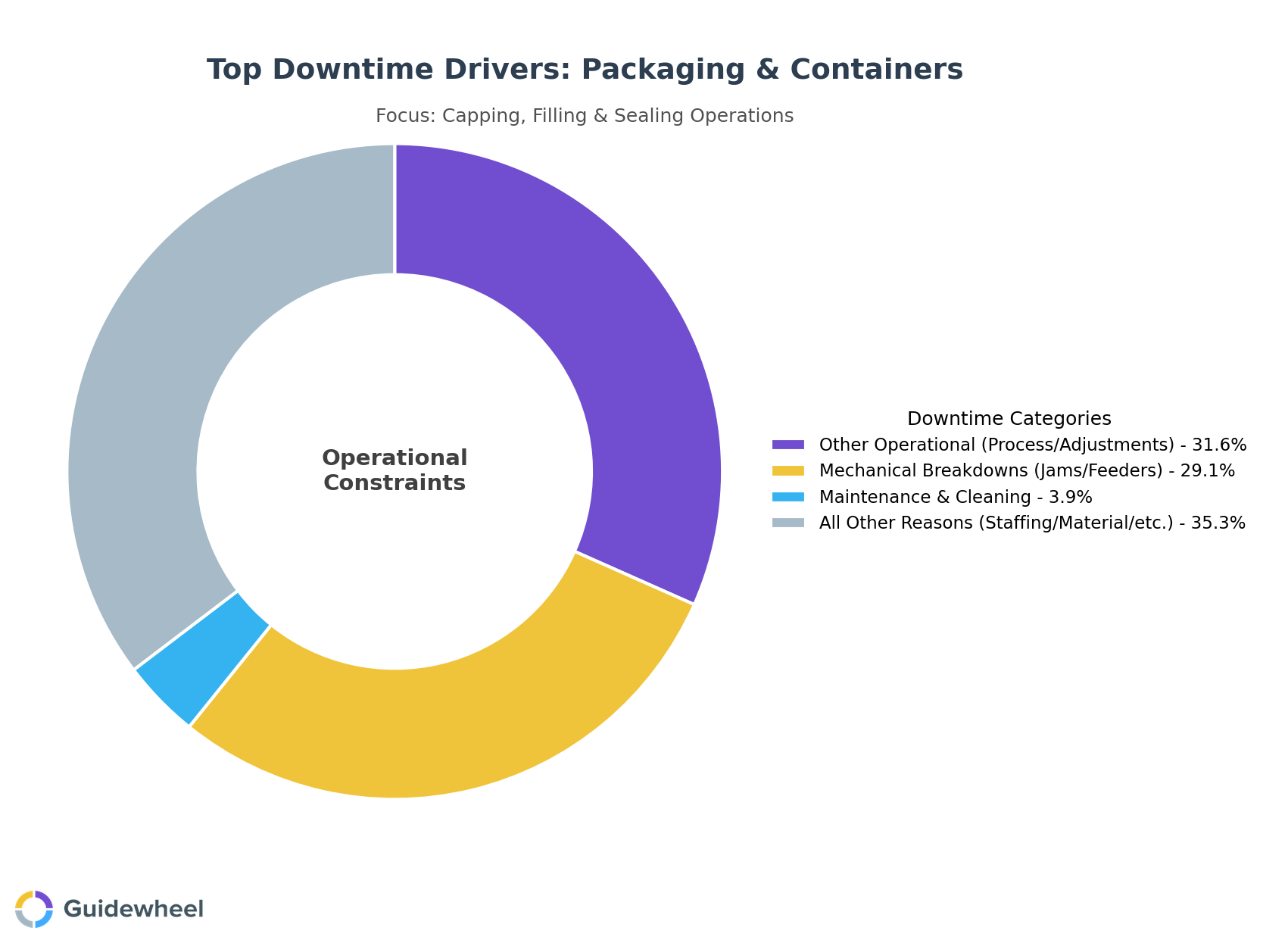
Figure 1: Primary downtime drivers for Packaging & Containers equipment. (Source: Guidewheel Performance Analysis, n=35.6 million machine-minutes).
Changeover Efficiency: A Major Opportunity
Changeovers remain a complex challenge in Plastics & Packaging, particularly when compared to other high-volume industries. The data highlights substantial variability in how long it takes to switch capping lines between SKUs.
Duration Benchmarks: The median changeover time for packaging lines in this sector is 31.0 minutes.
Variability: The spread between changeovers is high (216%), indicating a lack of standardized processes. Some shifts execute changeovers rapidly, while others record longer setup and calibration durations (Source: Guidewheel Performance Analysis).
Industry Comparison: For context, similar equipment in the Food & Beverage sector achieves a median changeover of 10.0 minutes. This suggests that while material constraints differ, there is likely significant room for improvement in Plastics & Packaging through Single-Minute Exchange of Die (SMED) methodologies (Source: Guidewheel Performance Analysis).
Reducing this gap requires moving beyond "we've always done it this way" and looking at how mechanical adjustments on capping heads and rails can be standardized to reduce the reliance on "tribal knowledge."
Analyzing the "Big Rocks" of Capping Downtime
To improve OEE (Overall Equipment Effectiveness) on capping lines, we must look beyond the generic "downtime" label. The sensor data dissects stoppages into specific categories, revealing where maintenance and operations teams should focus their limited resources.
Other Operational Issues (32%)
The leading cause of downtime in the analyzed set, accounting for roughly 32% of losses, falls under "Other Operational" issues. These events have an average duration of approximately 81 minutes (Source: Guidewheel Performance Analysis).
In capping operations, this category often captures process anomalies that don't fit neatly into "mechanical failure." These include:
Micro-stops: Brief interruptions where the machine is idle but not broken, often due to sensor misalignments or minor jams that operators clear quickly but repeatedly.
Setup Adjustments: Time spent tweaking torque settings or rail widths after a changeover has officially "ended" but the line isn't running at rate.
Process Anomalies: Uncategorized stops that often point to a need for better operator training or standardized operating procedures.
Mechanical Breakdowns (29%)
Mechanical failures account for 29% of downtime, with an average duration of 53 minutes per event. While less frequent than operational pauses, they are more disruptive to the maintenance schedule (Source: Guidewheel Performance Analysis).
Specific to capping and sealing, the data and operator notes point to recurrent physical issues:
Feed System Jams: Explicit references to "cap feeder jam" and "chute jam" appear frequently. The cap sorting bowl and chute are notorious reliability pinch points.
Wear and Tear: Capping heads and chucks are high-wear components. When they drift out of spec, they cause cross-threading or missed caps, leading to stoppages.
Component Failure: Belts, motors, and sensors in the packaging line are subject to high stress and repetitive motion.
Maintenance & Cleaning
Planned maintenance and cleaning strategies vary significantly across the sector. In the broader plastics segment, this accounts for over 11% of downtime with very long durations (averaging over 200 minutes). However, in the specialized packaging sub-segment, this drops to under 4% (Source: Guidewheel Performance Analysis).
This variance suggests that some facilities may be running capping machines to failure rather than employing preventative strategies, or that cleaning cycles are being compressed to meet demand. While reducing planned downtime seems positive, if it correlates with the high mechanical breakdown rate (29%), it may indicate a need to rebalance proactive maintenance.
Staffing Challenges
Labor shortages continue to impact operations. Staffing issues account for roughly 5% of downtime in the broader data set. Crucially, when these events occur, they are severe, with an average duration of over 200 minutes (Source: Guidewheel Performance Analysis).
This does not imply a need for replacing operators, but rather for tools that make existing teams more efficient. When a capping line sits idle for three hours because "No Operator" is available, it highlights the need for systems that allow fewer personnel to monitor more assets effectively.
Bridging the Gap: Monitoring Solutions for Capping
The data indicates a clear correlation: facilities with high variability in changeovers and high operational downtime often lack real-time visibility. You cannot fix a 31-minute changeover average if you don't know which shifts are hitting 10 minutes and which are hitting 60.
The Problem with Legacy Capping Machines
A common barrier to improvement is the age of the equipment. Many capping machines in plastics plants are reliable workhorses that predate the internet. They lack Ethernet ports or advanced PLCs, making data extraction difficult. This leads to manual tick-sheets, which are often inaccurate and provide data too late to save a shift.
How Real-Time Visibility Transforms Operations
Modern monitoring platforms, like Guidewheel, address the specific challenges identified in the performance analysis by democratizing access to machine data. Rather than requiring complex IT integration, these solutions focus on the universal language of all machines: power.
Universal Compatibility: By using non-intrusive, clip-on sensors that measure the electrical draw of the machine, operations leaders can get data from a 30-year-old mechanical capper just as easily as a brand-new filling line. This is critical for Plastics & Packaging plants managing mixed fleets of legacy and modern assets.
Addressing Operational Downtime: The 32% "Other Operational" downtime often stems from micro-stops that go unreported. Real-time monitoring captures every second of downtime automatically. When operators can categorize these stops on a tablet, patterns emerge—revealing, for example, that a specific cap size causes 80% of feeder jams.
Standardizing Changeovers: To attack the 31-minute changeover median, monitoring tools allow teams to compare changeover durations across shifts and crews. This data helps identify best practices (who is doing it fastest?) and standardize them, moving the facility closer to the 10-minute benchmark seen in other industries (Source: Guidewheel Performance Analysis).
Connectivity Options: Recognizing that Wi-Fi can be spotty on a factory floor, Guidewheel works effectively via cellular networks or facility internet. This ensures that the "Staffing" downtime (avg 202 minutes) can be mitigated by allowing managers to monitor line status remotely and deploy resources where they are needed most.
From Reactive to Proactive: By analyzing the electrical "heartbeat" of a motor, proprietary algorithms can often detect the increased resistance associated with a failing bearing or a jamming feed screw before a catastrophic mechanical breakdown occurs.
This approach does not aim for "lights out" manufacturing but rather "lights on" intelligence—giving plant managers and maintenance leaders the insights they need to stabilize the process and support their workforce.
Start Optimizing Your Operations
The data reveals that while capping operations face significant hurdles—from low uptime to extended changeovers—these challenges are solvable. By moving from reactive operations to a data-driven approach, you can uncover the hidden capacity already present in your facility.
To see how you can achieve similar results on your capping lines, Book a Demo with the Guidewheel team today.
About the Author
Lauren Dunford is the CEO and Co-Founder of Guidewheel, a FactoryOps platform that empowers factories to reach a sustainable peak of performance. A graduate of Stanford, she is a JOURNEY Fellow and World Economic Forum Tech Pioneer. Watch her TED Talk—the future isn’t just coded, it’s built.