No items found.
blog
Optimizing Blow Molding Conveyor Flow: Monitoring Platforms Compared
By: Guidewheel
Updated:
December 18, 2025
8 min read
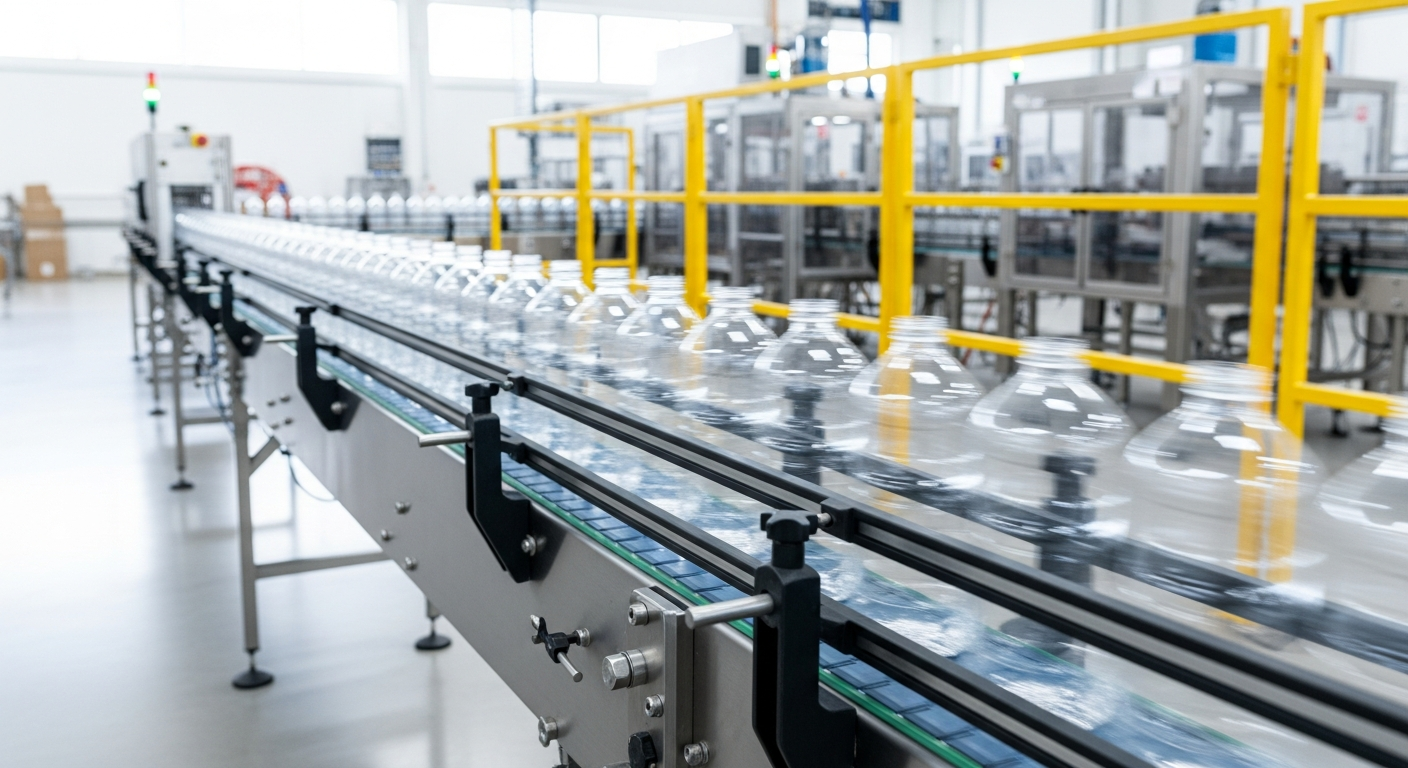
In high-speed blow molding and packaging, your blow molding conveyor systems are the facility's circulatory system. When they stutter, the ripple effect is instant—starving the filling line or backing up the molder. If you are a plant manager in this environment, your days aren't usually derailed by catastrophic motor failures. You are losing the shift to the losses you can't see: the jammed bottle at the diverter, the tipped container at the leak tester, or the sensor obstruction at the wrapper.
These are micro-stops. They happen dozens of times a shift, often lasting only seconds, but they destroy your OEE. Manual logs will never capture them. Operators running high-speed lines simply cannot record every 10-second jam without sacrificing production. To move from reactive firefighting to strategic optimization, you need visibility into the flow, not just the machinery.
Below, we break down the top solutions for tracking flow and stops on plastics packaging conveyors, helping you choose the right tool to reclaim lost capacity.
Top Blow Molding Conveyor Monitoring Solutions Compared
You need a conveyor monitoring solution that works on your specific equipment—whether it's a brand-new high-speed sorting line or a 20-year-old outfeed conveyor with no PLC connection. Below is a comparison of how leading conveyor analytics platforms stack up for the specific needs of plastics and packaging environments.
Feature | Guidewheel | MachineMetrics | Vorne | Redzone | Amper |
|---|---|---|---|---|---|
Installation Method | Non-intrusive Clip-on Sensors | Edge Device / PLC Integration | Hardware (XL Productivity Appliance) | Software / iPad Focus | Clip-on Current Sensors |
Legacy Compatibility | Universal (Works on any age/type) | Requires specific protocols | Universal (via sensors) | Moderate | Universal |
Internet Requirement | None (Cellular Hub) | Facility WiFi/Ethernet | Ethernet | Facility WiFi | Cellular / WiFi |
Primary Focus | FactoryOps & Process Flow | CNC / Machine Data | Visual Scoreboards | Workforce / Compliance | Machine Monitoring |
Deployment Speed | Days | Weeks/Months | Weeks | Months | Weeks |
Guidewheel: The FactoryOps Standard
Guidewheel is built for the operations leader who needs to drive rapid improvements and requires immediate visibility without a complex IT project. It is designed to democratize real-time conveyor belt monitoring by removing the barriers of cost and complexity.
Why it stands out for Plastics & Packaging:
Universal Compatibility: Whether monitoring a vintage belt conveyor or a modern robotic palletizer, Guidewheel uses non-intrusive clip-on sensors. These clip around the power cord of the conveyor motor to capture its electrical “heartbeat.” Algorithms interpret that heartbeat to identify run, idle, and down states—providing operational insight.
No Facility Internet Required: Unlike competitors that clog your plant bandwidth or require complex firewall permissions, Guidewheel hubs use their own cellular connection. The dashboards populate regardless of your facility's internet status.
Micro-Stop Detection: The high-frequency sampling captures the split-second jams typical in bottling and packaging lines that PLC-based systems often smooth over or miss.
FactoryOps Philosophy: It empowers operators to "win the shift" by giving them real-time feedback, rather than just reporting data to management.
Limitations:
While Guidewheel excels at providing immediate visibility across diverse equipment, it focuses on production monitoring rather than deep mechanical diagnostics. For highly specialized applications requiring detailed vibration analysis or acoustic monitoring of specific components, complementary condition monitoring tools may be beneficial.
Customer Impact:
38% increase in uptime on monitored machines
Pack Labs via Guidewheel Customer Research
Vorne (XL Productivity Appliance)
Vorne is a well-established player known for its physical LED scoreboards (the XL devices) that display counts and rates on the factory floor.
Strengths:
Excellent visual management for operators.
Strong focus on simple count and rate data.
Limitations: It is a "builder's kit." If you don't have a dedicated controls engineer or integrator on staff, you can't just "turn it on." For the plant manager juggling daily operational demands, this often means a long implementation timeline before seeing data.
Ensuring everyone is actually using it correctly
Hakon H., Industrial Engineer, Automotive, Capterra
For a plant manager managing multiple lines, managing individual hardware appliances can become a maintenance task in itself.
MachineMetrics
MachineMetrics is a powerhouse in the CNC and machining space, offering deep integration with machine controls.
Strengths:
Deep data extraction from modern CNC PLCs.
High-frequency data for tool monitoring.
Limitations: For general conveyor system optimization, the deep PLC integration can be overkill and difficult to deploy on older auxiliary equipment found in packaging lines. It generally requires a more robust IT infrastructure (Edge devices connected to ethernet) compared to cellular-based solutions.
Redzone
Redzone focuses heavily on the "social" aspect of manufacturing—connecting workers via iPads and chat functions to drive productivity.
Strengths:
Great for operator engagement and communication.
Strong compliance and huddle modules.
Limitations: It is often viewed as rigid in its workflow. For a dynamic plastics plant, flexibility is key.
there are some limitations when we do compliance module, for example each check must be linked to a production run or we wouldn't be able to sign off. We can only copy data sheets and we can't copy triggers!
Barbara, Software Advice
Inductive Automation (Ignition)
Ignition is a SCADA platform that allows you to build almost anything.
Strengths:
Infinite customizability.
One central platform for SCADA and MES.
Limitations: It is a "builder's kit." If you don't have a dedicated controls engineer or integrator on staff, you can't just "turn it on." For the plant manager juggling daily operational demands, this often means a long implementation timeline before seeing data.
Amper
Amper is similar to Guidewheel in using clip-on current sensors.
Strengths:
Easy installation.
Good for basic machine utilization tracking.
Limitations: Primarily focused on uptime, with a narrower toolset and limited support for detailed conveyor downtime tracking or broader operational workflows.
Condition Monitoring Specialists
These companies (Augury, Asset Watch, Neuron Soundware, IPercept) focus primarily on asset health rather than process flow. They use vibration and acoustic sensors to predict bearing failures or motor burnouts.
Strengths:
Excellent for preventing catastrophic failure of critical large motors.
Deep diagnostics on mechanical health.
Limitations: They tell you if the conveyor is breaking, but not necessarily how it is performing regarding flow. They might miss the "jam" that stops production because the motor is still running fine—it’s just slipping or blocked.
Augury & Asset Watch: Heavy focus on vibration analysis.
Neuron Soundware: Uses audio/sound analysis for diagnostics.
IPercept: Focuses on high-end motion analysis.
For tracking flow and stops to improve OEE, these are often complementary to, rather than replacements for, a production monitoring system like Guidewheel.
The Future of High-Speed Blow Molding and Packaging Flow
In the high-volume world of blow molding, a blow molding conveyor jam is never just a pause. Stops cause significant energy waste and material scrap during the ramp-down and ramp-up phases of the blow molder. The old "run to failure" model is dead; today’s efficiency depends on the continuity of flow, not just machine speed.
The most successful blow molding plants treat conveyors as critical arteries, not auxiliary hardware. By shifting from reactive repairs to proactive flow optimization, you unlock the "hidden factory" without capital expenditure. This is the productivity-sustainability flywheel in action: ensuring every kilowatt and minute spent actually produces value. Visibility into this flow is no longer a luxury—it is the baseline for staying competitive.
Turn Conveyor Noise into OEE Production Gains
Conveyor alarms, jam clears, and micro-stops are all saying the same thing: flow is breaking down. The question is where, how often, and what to do about it.
Guidewheel gives your team real-time visibility into run / idle / down on every key conveyor and downstream asset, so you can see the true impact of blockages, starvation, and slow ramps on OEE. That same view helps operators and leaders align on the few issues that will unlock the most stable, predictable flow.
If you're ready to turn conveyor into a focused improvement plan, Book a demo with Guidewheel today and see the FactoryOps Platform in action.
About the Author
Lauren Dunford is the CEO and Co-Founder of Guidewheel, a FactoryOps platform that empowers factories to reach a sustainable peak of performance. A graduate of Stanford, she is a JOURNEY Fellow and World Economic Forum Tech Pioneer. Watch her TED Talk—the future isn’t just coded, it’s built.