No items found.
blog
How Motor Load Monitoring Cuts Unplanned Downtime in Plastics Regrind Operations
By: Guidewheel
Updated:
December 19, 2025
9 min read

In the modern plastics and packaging facility, the regrind system is the heartbeat of the "productivity-sustainability flywheel." When these systems run efficiently, they reclaim material, reduce waste, and lower material costs, directly funding further operational improvements. However, when a granulator or shredder goes down unexpectedly, it creates a bottleneck that can starve downstream extrusion or molding lines, turning a sustainability asset into a production liability.
To understand the current state of regrind reliability, we analyzed recent performance data captured directly from the factory floor. This article draws on insights based on Guidewheel’s sensors over the last few months, between September and November 2025, covering a sample size of n=0.21 million machine-minutes across relevant manufacturing sectors (Source: Guidewheel Performance Analysis).
While every facility operates under unique contexts—varying by material type, shift structure, and production goals—the data reveals distinct performance patterns. This guide examines those benchmarks and explores how bearing condition monitoring serves as a pragmatic, high-impact strategy to bridge the gap between average performance and top-tier reliability.
The State of Regrind Performance in Plastics & Packaging
Recent performance data highlights a compelling narrative about regrind operations. Unlike standalone machinery in other sectors, granulators in Plastics & Packaging often operate inline with primary production equipment, leading to higher utilization rates but also higher stakes when failure occurs.
Industry Benchmarks and The Utilization Gap
Data indicates that Grinders within the Plastics & Packaging sector achieve a median runtime of 59% (Source: Guidewheel Performance Analysis). This is significantly higher than similar equipment in the Industrial Machinery sector, which benchmarks at 22%. This disparity likely reflects the integrated nature of plastics operations, where regrind systems are essential components of continuous production loops rather than batch-fed auxiliary units.
However, the most critical insight lies in the "Top Quartile Potential."
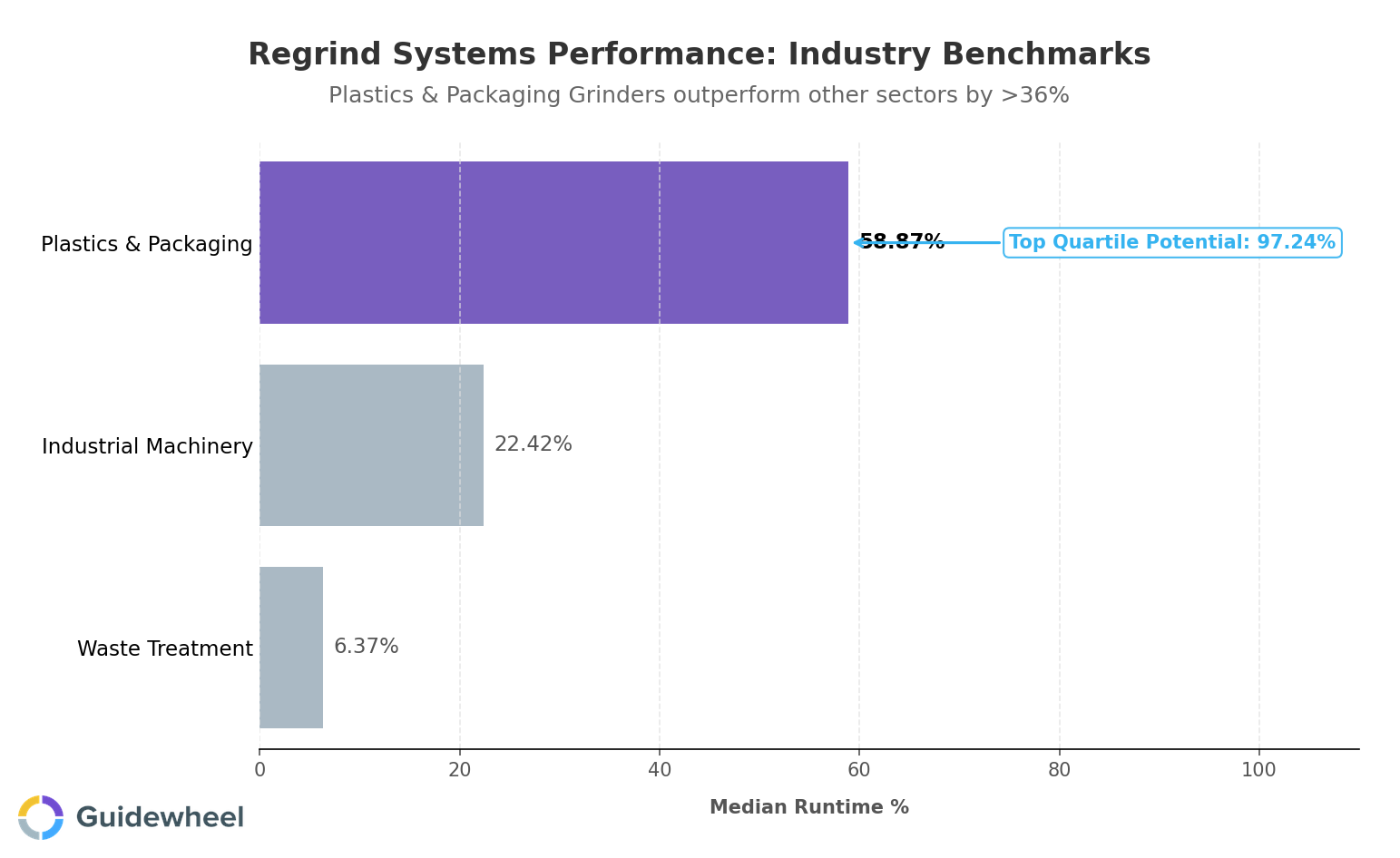
Figure 1: Comparison of median runtime percentages for regrind systems across industries, highlighting the optimization gap in Plastics & Packaging. (Source: Guidewheel Performance Analysis, n=0.21 million machine-minutes)
The top-performing regrind systems in the dataset achieve a runtime of 97% of scheduled time (Source: Guidewheel Performance Analysis). This creates a massive utilization gap between the median (59%) and the top performers. While specific operational requirements vary—some plants run batch processes that naturally limit runtime—this gap suggests that for many facilities, there is significant hidden capacity waiting to be unlocked.
These benchmarks serve as reference points. The goal is not necessarily to run every machine 24/7, but to ensure that when the machine needs to run, it is available and reliable.
Analyzing the Drivers of Downtime
To close the gap between median and top-tier performance, we must understand what stops these machines. The data identifies five primary categories of downtime for regrind systems in Plastics & Packaging.
1. No Business/Orders (65% of Downtime)
The largest statistical share of downtime is attributed to "No Business/Orders," averaging nearly 1,600 hours per year per line (Source: Guidewheel Performance Analysis). This category reflects market demand and production scheduling rather than machine health. While this downtime is "planned" in a sense, it represents idle capital.
2. Maintenance & Cleaning (11% of Downtime)
This is the largest operational loss driver. Events in this category average 3.5 hours in duration (Source: Guidewheel Performance Analysis). In plastics operations, this typically involves time-intensive activities like purging, cleaning screws, or clearing screen blockages. Reducing this time requires process optimization, but it is often a necessary part of the production cycle.
3. Other Operational (9% of Downtime)
Accounting for nearly 2 hours per event on average, this category includes startups, shift changes, and meal breaks (Source: Guidewheel Performance Analysis). These are "soft" losses that often go unnoticed but accumulate significantly over a quarter.
4. Mechanical Breakdowns (5.5% of Downtime)
While mechanical breakdowns account for a smaller percentage of total time than lack of orders, their impact is disproportionately high because they are unplanned.
- Average Duration: ~1 hour per event.
- Impact: These stops disrupt the rhythm of the factory. Common notes in the data cite "Technical," "Upstream Failure," and "Preform Tipping," indicating that regrind systems are often the victim of—or the trigger for—wider line stoppages (Source: Guidewheel Performance Analysis).
5. Staffing Issues (5% of Downtime)
Staffing-related downtime averages over 3 hours per event (Source: Guidewheel Performance Analysis). In an era of skilled labor shortages, this is a critical challenge. However, the solution is rarely about replacing people; it is about equipping the existing workforce with tools that allow them to monitor equipment remotely and prioritize their attention effectively.
Real-Time Monitoring: A Solution for Reliability
To address the mechanical and operational downtime drivers identified in the data, modern plastics facilities are turning to condition monitoring. This technology bridges the gap between the 59% median and the 97% potential by providing visibility into the machine's actual health.
From Reactive to Proactive
Traditional maintenance relies on calendars (e.g., "grease every month") or failure (e.g., "fix it when it smokes"). Condition monitoring uses sensors to track the physical state of the machine.
- Vibration Analysis: Changes in vibration frequency can indicate bearing pitting, misalignment, or looseness weeks before a failure occurs (Source: Treon).
- Amperage (Current) Monitoring: Measures the electrical load on the motor. A spike in amperage often correlates with dull blades or overfeeding, allowing operators to adjust feed rates before the machine jams or trips.
The Guidewheel Approach to Regrind Optimization
Guidewheel approaches this challenge not just as a technology installation, but as a "FactoryOps" enablement strategy. The goal is to make machine data accessible and actionable for the people running the floor.
- Universal Compatibility via Clip-On Sensors One of the distinct advantages of the Guidewheel platform is its ability to monitor any machine—from a brand-new shredder to a 30-year-old legacy granulator—using simple clip-on current sensors. These non-intrusive sensors can be installed in minutes without cutting wires or integrating with complex PLCs. While the sensors measure electrical current, Guidewheel’s proprietary algorithms process this signal to detect the machine's "heartbeat," identifying micro-stops, cycle times, and load variations associated with jamming, overfeeding, dull blades, and motor overload.
- Flexible Connectivity Unlike systems that demand hardwired ethernet or complex IT integration, Guidewheel hubs can utilize cellular connections to transmit data securely. However, for facilities where Wi-Fi or ethernet is readily available, the system fully supports internet connectivity. This flexibility allows plants to bypass common IT bottlenecks and achieve visibility in days, not months.
- Empowering Operators (Not Just Engineers) The data highlights that "Maintenance & Cleaning" and "Staffing" are major downtime drivers. Guidewheel directly addresses this by acting as a digital "sidekick" for operators.
- Real-Time Alerts: If a granulator jams or stops unexpectedly, the system alerts the operator immediately via mobile app or workstation dashboard. This reduces the response time for the 5.5% of mechanical breakdowns.
- Process Visibility: By tracking run/idle/down states, teams can identify if cleaning cycles are taking longer than the 3.5-hour average and standardize best practices to reduce that time.
- Data-Driven Decisions By aggregating data from the clip-on sensors, the platform provides the median and top-quartile context specific to your facility. It moves the conversation from "I think the grinder is the bottleneck" to "Data shows the grinder lost 135 hours to mechanical failure this year."
Implementation Strategy: The PDCA Cycle
For Plant Managers and CI Leaders, implementing this technology should follow a pragmatic, iterative approach.
- Plan (Baseline): Use the data benchmarks provided (59% runtime, 11% maintenance loss) to set realistic targets for your facility.
- Do (Pilot): Deploy monitoring on one critical regrind line. Focus on capturing accurate downtime reasons.
- Check (Analyze): After 30 days, review the data. Are mechanical breakdowns aligning with the 5.5% industry average, or are they higher? Are cleaning times exceeding the 210-minute benchmark?
- Act (Optimize): If motor load trends indicate increased mechanical resistance (dull blades or binding), schedule inspection. If cleaning is the bottleneck, investigate rapid-purge compounds or tool-free screen changes.
Start Optimizing Your Operations
The data indicates that while market demand dictates overall utilization, the reliability of your regrind systems is firmly within your control. Closing the gap between median performance and top-quartile potential requires more than just hard work; it requires the visibility to see problems coming before they stop the line.
By combining robust bearing condition monitoring with a platform that empowers your workforce, you can reduce unplanned downtime, protect your equipment assets, and ensure your sustainability goals translate into operational reality.
Bernie Hogue, Director of Quality and Process Excellence, Anchor Packaging via Guidewheel's Customer ResearchNow that we’re capturing granular data, we gain valuable insights into our operations. Guidewheel helps us take our OEE improvements to the next level, identifying which lines, products, and shifts require attention... With Guidewheel, I’m alerted whenever a machine goes down, allowing us to prevent non-conforming material from reaching the customer.
Ready to unlock hidden capacity in your regrind operations?
About the Author
Lauren Dunford is the CEO and Co-Founder of Guidewheel, a FactoryOps platform that empowers factories to reach a sustainable peak of performance. A graduate of Stanford, she is a JOURNEY Fellow and World Economic Forum Tech Pioneer. Watch her TED Talk—the future isn’t just coded, it’s built.