No items found.
blog
Industry Guide: Monitoring and Optimizing Liquid Filling Systems to Maximize Uptime
By: Guidewheel
Updated:
December 19, 2025
10 min read

In the high-volume world of Consumer Goods manufacturing, liquid filler machines are the heartbeat of the production line. Whether filling beverages, personal care products, or household chemicals, these assets directly dictate throughput and profitability. However, a gap often exists between perceived performance and operational reality. Data indicates that while many operations run smoothly, significant capacity remains hidden behind unmeasured downtime and inefficient changeovers.
To bridge this gap, we analyzed anonymized data from Guidewheel’s sensors over the last few months, between September and November 2025. This analysis covers specific manufacturing areas within Consumer Goods—primarily Packaging & Containers and Food & Beverage—to provide a realistic snapshot of current industry performance. By establishing these benchmarks, plant managers and operations directors can better understand where their facilities stand and identify pragmatic opportunities to "unlock" hidden capacity.
This guide explores the specific performance patterns of filler machines, the primary drivers of downtime, and how real-time monitoring transforms raw data into a "system of action" for frontline teams.
Benchmarking filler machine runtime in consumer goods
Runtime percentage—the proportion of time a machine is actively producing—is a critical metric for assessing asset utilization. The recent performance data reveals a wide range between 'median' performance and 'top-quartile' benchmarks, highlighting the potential for optimization.
Performance variance by sector
The data indicates that filler machines in the Packaging & Containers sector operate with a median runtime of 32.4% (Source: Guidewheel Performance Analysis). However, the top quartile of performers in this same sector achieves a runtime of 86.4% (Source: Guidewheel Performance Analysis).
This 50-percentage-point variance suggests that while the "norm" may involve significant idle time or interruptions, high efficiency is mechanically and operationally achievable. For operations leaders, this gap represents the "hidden factory": capacity that exists but is currently lost to unaddressed inefficiencies.
In the Food & Beverage sector, the median runtime sits at 28.8%, with top performers reaching 57.1% (Source: Guidewheel Performance Analysis). The lower ceiling in this sector often reflects the necessary rigor of sanitation protocols, such as allergen washdowns, which naturally cap theoretical uptime compared to non-food packaging.
The implication of low median utilization
The fact that median runtimes across these Consumer Goods sectors hover around 30% indicates that many filler machines are not running continuously. This aligns with industry observations that OEE (Overall Equipment Effectiveness) scores often cluster around 55-60% globally (Source: Evocon).
For maintenance leaders and plant managers, this data establishes a broader industry context for current utilization levels. However, it also serves as a call to action. Moving from the median to the top quartile does not necessarily require new equipment; rather, it requires visibility into why the machine is stopping and the agility to address those root causes.
Industry Guide 2026: Monitoring and Optimizing Liquid Filler Machines to Maximize Uptime
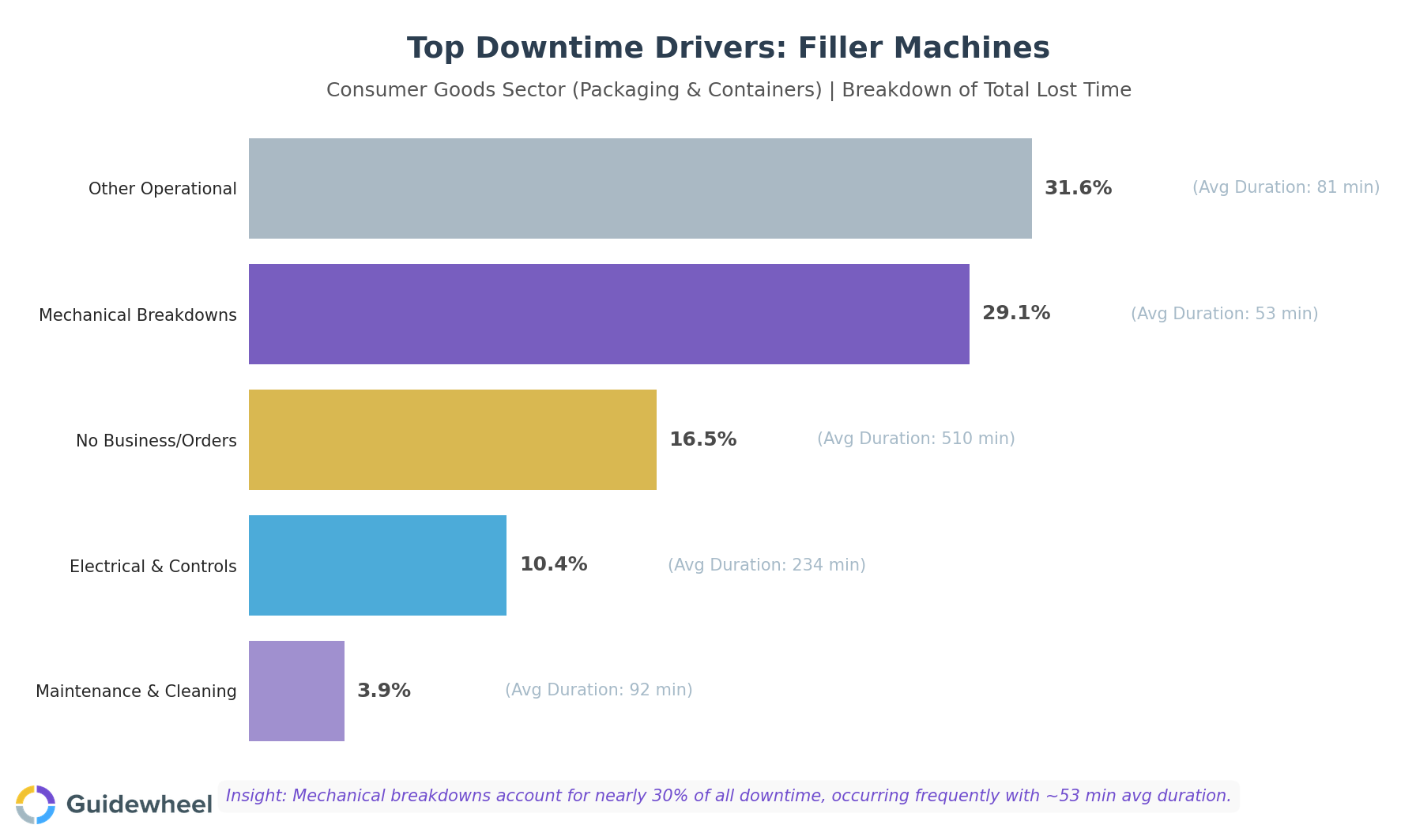
Figure 1: Top downtime drivers for filler machines in the Packaging & Containers industry. (Source: Guidewheel Performance Analysis, n=0.2 million machine-minutes)
Analyzing downtime drivers: Why filler machines stop
To improve uptime, we must move beyond tracking when a machine stops to understanding why it stops. The performance analysis reveals distinct downtime profiles for different segments of the Consumer Goods industry.
Mechanical breakdowns vs. operational adjustments
In the Packaging & Containers sector, "Mechanical Breakdowns" account for 29.1% of total downtime (Source: Guidewheel Performance Analysis). This is a significant finding. While "Other Operational" issues (such as job setups and anomalies) take the top spot at 31.7%, mechanical failure is a close second.
The Opportunity: Because nearly one-third of downtime is mechanical, predictive maintenance and condition monitoring offer a direct path to reclaiming lost hours. These are not "soft" losses due to scheduling; they are hard equipment failures that can often be predicted by analyzing vibration or current spikes.
Duration Impact: The average duration of a mechanical breakdown event in this sector is approximately 53 minutes (Source: Guidewheel Performance Analysis). These frequent, mid-duration stops disrupt flow and often lead to reactive maintenance cycles that strain technical teams.
The sanitation constraint in Food & Beverage
The profile shifts in the Food & Beverage sector. Here, "Other Operational" issues—which include washdowns and non-allergen cleaning—dominate, accounting for 62.7% of downtime (Source: Guidewheel Performance Analysis). "Mechanical Breakdowns" drop to 17.7% (Source: Guidewheel Performance Analysis).
Process vs. Machine: In food environments, the primary constraint is often the process itself (cleaning), not the machine's reliability.
Optimization Focus: Improvement strategies here should focus on SMED (Single-Minute Exchange of Die) principles to shorten washdown cycles and improve changeover efficiency, rather than solely focusing on mechanical repairs.
Secondary downtime drivers
Beyond the primary causes, secondary drivers provide actionable insights for specific operational improvements.
No Business/Orders: In Packaging, this accounts for 16.5% of downtime (Source: Guidewheel Performance Analysis). This suggests that for some lines, the constraint is market demand, not machine capability. However, during active production shifts, availability losses remain the priority.
Electrical & Controls: While less frequent, these events are costly. In Packaging, they account for 10.4% of downtime but have a massive average duration of 234 minutes (Source: Guidewheel Performance Analysis). A single electrical failure can wipe out half a shift, emphasizing the need for robust electrical cabinet monitoring (temperature/humidity).
Leveraging monitoring solutions to close the gap
The data indicates that mechanical breakdowns (29.1% in Packaging) and operational inefficiencies are the primary obstacles to higher uptime (Source: Guidewheel Performance Analysis). To address these challenges, Consumer Goods manufacturers are increasingly turning to real-time monitoring solutions. The goal is not just to collect data, but to surface insights that empower teams to act before a small issue becomes a 53-minute breakdown.
From reactive to proactive operations
Traditional manufacturing often relies on manual logs or "end-of-shift" reports. The limitation of this approach is latency; by the time the data is analyzed, the production hours are already lost. Real-time monitoring shifts the paradigm from looking in the rearview mirror to navigating the road ahead.
Addressing Mechanical Breakdowns: With mechanical failures driving nearly 30% of downtime in packaging fillers (Source: Guidewheel Performance Analysis), detecting anomalies early is crucial. Monitoring systems that track motor current or vibration can identify the "wobble" of a wearing bearing or the strain of a jamming pump before the machine halts.
Optimizing Changeovers: Automated tracking of "Planned Downtime" allows teams to benchmark changeover durations against the 15-minute or 107-minute reference points found in the analysis. This visibility turns changeover reduction into a measurable, gamified team goal.
The Guidewheel approach: FactoryOps
Guidewheel addresses these specific industry challenges through a "FactoryOps" philosophy—treating the factory as a connected, intelligent system where every stakeholder has the visibility they need.
Universal Compatibility: Recognizing that many Consumer Goods facilities operate a mix of legacy filler machines and modern lines, Guidewheel utilizes simple, non-intrusive clip-on sensors. These measure the electrical current draw of the machine's power cord. This approach bypasses the need for complex PLC integrations, allowing deployment on any machine, regardless of age or manufacturer.
Proprietary Algorithms: The hardware is simple, but the intelligence lies in the cloud. Guidewheel's proprietary algorithms analyze the power draw patterns to distinguish between different machine states—running, idling, changeover, or breakdown—with high accuracy. This directly addresses the data gaps identified in the industry analysis.
Connectivity Flexibility: While cloud connectivity offers powerful analytics, Guidewheel is designed to work with the infrastructure available at the facility. Whether using cellular connections or existing internet, the system ensures consistent data flow.
Empowering the Frontline: The platform provides "Operator Sidekicks"—interfaces designed for the floor. Instead of complex charts, operators see real-time status and can quickly tag downtime reasons (e.g., "No Cap Supply" vs. "Jam at Filler Head"). This contextualizes the automated sensor data, creating a complete picture of production reality.
By combining the "what" (sensor data) with the "why" (operator context), facilities can systematically attack the 53-minute breakdowns and the 2-hour changeovers identified in the performance analysis.
Strategic implementation: Moving forward
For plant managers and operations directors in Consumer Goods, the path to maximizing filler machine uptime is iterative. It begins with visibility and evolves into optimization.
Establish a Baseline: Stop relying on estimates. Use automated sensors to determine your true runtime percentage. Compare this against the 32.4% median and 86.4% top-quartile benchmarks (Source: Guidewheel Performance Analysis) to gauge your potential for improvement.
Categorize Your Downtime: Is your facility following the Packaging profile (high mechanical breakdown) or the Food & Beverage profile (high operational/cleaning)? Knowing this determines whether you need to invest in maintenance technician training or SMED workshops.
Start Small, Scale Fast: Do not attempt to overhaul the entire plant at once. Pilot monitoring on your bottleneck filler machine. Once you demonstrate a reduction in unplanned downtime, expand to the rest of the line.
Engage the Team: Technology should augment human judgment, not replace it. Involve operators in the process by showing them how data helps eliminate the frustrations of constant troubleshooting and reactive fixes.
Transforming operations with actionable data
The difference between median performance and world-class uptime is rarely just about buying newer machines. It is about maximizing the value of the assets you already have through better visibility and faster reaction times. The data shows that mechanical breakdowns and operational adjustments are the thieves of capacity—but they are thieves that can be caught.
Ready to uncover the hidden capacity in your filler machines?
Book a Demo to see how Guidewheel can transform your production visibility in days, not months.
About the Author
Lauren Dunford is the CEO and Co-Founder of Guidewheel, a FactoryOps platform that empowers factories to reach a sustainable peak of performance. A graduate of Stanford, she is a JOURNEY Fellow and World Economic Forum Tech Pioneer. Watch her TED Talk—the future isn’t just coded, it’s built.