No items found.
blog
Industry Report: Hydraulic Shearing Machine Operational Utilization Benchmarks in Steel & Metals for 2026
By: Guidewheel
Updated:
December 19, 2025
9 min read
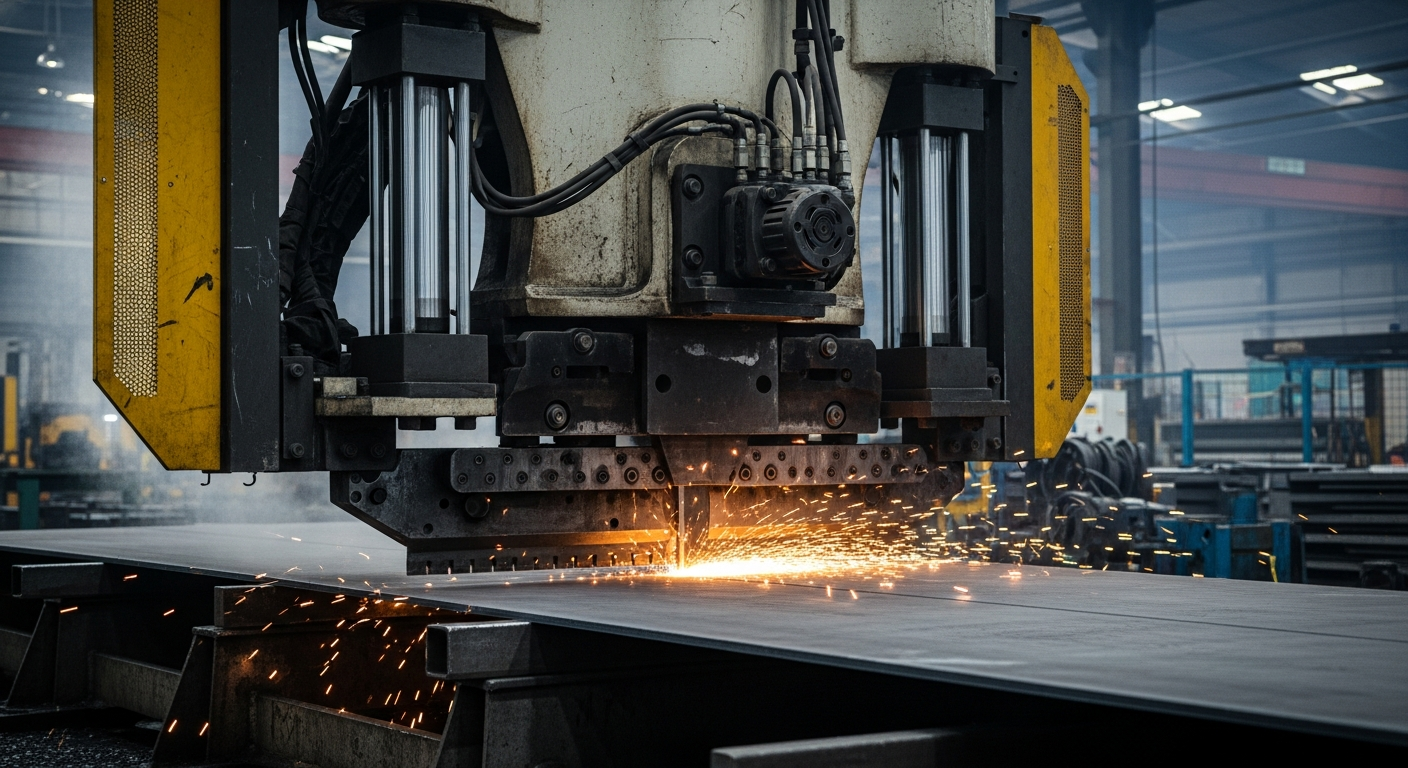
For plant managers and operations directors in the steel and metals industry, the variance between "running" and "productive" is often where profit margins are impacted. In a sector characterized by high-mix, low-volume production runs and aggressive delivery timelines, the performance of core fabrication assets like hydraulic shearing machines can dictate the pace of the entire shop floor.
However, distinguishing between necessary idle time and preventable downtime remains a persistent challenge. Without clear benchmarks, it is difficult to determine if a shearing machine running at 20% utilization is a bottleneck or simply operating within normal parameters for a job shop environment.
Industry Report: Hydraulic Shearing Machine Maintenance Benchmarks in Steel & Metals for 2026
The State of Shearing Machine Performance
Hydraulic shearing machines (categorized as "Cutters" in the performance dataset) act as the primary feed mechanism for many fabrication workflows. Unlike continuous process equipment found in industries like Food & Beverage or Chemical processing, shearing machines in metal fabrication typically operate as shared resources—utilized on demand to feed downstream bending, welding, or assembly stations.
Recent performance data confirms this operational model. The median runtime for shearing machines in the Industrial Machinery sector is approximately 17% (Source: Guidewheel Performance Analysis). This indicates that for the vast majority of planned production time, these machines are sitting idle.
However, a deeper look at the data reveals a significant performance gap. While the median facility sees 17% runtime, the top quartile of performers achieves approximately 45% runtime (Source: Guidewheel Performance Analysis).

(Source: Guidewheel Performance Analysis, n=6.4 million machine-minutes)
This variance suggests that while low utilization is common, it is not inevitable. Facilities in the top quartile are managing to nearly triple the asset utilization of their peers. This is often achieved not by simply "running faster," but by reducing the friction surrounding the machine—minimizing changeover times, improving material availability, and ensuring the machine is mechanically available when the schedule demands it.
Comparative Equipment Analysis
To contextualize shearing machine performance, it is helpful to look at other assets within the same Steel & Metals environments. The data indicates that low runtime is a sector-wide characteristic rather than a specific issue with shearing technology.
- Compressors: ~39% Median Runtime
- Lasers: ~27% Median Runtime
- Presses: ~20% Median Runtime
- CNCs: ~19% Median Runtime
- Shearing Machines (Cutters): ~17% Median Runtime
- Benders: ~13% Median Runtime
(Source: Guidewheel Performance Analysis)
The data indicates that shearing machines align closely with Presses and CNCs in terms of utilization. This reinforces the "job shop" nature of the sector, where equipment availability is often prioritized over continuous throughput. However, the top quartile performance of 45% for shears demonstrates that there is significant "hidden capacity" available in most fleets without the need for capital investment in new machinery.
Understanding Downtime Drivers in Metal Fabrication
If shearing machines are idle for more than 80% of the time, understanding why they are stopped is the first step toward optimization. The analysis identifies five primary categories of downtime that affect the Industrial Machinery sector.
1. No Business / Orders (~49% of Total Downtime)
The single largest driver of downtime is categorized as "No Business/Orders," accounting for nearly half of all non-running time (Source: Guidewheel Performance Analysis).
- Average Duration: ~233 minutes per event.
- Operational Context: This confirms that shearing machines often sit idle simply because there is no immediate demand. While this downtime is "planned" in a sense, it highlights the importance of production scheduling. Top-quartile performers likely minimize this loss through tighter integration between sales orders and production planning, smoothing out the "feast or famine" workflow common in job shops.
2. Staffing Issues (~20% of Total Downtime)
Labor availability has emerged as a critical constraint. Staffing issues account for one-fifth of all downtime losses, with an average duration of over two hours (~143 minutes) per event (Source: Guidewheel Performance Analysis).
- Operational Context: This is significantly higher than in continuous process industries. For shearing operations, this often manifests as the machine waiting for a qualified operator to become available, or breaks extending beyond scheduled times. It underscores the value of cross-training and tools that allow fewer operators to monitor multiple assets effectively.
3. Other Operational Stops (~8% of Total Downtime)
This category captures the minor, frequent interruptions that disrupt flow—feeding issues, minor adjustments, or waiting for material.
- Average Duration: ~47 minutes per event.
- Operational Context: While these events are shorter, they break the operator's rhythm. For shearing machines, this is the primary "active" loss driver (Source: Guidewheel Performance Analysis). Reducing these friction points often yields the quickest gains in OEE (Overall Equipment Effectiveness).
4. Maintenance & Cleaning (~8% of Total Downtime)
Planned and reactive maintenance consumes nearly 8% of lost time, with events averaging over 70 minutes (Source: Guidewheel Performance Analysis).
- Operational Context: In hydraulic shearing, this often relates to blade rotations, hydraulic fluid checks, or backgauge calibration. The duration suggests that when maintenance occurs, it is substantial. Moving from reactive repairs to predictive strategies can significantly reduce the impact of these events.
5. Mechanical Breakdowns (~7% of Total Downtime)
True mechanical failure accounts for roughly 7% of downtime, with an average resolution time of ~35 minutes (Source: Guidewheel Performance Analysis).
- Operational Context: While statistically smaller than "No Orders," mechanical breakdowns are the most disruptive because they are unplanned. A 35-minute hydraulic seal failure during a rush order results in variances that impact the entire production schedule.
Real-Time Monitoring: Bridging the Visibility Gap
The performance data reveals a landscape where machines are capable of 45% utilization but often run at 17%. Bridging this gap requires visibility. The difference between a "No Orders" stop and a "Mechanical Breakdown" is obvious to an operator standing at the machine, but it is often invisible to management looking at end-of-week reports.
To address these specific challenges—high variability in setup times, staffing constraints, and unplanned mechanical stops—modern steel and metals facilities are turning to real-time monitoring solutions like Guidewheel.
From Data to Action
Guidewheel’s platform is designed to address the exact inefficiencies identified in the analysis:
- Universal Compatibility: Steel & Metals facilities often rely on robust, legacy hydraulic shears that may be decades old. Guidewheel utilizes non-intrusive, clip-on sensors that measure the electrical current (the "heartbeat") of the machine. This allows for monitoring of any asset—from a brand-new CNC to a 1980s hydraulic shear—without complex PLC integration.
- Addressing Staffing Gaps: With staffing accounting for ~20% of downtime, remote visibility becomes a force multiplier. Guidewheel’s "FactoryOps" approach allows a smaller team to monitor multiple machines from mobile devices or central scoreboards. If a shear stops unexpectedly, the maintenance lead knows immediately, reducing reaction time.
- Reducing "Other" Operational Losses: The data shows that minor operational stops accumulate rapidly. By tracking micro-stops and setup times automatically, Guidewheel helps teams identify process bottlenecks. If the morning shift consistently sets up the shear in 15 minutes while the night shift takes 45, the data makes that training opportunity visible.
- Connectivity Flexibility: Recognizing that not every corner of a steel mill has reliable Wi-Fi, Guidewheel can operate using cellular connections, ensuring data continuity even in challenging industrial environments.
This approach moves maintenance from a reactive "break-fix" model to a proactive, data-driven strategy. By identifying the root causes of the 8% operational loss and the 7% mechanical breakdown rate, facilities can systematically work toward the top-quartile benchmark of 45% runtime.
Strategies for Optimization
Based on the data benchmarks, facilities can adopt the following strategies to improve shearing machine performance:
- Standardize Changeovers: Address the >300% spread in setup times. Create standard operating procedures (SOPs) for blade gap adjustments and backgauge settings to bring the bottom quartile of operators up to the median.
- Attack the "Other" Category: Use reason codes to drill down into the 8% operational downtime. Is it material waiting? Blade jams? Scrap removal? Small process fixes here compound into significant gains.
- Implement Condition-Based Maintenance: Use the "heartbeat" data from the machine's motor to detect strain before a breakdown occurs. A spike in current draw during a cut can indicate dull blades or hydraulic pressure issues long before the machine fails completely.
- Align Production with Demand: Since ~49% of downtime is lack of orders, ensure that when orders are present, the machine is ready. Use uptime data to schedule maintenance during known low-demand windows rather than risking downtime during production sprints.
Moving Toward the Top Quartile
The data indicates that for Steel & Metals manufacturers, the path to optimization is not necessarily about buying new equipment. It is about unlocking the potential of existing assets. With a median runtime of ~17% but a top-quartile potential of ~45%, there is substantial room for improvement within the current capital structure.
By acknowledging that different facilities have different constraints, these benchmarks serve as a guide. Whether the goal is to reduce staffing-related downtime or simply to stabilize changeover times, the key lies in visibility.
Michael Sanchez, Industrial Metal Supply.With the updated Scoreboard, our supervisors quickly got up to speed. We review it together, and it’s already helping day-to-day.
Ready to uncover the hidden capacity in your operation?
Book a demo to see how Guidewheel can help you optimize your shearing machine performance.
About the Author
Lauren Dunford is the CEO and Co-Founder of Guidewheel, a FactoryOps platform that empowers factories to reach a sustainable peak of performance. A graduate of Stanford, she is a JOURNEY Fellow and World Economic Forum Tech Pioneer. Watch her TED Talk—the future isn’t just coded, it’s built.