No items found.
blog
How Siemens Rolls Out AI in Manufacturing: A Phased Playbook for Shop Floor Adoption
By: Guidewheel
Updated:
March 6, 2026
7 min read
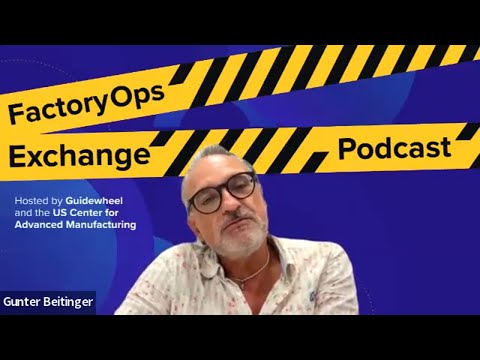
How Siemens rolls out AI in manufacturing: a phased playbook for shop floor adoption
In this episode of the FactoryOps Exchange, Gunter Beitinger (Senior Vice President of Manufacturing at Siemens and author of Crisp Manufacturing) joins Lauren Dunford, CEO of Guidewheel, to discuss practical strategies for deploying AI in manufacturing and leading people through technological change.
Top 5 takeaways
💡Here are the top five takeaways from Gunter Beitinger's conversation on deploying AI in manufacturing:
- Translate AI into lean language. Strip away IT jargon and describe industrial AI tools using the continuous improvement terminology your shop floor teams already speak. Trust starts with shared language.
- Roll out AI in phases: explain, suggest, then act. Start with explainable AI, move to human-approved suggestions, then shift to AI-driven decisions with human override. This builds trust without disruption.
- Stop underestimating frontline workers. Your operators manage complex financial and personal decisions daily. They can handle ai technology on the shop floor when given autonomy, context, and purpose.
- Align every improvement to an overall goal. Isolated fixes feel productive but miss the bigger picture. Tie each change to a measurable outcome like delivery performance, quality, or throughput.
- Leaders should reflect on their own role in problems. Go beyond root cause analysis. Ask how your own decisions and conditions may have contributed to the patterns you are trying to fix.
Best practices and key learnings
Speak their language: overcoming workforce fear of AI
One of the biggest barriers to deploying ai automation on the shop floor is not technical. It is human. Fear of job loss. Fear of irrelevance. Fear that decades of hard-won expertise will be handed to a machine.
Gunter's team at Siemens learned this the hard way. When they first introduced AI into X-ray quality inspection, resistance was immediate. Operators worried their knowledge would be devalued. The breakthrough came when the team stopped using IT terminology altogether and reframed every concept in the lean language operators already used daily.
This was not a cosmetic change. It fundamentally shifted how teams perceived the technology. Instead of seeing a threatening "AI system," they saw a continuous improvement tool that reduced the stress of staring at screens for hours evaluating defects. The ai software became a tool in their existing workflow, not a replacement for it.
"People nowadays, what we have in our operation, they seek autonomy, they seek purpose and recognition. Sometimes we really underestimate our people."
Gunter Beitinger, Senior Vice President of Manufacturing, Siemens
The lesson is clear. If you want adoption, meet people where they are. Use the words they use. Explain the problem you are solving in terms they care about. For Siemens, that meant framing AI as a way to handle surging demand when new machines could not be purchased fast enough, not as an efficiency play that threatened headcount.
The "explain, suggest, intervene" rollout model
Gunter outlined a specific phased approach to deploying AI that any operations leader can adapt. It is built on a simple principle: managers would rather live with a known problem than accept a solution they do not understand.
Phase 1: Explainable AI. The system shows its work. Every recommendation comes with a clear explanation of how it reached its conclusion. Operators can see the reasoning and compare it to their own judgment. Step by step, they begin to trust the logic.
Phase 2: AI suggests, human approves. The system proposes a decision, but the operator must actively accept it. The human stays in the driver's seat. Nothing happens without their explicit agreement.
Phase 3: AI acts, human can override. The system makes the decision by default, but the operator can intervene at any time. Over time, Siemens found that operators intervened less and less as confidence grew.
"The explainable AI was very, very important at the beginning. Step by step they were accepting the way how the decision was made by the AI system."
Gunter Beitinger, Senior Vice President of Manufacturing, Siemens
This phased model achieved 80% acceptance among the workforce. The remaining skeptics came around naturally as they watched their coworkers adopt the tools. No pressure required. The AI became, in Gunter's words, "a coworker" rather than a threat.
This approach mirrors how Guidewheel thinks about deploying ai in manufacturing. Start with visibility. Give teams real-time data they can see and interpret. Let them build confidence with the insights before layering in AI-driven guidance. No rip-and-replace. No black boxes.
✅
Siemens' three-phase rollout model — explain, suggest, then act — achieved 80% workforce acceptance without pressure. The key ingredients were: using lean language instead of IT jargon, ensuring every AI recommendation showed its reasoning so operators could compare it to their own judgment, and keeping humans in the decision loop until trust was organically established. This phased approach works because it treats adoption as a trust-building exercise, not a technology deployment.
Align improvements to a bigger purpose
When Gunter walks into a new factory, he does not start with answers. He starts by observing. Listening. Asking questions that sometimes frustrate teams because they seem too simple.
One story stood out. He visited a plant where small teams eagerly presented their improvements. His response was not praise. It was a question: "Which bigger problem did this solve?" Teams had been making isolated fixes, optimizing locally, but missing the connection to overall performance goals like customer delivery or quality.
This is one of the most common patterns in manufacturing. Teams are busy. They are fixing things. But without alignment to a shared goal, the cumulative impact is a fraction of what it could be. The improvements cancel each other out, or worse, create new problems downstream.
The fix is straightforward but requires discipline: every improvement initiative should trace back to a measurable outcome that matters to the customer. This is where having a real-time operating layer across your plants becomes critical. When everyone can see the same data, the same performance metrics, the same targets, alignment happens naturally. Arguments about what actually happened last week disappear. Energy shifts from debating the numbers to improving them.
How to put these insights into practice
Gunter's experience at Siemens offers a concrete playbook that any manufacturer can start applying this week. Here is how to translate these insights into action.
Step 1: Audit your language. Walk the floor and listen to how your teams talk about their work. Then review how your technology vendors, your internal IT team, and your improvement programs describe AI tools. If there is a gap, close it. Rewrite your rollout materials in the language your operators actually use. If they say "changeover" and not "setup optimization," use "changeover."
Step 2: Start with explainability. Before deploying any ai software or ai automation tool, make sure it can show its reasoning. If your team cannot look at a recommendation and understand why the system made it, you are not ready to deploy. This is not a nice-to-have. It is the difference between adoption and rejection.
Step 3: Phase your rollout deliberately. Do not jump to full automation. Start with the system showing insights. Move to the system suggesting actions that require human approval. Only after trust is established should you shift to AI-driven defaults with human override. Document each phase and the criteria for moving to the next one.
Step 4: Connect every improvement to a customer outcome. For every project, every fix, every new tool, ask: which overall goal does this serve? If the team cannot answer, pause and align before proceeding. Post the top three plant-level goals visibly on the floor and reference them in every review.
Step 5: Reflect on your own leadership patterns. Gunter pushes leaders past root cause analysis to self-reflection. When a recurring problem surfaces, ask yourself: what decisions or conditions did I create that contributed to this? This is uncomfortable. It is also where the deepest improvements come from.
Step 6: Give your frontline real-time data and real authority. Stop treating operators like they need to be protected from complexity. Give them dashboards they can act on. Give them the autonomy to make decisions in real time. Guidewheel's approach of equipping frontline managers with second-by-second machine data is built on exactly this principle: the people closest to the work are the ones best positioned to improve it, if they have the right information.
Building a factory floor where AI and people thrive together
The path to effective industrial AI is not a technology problem. It is a trust problem. And trust is built through transparency, phased rollouts, shared language, and respect for the people doing the work.
Gunter Beitinger's experience across 34 Siemens plants confirms what we see across 400+ manufacturers using Guidewheel: the factories that win are the ones that modernize without the mess. They start with visibility. They build confidence through explainable, practical ai technology. They align every improvement to outcomes that matter. And they treat their frontline teams as the capable, creative, resourceful people they are.
The question is not whether to adopt AI in manufacturing. The question is whether you will do it in a way that your people trust, understand, and champion.
Book a Demo to see how Guidewheel helps manufacturers go live in hours with real-time visibility across every machine, giving your teams the data foundation to adopt AI with confidence.
Watch and listen
Watch the full conversation now: