No items found.
blog
How Rockwell Automation Builds the Factory of the Future: AI, Disciplined Innovation, and the Metrics That Actually Matter
By: Guidewheel
Updated:
March 6, 2026
7 min read
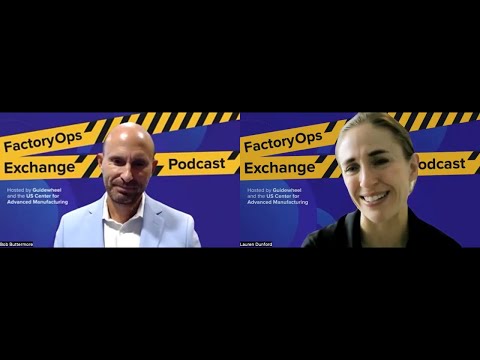
How Rockwell Automation builds the factory of the future: AI, disciplined innovation, and the metrics that actually matter
In this episode, Bob Buttermore (Chief Supply Chain Officer, Rockwell Automation) joins Lauren Dunford, CEO of Guidewheel, to discuss how Rockwell is transforming its own factories with AI automation, simplified metrics, and a people-first approach to industrial AI.
Top 5 takeaways
💡Here are the key takeaways from Bob Buttermore's conversation on building the factory of the future:
- Cut your executive metrics to the vital few. Rockwell moved from 30 metrics to 5 at the leadership level, eliminating data definition debates and driving focused action on root causes.
- AI in manufacturing delivers even in world-class facilities. Rockwell's Singapore plant, already top-tier, achieved 35% cost reduction, 25% energy savings, and 60% faster time to competency after transformation.
- Pilot one use case, prove ROI, then scale. Letting every plant build its own AI model creates chaos. Disciplined innovation means selecting the best use case, validating it in one facility, and rolling it out systematically.
- Technology is a workforce multiplier, not a replacement. Manufacturing faces a labor gap. Machine learning in manufacturing and digital tools make jobs more achievable and rewarding, attracting the next generation of makers.
- Resilience now outweighs pure efficiency. The shift from just-in-time to just-in-case demands real-time visibility, redundant capacity, and continuous investment in operational agility.
Best practices and key learnings
Simplify metrics to drive action, not arguments
One of the most common traps in manufacturing operations is drowning in data. Bob described a familiar scene: executive reviews where teams debated whether a metric was a 12-month rolling average, a 3-month average, or a blended number. Thirty metrics on the screen. No actions coming out of the room.
The fix was ruthless simplification. Rockwell cut its executive-level metrics from 30 to 5. The logic: if those five are healthy, the thousands of metrics underneath are probably healthy too. When something is off, the team digs into causals and drives specific actions rather than relitigating how a number was calculated.
This is a principle that applies at any scale. Whether you run one plant or twenty, the question is the same: are your teams spending review time arguing about data definitions, or acting on what the data tells them? Real-time visibility into the few things that matter most, like downtime and throughput, changes behavior faster than a dashboard with 30 tabs.
"We changed from talking about 30 different metrics at an executive level to five. If these five metrics are good, then all these are probably good. So focus on these, focus on what's working, what's not, and you'll deliver great performance."
Bob Buttermore, Chief Supply Chain Officer, Rockwell Automation
Prove ROI first, then scale with discipline
Bob's framework for implementing AI automation in Rockwell's supply chain comes down to three principles: return on investment, disciplined innovation, and fusion teams.
ROI first. Every technology request starts with the same question: does this have an ROI? Bob noted that the first question customers ask when they tour a Rockwell facility and see new technology is not "how does it work?" It is "what was the return on investment?" If your own team cannot answer that question clearly, the implementation is not ready.
Disciplined innovation. The temptation with industrial AI is to go wide and fast. Bob painted the cautionary picture: imagine telling 20 plants to each implement their own AI planning model simultaneously. The result is 20 different models, no standardization, customer service problems, and a supply system nobody understands. The better path is to identify the top use case, pilot it in one plant, validate the results, and then scale it across the network.
Fusion teams. Implementation works when you bring the right people together: subject matter experts who know the process, data scientists and digital engineers who know the technology, and the frontline associates who will use it every day. This is not a handoff from IT to operations. It is a collaborative team built for the specific problem.
This approach mirrors what works in any predictive maintenance AI or throughput optimization project. Start small. Prove value in weeks, not years. Then scale with confidence.
✅
When scaling AI in manufacturing, resist the urge to let every plant build its own solution. Rockwell's approach shows that disciplined innovation — piloting one use case, validating ROI in a single facility, and then rolling out a standardized playbook — avoids the chaos of 20 different models and delivers enterprise-wide value faster. Pair this with fusion teams that combine process experts, data scientists, and frontline operators to ensure tools actually get adopted on the floor.
Technology makes work better for people on the floor
The most compelling story Bob shared was not about cost savings or energy reduction. It was about how people feel at the end of a shift.
In Rockwell's engineer-to-order facilities, the hardest job was wiring complex panels. Associates had to read 2D schematics, mentally translate them to a 3D panel, and manually cut, strip, and route every wire. It was the highest-turnover role, the worst quality outcome, and the lowest job satisfaction in the factory.
The solution combined a machine for automated wire cutting and stripping with a digital screen that shows exactly where each wire goes in the panel. The idea came from Rockwell's internal innovation challenge, where teams compete to solve real problems. This team won. The project was funded, implemented, and scaled to all engineer-to-order factories globally.
The productivity and quality gains were meaningful. But the real impact was human. Associates who used to leave work feeling defeated because the job was nearly impossible to do perfectly now leave feeling successful. That shift in how people experience their work is what makes technology adoption stick.
"What you'll hear from them is it's transformed the way they feel. This tool now allows them to be successful and when they leave at the end of the day they feel fantastic. It's like job well done."
Bob Buttermore, Chief Supply Chain Officer, Rockwell Automation
This is the real promise of machine learning in manufacturing and AI in manufacturing more broadly. Not replacing the operator. Augmenting them so they can do their best work.
How AI slashed costs by 35% in a world-class factory
"We got 35% reduction in costs. We got a 25% reduction in energy. And one of the most important metrics to me was the time to competency for our associates by integrating AI and new technology and we were able to improve our time to competence by 60% for our associates."
How to put these insights into practice
Bob's playbook is practical and transferable. Here is how to apply it in your own operation, regardless of size or sophistication.
Step 1: Audit your metrics ruthlessly. List every metric your leadership team reviews. Ask: if we could only track five, which five would tell us whether the operation is healthy? Cut the rest from executive reviews. Push the detailed metrics down to the teams that own them.
Step 2: Pick one AI or automation use case with clear ROI. Do not try to transform everything at once. Identify the single highest-impact problem, whether it is downtime on a critical line, a quality bottleneck, or a manual process that drives turnover. Build a business case with a specific dollar value.
Step 3: Pilot in one facility. Run the use case in a single plant. Measure results against your baseline. Document what worked, what did not, and what you would change. This is your proof point for scaling.
Step 4: Build a fusion team. Pair your best operators and process experts with digital or data talent. Include the frontline associates who will use the tool daily. Their input is not optional. It is the difference between a tool that gets adopted and one that gets ignored.
Step 5: Scale with a standard playbook. Once the pilot proves ROI, create a repeatable implementation guide. Roll it out plant by plant. Resist the urge to let each site customize independently. Standardization is what turns a pilot into enterprise value.
Step 6: Invest in resilience, not just efficiency. Evaluate where your operation is vulnerable to disruption. Power redundancy, capacity buffers, real-time visibility into machine health. These are not luxuries. They are the cost of running 24/7 in a world where disruption is the norm.
Building the factory of the future, one practical step at a time
The factory of the future is not a single massive project. It is a series of practical, ROI-proven steps that compound over time. Rockwell's experience shows that even world-class facilities have significant room to improve when you apply the right technology with discipline.
The pattern is clear: simplify what you measure, prove value before you scale, and always design for the people doing the work. Whether you are running a single plant or a global network, these principles hold.
The biggest risk is not moving too slowly on any one technology. It is waiting for the perfect plan while capacity leaks, expertise walks out the door, and competitors close the gap.
Start with visibility. Know what your machines are actually doing, in real time, across every shift and every plant. That foundation makes every subsequent investment, from predictive maintenance AI to production logistics automation, more effective and easier to justify.
Book a Demo to see how Guidewheel helps manufacturers get real-time visibility across every machine, without IT overhead or production disruption, so you can find hidden capacity and start improving today.
Watch and listen
Watch the webinar now:
Listen on Apple Podcasts: FactoryOps Exchange