No items found.
blog
The hidden factory: how to find capacity you already have
By: Guidewheel
Updated:
May 4, 2026
7 min read
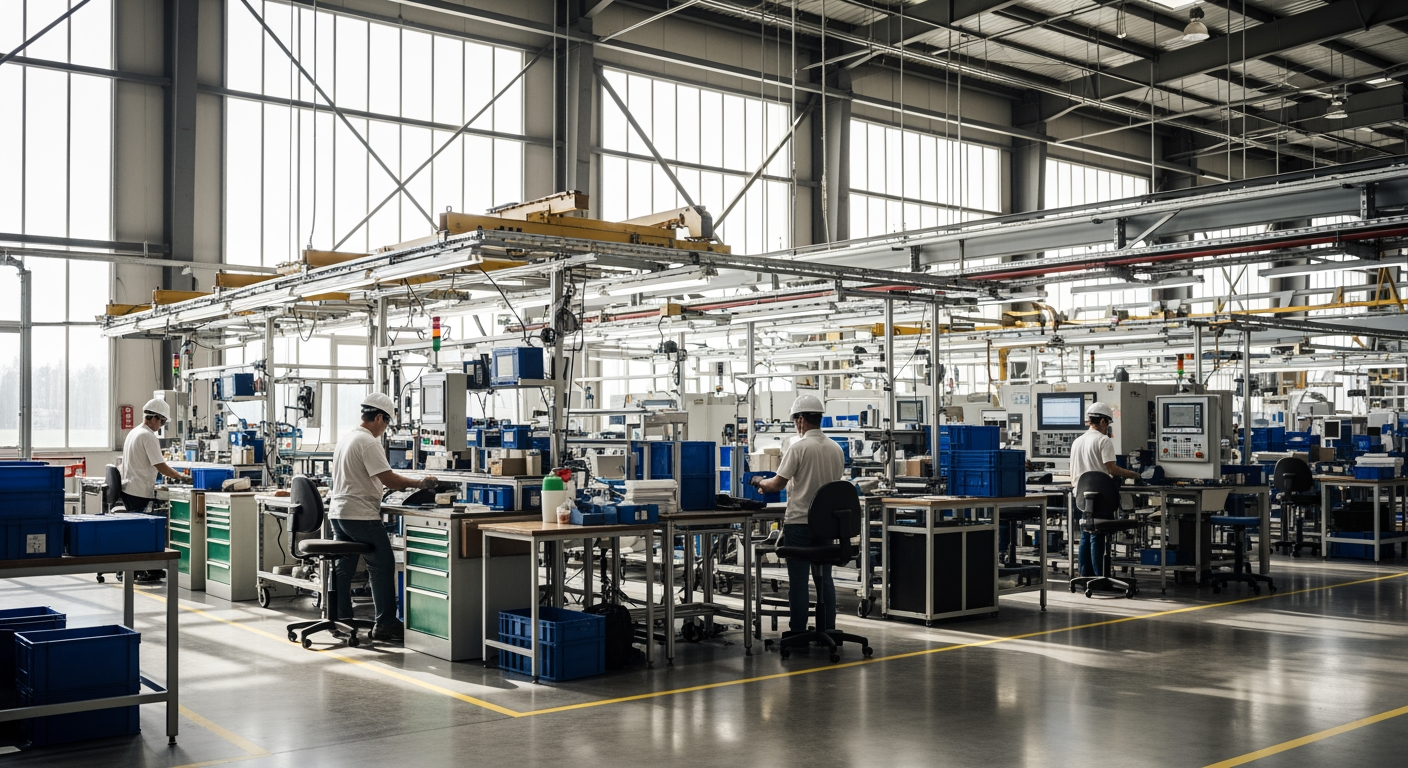
Your plant likely has 15–30% more capacity than anyone realizes (Source: Guidewheel Performance Analysis). Not in a new line. Not in a capital request. In the machines already bolted to your floor, running right now, losing minutes that nobody is counting.
That gap between what your equipment could produce and what it actually delivers is what lean practitioners call the "hidden factory." It's the shifts lost to vague downtime codes, the speed losses everyone has learned to live with, and the startup scrap that gets written off as normal. The good news: overall equipment effectiveness (OEE) is the diagnostic that makes those losses visible, and you don't need a massive IT project to start finding them.
This guide walks through the OEE formula, common calculation traps, sector-specific benchmarks, and a practical improvement playbook you can start this month.
Understanding the basics: OEE and its three components
OEE (overall equipment effectiveness) is a manufacturing KPI that answers one question: of the time you planned to run, how much actually produced good parts at full speed?
It combines three independent loss categories into a single percentage:
OEE component |
What it measures |
Formula |
Common loss sources |
|---|---|---|---|
Availability |
Uptime during planned production |
(Planned Time − Downtime) / Planned Time |
Unplanned maintenance, changeovers, jams |
Performance |
Speed relative to design rate |
Actual Rate / Design Rate |
Reduced speed, micro-stops, material variability |
Quality |
First-pass yield |
Good Units / Total Units |
Scrap, rework, startup waste |
The power of OEE in manufacturing is that it forces you to see all three loss types at once. A line might have 95% availability but run 15% slower than design speed, and nobody notices because the machine "looks busy." OEE catches that.
The OEE formula: step-by-step calculation
The OEE calculation is straightforward:
OEE (%) = Availability × Performance × Quality
Here's a worked example from a discrete manufacturing line:
Input |
Value |
|---|---|
Planned production time |
480 min (one shift) |
Downtime (maintenance + changeovers) |
60 min |
Design rate |
100 units/min |
Total units produced |
35,000 |
Good units (first-pass) |
33,600 |
Step-by-step:
Availability = (480 − 60) / 480 = 87.5%
Performance = (35,000 / 420 min) / 100 units/min = 83.3%
Quality = 33,600 / 35,000 = 96%
OEE = 0.875 × 0.833 × 0.96 = 70%
That means 144 minutes of every shift produce nothing sellable. Sixty go to downtime, roughly 67 to speed losses, and 17 to quality defects. This is the hidden factory, expressed in minutes you can actually recover.
Five OEE calculation mistakes that hide your real capacity
Before you benchmark anything, make sure your numbers are clean. These are the traps I see most often:
Fuzzy design rates. Using nameplate speed when your actual process capability is lower inflates performance losses and hides the real constraint. Update your design rate to reflect current capability, then improve from there.
Lumping changeovers into "other." Changeover time is an availability loss. If it's buried under vague codes, you can't target it for SMED improvements.
Counting rework as "good." Rework consumes capacity. If reworked units show up in your good-unit count, your quality number is lying.
End-of-shift estimation. Spreadsheet-based OEE tracking introduces a ±5–10% error range because operators estimate durations and generalize downtime reasons hours after the event.
Inconsistent scope. Are you measuring one machine or a whole line? Including planned maintenance or excluding it? Without consistent definitions, shift-to-shift and plant-to-plant comparisons are meaningless.
✅
Most OEE calculation errors stem from the same root cause: data captured too far from the machine and too long after the event. Switching from end-of-shift spreadsheets to real-time machine monitoring eliminates the ±5–10% error range, removes subjective downtime coding, and ensures that availability, performance, and quality losses are categorized consistently across every shift and every line — making your benchmarks trustworthy enough to act on.
The fix for most of these is the same: capture data closer to the machine, closer to real time. When a production monitoring system logs state changes automatically, the "what really happened" debates between maintenance and production go away.
What counts as good OEE? Benchmarks by sector
One of the most common questions is: is my OEE score actually bad, or is it normal for my industry? The answer depends heavily on your product mix, changeover frequency, and equipment age. These benchmarks serve as reference points, not universal targets.
Sector |
Good OEE range |
Typical availability |
Typical performance |
Typical quality |
|---|---|---|---|---|
Discrete (automotive, electronics) |
75–85% |
80–90% |
85–95% |
95–98% |
Packaging & converting |
70–85% |
65–80% |
75–90% |
92–97% |
Food & beverage |
70–85% |
75–85% |
85–95% |
95–99% |
Metals & heavy manufacturing |
70–85% |
75–85% |
80–95% |
94–98% |
Plastics (injection, extrusion) |
70–80% |
75–85% |
75–90% |
92–97% |
Pharma & high-precision |
75–90% |
80–90% |
90–98% |
98–99.5% |
The OEE Foundation generally cites 85%+ OEE as world-class, but that number applies mostly to high-volume, low-mix environments with strong TPM programs. A multi-SKU packaging line running 6–8 changeovers per day at 76% OEE might be outperforming a single-format line at 82%.
The real question isn't "are we world-class?" It's "where are we losing the most, and can we recover it?"
Where hidden capacity actually lives: your top downtime drivers
This is where the hidden factory gets concrete. Recent performance data from Guidewheel's FactoryOps platform, spanning thousands of machines and downtime events, reveals a pattern that matches what most plant managers already feel but can't always prove.

While market-driven stops like "No Business/Orders" have the longest average duration (318 minutes per event), the categories within your direct control tell a more actionable story (Source: Guidewheel Performance Analysis):
Downtime category |
% of total downtime |
Avg. duration per event |
Why it matters |
|---|---|---|---|
Other operational issues |
28% |
81 min |
Broad category, high frequency across 11 industries |
Mechanical breakdowns |
20% |
72 min |
Short but frequent; 3,300+ events sampled |
Material & supply issues |
17% |
119 min |
Supply chain and material flow bottlenecks |
Staffing issues |
13% |
197 min |
Extended delays from scheduling gaps |
Maintenance & cleaning |
11% |
85 min |
Routine and unplanned maintenance combined |
These five categories are all internal operational factors. They collectively dwarf the market-driven category in terms of total impact, and every one of them responds to targeted intervention: better preventive maintenance schedules, standardized changeover procedures, material handling improvements, and remote monitoring to support teams across shifts.
This is how you find hidden capacity before you approve new equipment. Track these losses for 30 days with real data, and the business case writes itself.
The utilization gap: why averages lie
Here's another place hidden capacity hides: in the gap between your busiest machines and your least-utilized ones. Sector averages can mask enormous variation.

In sectors like plastics and pharmaceuticals, the weighted average runtime is dramatically higher than the median, meaning a few workhorse machines run constantly while many others sit idle. This is exactly the kind of insight that answers the question: should I monitor every machine, or just the bottlenecks?
The short answer: monitor broadly. Your bottleneck today might not be your bottleneck tomorrow. A machine running at 26% median uptime in a plastics facility isn't necessarily broken. It might be a secondary line waiting for orders, or it might be starved by an upstream constraint nobody has quantified. You can't tell without runtime data across the full floor.
Guidewheel's FactoryOps platform makes this practical by using clip-on current sensors that read electrical current from any machine — old or new — and transmit over cellular connections — no plant Wi-Fi required — without involving IT. The system turns raw current readings into run/idle/down data, OEE components, and Pareto-ranked loss drivers, giving you shop floor visibility across every line and every shift.
Start recovering your hidden factory
Every plant has capacity hiding in plain sight. The path from "we think our OEE is around 75%" to "we know it's 71%, and here's exactly where the losses are" is shorter than most people expect, and it doesn't require ripping out existing systems.
The practical first step: get accurate runtime data on your lines, identify your top three downtime drivers, and run one focused test. The results from that first cycle fund everything that follows.
Book a Demo to see how Guidewheel's FactoryOps platform can help you find and recover your hidden factory capacity — starting with your toughest line, with deployment in days, not months.
We had our best month of the year, increasing production from 26k-35k/month to 46k cases in March. I attribute this to Guidewheel. Being able to see downtime data and address downtime reasons directly correlates to higher production.
Michael Palmer, VP of Operations, Direct Pack (Source: Guidewheel's Customer Research)
💡
Frequently asked questions
What is OEE and what does it measure in manufacturing?
OEE stands for overall equipment effectiveness. It's a single percentage that combines three factors: availability (did the machine run when it was supposed to?), performance (did it run at full speed?), and quality (did it produce good parts the first time?). Together, these three components show you how much of your planned production time actually produced sellable output. OEE originated within Total Productive Maintenance (TPM) at Toyota and has become the standard asset-level KPI across lean manufacturing, Six Sigma, and continuous improvement programs.
Is 100% OEE possible?
No. 100% OEE would require zero downtime (including necessary changeovers and maintenance), full design speed at all times, and zero defects. In practice, even the most optimized facilities operate in the 85–90% range. Setting 100% as a target isn't useful. Instead, benchmark against your sector and focus on closing the gap to your next realistic milestone.
How do I calculate OEE with multiple products and frequent changeovers?
Calculate OEE separately by product or product family, applying the correct design rate for each. Classify changeover time as an availability loss, not a performance loss. Then report plant-level OEE as a weighted average based on production hours per product. The key is consistency: if you treat changeover time differently from shift to shift, your trending data becomes unreliable.
Why do spreadsheet-based OEE calculations often produce misleading results?
Manual data entry at end of shift introduces hours of delay. Operators estimate durations, generalize root causes, and may code downtime differently from their peers. The result is a ±5–10% error range that makes benchmarking across lines or shifts unreliable. Real-time machine monitoring eliminates this by capturing state changes automatically.
What metrics should I pair with OEE for a complete picture?
OEE is most powerful when paired with throughput (units per hour), mean time between failures (MTBF), changeover time, cost per unit, and on-time delivery percentage. OEE tells you how efficiently the asset performed; these supporting KPIs connect that performance to maintenance health, delivery commitments, and financial outcomes.
About the author
Lauren Dunford is the CEO and Co-Founder of Guidewheel, a FactoryOps platform that empowers factories to reach a sustainable peak of performance. A graduate of Stanford, she is a JOURNEY Fellow and World Economic Forum Tech Pioneer. Watch her TED Talk—the future isn't just coded, it's built.