No items found.
blog
Best Real-Time Monitoring Solutions for Granulators in Plastics & Packaging Manufacturing
By: Guidewheel
Updated:
December 18, 2025
7 min read
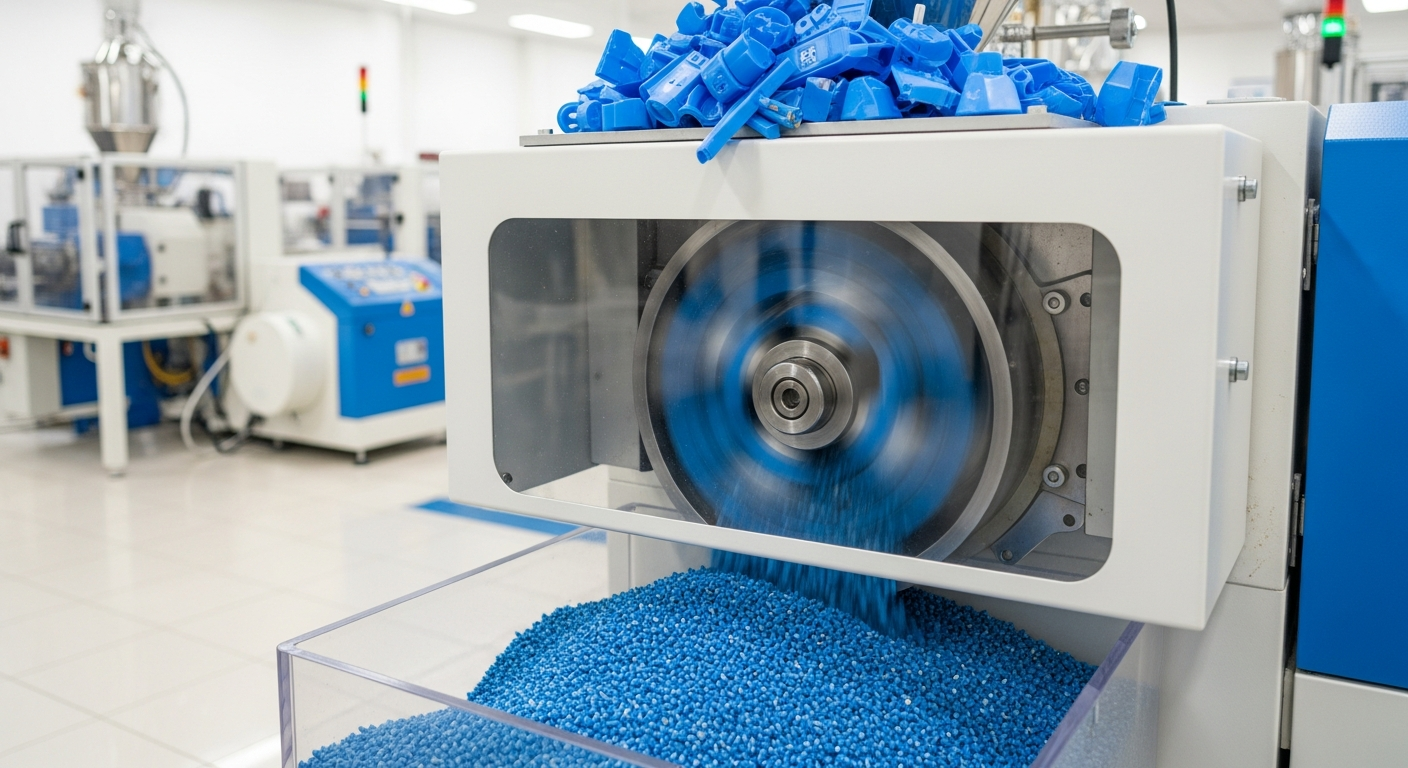
In many plastics facilities, the granulator is the blind spot in production line monitoring. Central units often sit in a soundproof room processing scrap, but when it stops, scrap accumulates rapidly, creating a bottleneck that disrupts the regrind stream and creates material handling hazards. For the hands-on plant manager in the plastics and packaging industry, this reactive downtime management is a constant headache. You are focused on improving OEE and throughput, yet often lack the data to prove exactly why the line went down.
Manual logs fail here because operators cannot monitor in real time every jam or bridging event. Yet, research shows these micro-stops—whether from heat in high-speed units or amperage spikes/motor overloads in slow-speed ones (Source: Ptonline)—account for significant capacity losses.
You cannot optimize what you cannot measure. Moving from intuition to the ability to monitor grinder performance in real time changes everything. This guide reviews the top real time monitoring solutions for grinders specifically tailored for the unique challenges of your facility.
Top Grinder Real Time Monitoring Solutions
When evaluating software, speed matters. You likely do not have many months for a complex IT integration. You need visibility now.
Below is a comparison of the leading solutions, focusing on how they handle the specific rugged requirements of plastics grinding.
Guidewheel
Guidewheel utilizes a "FactoryOps" approach, distinct from traditional MES (Manufacturing Execution Systems). It is built for speed, simplicity, and universal compatibility.
Key Strengths for Plastics Grinders:
Universal Compatibility: Guidewheel uses non-intrusive, clip-on current sensors. This is critical for grinders, which often lack modern PLCs or Ethernet ports. Whether it’s a brand-new granulator or a decades-old machine, the installation is identical. The sensors capture the machine’s electrical “heartbeat,” which algorithms interpret to determine how the machine is running—far beyond simple energy monitoring.
No Facility Internet Required: A key differentiator is that the hardware does not require a facility's Wi-Fi or ethernet to populate dashboards. The hubs can use cellular backhaul, bypassing complex IT security approvals.
Micro-stop Detection: By monitoring the electrical "heartbeat" of the motor, Guidewheel detects when a grinder is idling versus grinding, capturing every jam or bridge event that manual logs miss.
Operational Impact:
Because it measures the power draw, it can often serve as a proxy for blade sharpness. As blades dull or screens blind, amperage increases to process the same amount of plastic. This allows maintenance teams to change blades based on condition, not just a calendar.
Limitations:
Algorithms that read the machine’s electrical heartbeat give excellent visibility into run/idle/down states and performance trends, but they cannot directly assess particle size or regrind quality. Facilities that require those metrics typically supplement with periodic lab tests for a complete picture.
Customer Perspective:
Guidewheel has provided us with hard data about current state vs improved state. It is truthful source of information related to uptime.
Hans Hartmann, Sr. Director of Manufacturing T&I, PinnPACK Packaging via Guidewheel's Customer Research
Vorne
Vorne is well-known for its XL Productivity Appliance, a hardware-first solution that displays counts and rates on a scoreboard.
Strengths:
Visual Management: Excellent for showing operators real-time "target vs. actual" counts on the floor.
Simplicity: It is a "bolt-on" solution that is relatively easy to understand.
Limitations:
While effective for counting, it can lack the depth required for complex shift analysis in dynamic environments.
Customer Context:
Lack of options for setting up rotating shifts.
Ken M., Plant Manager, Capterra
MachineMetrics
MachineMetrics focuses heavily on high-frequency data collection, often connecting directly to the PLC or CNC control.
Strengths:
High-Fidelity Data: Captures extremely granular data, which is excellent for precision machining.
CNC Integration: If your facility mixes grinding with precision CNC machining, this deep integration is powerful.
Limitations:
For standalone plastic grinders, deep PLC integration can be overkill or technically impossible on older units without expensive retrofits.
Redzone
Redzone focuses on the workforce, gamifying production to encourage collaboration.
Strengths:
Culture Building: Excellent for engaging operators and creating competitive "wins" on the floor.
Communication: Strong tools for shift handovers and huddles.
Limitations:
It requires a significant cultural commitment and resource allocation to manage the software effectively.
Customer Context:
The transparency of what the software and tools require from personnel resource and what they need to do to truly make Redzone work effectively. We found out more as we learned about module implementation and had to adapt vs attempting to be prepared.
Tanner A., Process Improvement Leader, Capterra
Inductive Automation (Ignition)
Ignition is a SCADA platform that acts as a blank canvas. You can build almost anything with it.
Strengths:
Unlimited Customization: If you have a dedicated engineering team, you can build a bespoke grinder monitoring system.
Scalability: It scales well across massive enterprises with complex needs.
Limitations:
It is not a "plug-and-play" solution. It requires development time and specialized knowledge.
Customer Context:
Software has two options Vision and Perspective but both do not have same flexibility. Their Customer care is always busy with wait times of hours.
Pratik J., Instrumentation and Controls Engineer, Capterra
Specialized Monitoring (Amper, Augury, AssetWatch, Neuron Soundware, IPercept)
This category includes solutions that focus on specific niches of monitoring.
Amper: Uses electrical signature analysis similar to Guidewheel but focuses heavily on machine utilization metrics.
Augury & AssetWatch: These are primarily "Predictive Maintenance" tools focused on vibration and ultrasound. They are excellent for catching bearing failures on large motors but may lack the broader production OEE context.
Neuron Soundware & IPercept: Focus on audio and advanced sensing. While technologically impressive, audio analysis in a deafeningly loud grinding room can be challenging to calibrate compared to direct electrical monitoring.
Feature Comparison: Grinder Machine Monitoring Systems
Feature | Guidewheel | MachineMetrics | Vorne | Redzone |
|---|---|---|---|---|
Installation Method | Clip-on Sensors (Non-intrusive) | PLC/Ethernet Integration | Wired Hardware Sensors | Tablet/Software Focus |
Legacy Machine Compatibility | High (Universal) | Low (Requires Retrofit) | High (Digital IO) | Medium |
Deployment Speed | Days | Weeks/Months | Weeks | Months |
Facility Internet Required | No (Cellular Hubs) | Yes | Yes | Yes |
Primary Focus | FactoryOps / OEE / Power | Precision Data / CNC | Visual Counts | Workforce Collaboration |
Closing the Loop: The Strategic Value of Regrind Visibility
For years, the grinding room has been a data blind spot in real time monitoring—disconnected and reactive. But in today’s market, efficient regrind is one more competitive edge. Every pound of scrap reintroduced to the line is a direct hit to your bottom line and a win for sustainability. The goal isn’t just to keep the grinder running; it is to transform it from a silent efficiency killer into a predictable asset.
By shifting from manual logs to real-time visibility, you move from firefighting jams to optimizing uptime and throughput. You gain the insight to balance blade life with energy consumption and ensure your regrind stream is as reliable as your virgin feed. This is the essence of modern FactoryOps: simple, data-driven, and focused on protecting your margins.
Turn Your Grinder into a Predictable Asset
With Guidewheel, you don’t need to touch the control system. Clip non-intrusive sensors onto the power leads and see the real-time electrical "heartbeat" of every grinder in one place—run/idle/down, micro-stops, overloads.
For plant leaders, that means you can manage the grinding room with the same discipline as your molding lines: set blade changes based on actual load, spot screens starting to blind before they cause thermal overloads or excessive dust generation, and protect your material stream before it derails a shift. Deployment is simple, without months-long integration work or PLC retrofits.
Stop guessing about what is happening in the grinding room. Book a demo with Guidewheel today and start treating your regrind process like the strategic asset it is.
About the Author
Lauren Dunford is the CEO and Co-Founder of Guidewheel, a FactoryOps platform that empowers factories to reach a sustainable peak of performance. A graduate of Stanford, she is a JOURNEY Fellow and World Economic Forum Tech Pioneer. Watch her TED Talk—the future isn’t just coded, it’s built.