No items found.
blog
How to calculate energy cost per machine line (and why most manufacturers get it wrong)
By: Guidewheel
Updated:
March 20, 2026
8 min read

Most plants know their monthly electricity bill. Very few can tell you what a single machine line actually costs to run, let alone what it costs when it's sitting idle. That gap between the number on the invoice and the reality on the floor is where thousands of dollars disappear every year.
The standard approach—dividing the utility bill by total output—misses what's actually happening on the floor. It hides the machines pulling power while producing nothing, the demand spikes that inflate your bill for an entire month, and the overnight phantom loads nobody bothers to measure. If you're accountable for cost control and throughput, getting this calculation right is one of the fastest ways to find money you didn't know you were losing.
Here's how to do it properly, and where most facilities stumble.
Key terms before we dig in
If you're going to calculate energy cost per machine line accurately, a few concepts need to be crystal clear.
Term |
Plain-English definition |
|---|---|
Energy charge (kWh) |
What you pay for each kilowatt-hour of electricity consumed. Think of it as the "volume" charge. |
Demand charge (kW) |
What you pay based on your highest 15-minute average power draw in a billing cycle. One spike sets the rate for the whole month. |
Phantom load |
Power a machine draws when it's nominally "off" or idle: control cabinets, heaters, circulation pumps, safety interlocks. |
Machine state |
Whether equipment is in Run, Idle, Standby, Blocked, Starved, or Off. Each state has a distinct power profile. |
Energy intensity |
Total kWh divided by units produced. The metric that lets you benchmark machine against machine. |
With those definitions in hand, let's look at where the standard calculation breaks down.
Why "total kWh times rate" gets you the wrong number
Most manufacturers calculate energy cost like this:
Energy Cost = Total kWh × Rate per kWhIt's simple. It's tidy. And it's incomplete.
This approach ignores three things that, in many facilities, account for 25–50% of the actual electricity spend:
Demand charges that can represent 30–50% of an industrial electricity bill, yet never appear in a simple kWh calculation (Source: U.S. DOE Industrial Energy Efficiency Program)
Machine-state segmentation, because a CNC center drawing 7 kW while idle is a very different cost story than that same machine drawing 22 kW while cutting
Off-shift consumption, where phantom loads from heaters, coolant pumps, and controls quietly burn through budget overnight
If your energy "cost per part" relies on facility-wide averages, your most efficient machines and your biggest energy hogs look exactly the same on paper. That's not measurement—it's guesswork.
Machine states drive your real energy profile
The same asset consumes dramatically different power depending on what it's doing. Here's a practical reference for common equipment:
Machine state |
Typical load (% of full) |
Example: CNC center |
Example: injection molder |
|---|---|---|---|
Off |
0% |
0 kW |
0 kW |
Standby |
5–20% |
2–4 kW |
8–12 kW |
Idle |
20–60% |
5–8 kW |
12–18 kW |
Run |
70–100% |
18–25 kW |
30–50 kW |
Blocked |
40–90% |
Varies |
Varies |
So why does that press draw high power while "idle"? Because hydraulic pumps maintain pressure, heaters hold temperature, and circulation systems keep running whether or not parts are being formed. On an injection molder, idle power can be 40–60% of full-load draw. That's real cost hiding in plain sight.
A facility with 10 molding machines, each idling 3 hours per day due to material delays, consumes roughly 360 kWh daily on idle alone. At $0.10/kWh, that's approximately $10,800 per year in energy for zero output.
Phantom loads: the overnight cost nobody tracks
Phantom loads are the power your equipment draws when it's supposedly not working. Control cabinets staying energized. Thermal elements maintaining set-points. Coolant pumps circulating through empty loops.
According to the U.S. EPA's ENERGY STAR Industrial Program, off-shift energy consumption in discrete manufacturing plants averages 15–25% of total facility consumption, with phantom loads representing the majority of that draw.
Here's what that looks like in a real shop:
Component (8-machine CNC shop) |
Standby power (kW) |
Hours/week off-shift |
Weekly kWh |
Annual cost @ $0.10/kWh |
|---|---|---|---|---|
Control cabinets |
1.2 |
56 |
67 |
$350 |
Heaters/thermal holding |
2.5 |
56 |
140 |
$728 |
Circulation pumps |
1.8 |
56 |
101 |
$525 |
Total |
5.5 |
56 |
308 |
~$1,600 |
That's $1,600 per year from a single shop's overnight standby, much of it preventable through shutdown protocols or smart power distribution. Scale that to a multi-line facility and the numbers compound fast.
Peak demand charges: the hidden 30–50% of your bill
Here's where energy cost calculations go most dramatically wrong. Demand charges are billed on your highest 15-minute average power draw in a billing period. One bad morning, every machine starting simultaneously, and you've set the demand charge for the entire month.
Facility size |
Typical demand rate |
Estimated bill share from demand |
|---|---|---|
Small industrial (< 100 kW) |
$10–15/kW/month |
~20–25% |
Medium industrial (100–1,000 kW) |
$12–18/kW/month |
~35–45% |
Large industrial (> 1,000 kW) |
$14–25/kW/month |
~40–60% |
Practical example: Your facility baseline runs at 400 kW. One morning, a press and compressor kick on together, spiking demand to 550 kW for 15 minutes. At $15/kW/month, that spike costs you $8,250 for the month instead of $7,125 with a staggered start. The difference: $1,125 per month, or $13,500 annually, with zero change to production volume.
Which machines are driving your peak demand charges? Without interval-level data tied to specific assets, there's no way to know. And if you can't identify the source, you can't fix the schedule.
✅
A single 15-minute demand spike from simultaneous equipment start-ups can cost $1,125 per month—or $13,500 annually—with no change in production volume. Staggering machine start-ups by just 2 minutes is a PLC or SOP change that typically pays for itself in days and can save $5,000–$17,000 per year. Pair that with automated power monitoring on your top 5 energy consumers to identify exactly which assets are driving your peak demand charges.
The complete energy cost calculation formula
Here's the formula that actually works:
Machine Energy Cost ($/month) =
  [kWh in Run × Rate]
  + [kWh in Idle × Rate]
  + [kWh in Standby × Off-Peak Rate]
  + [Allocated Demand Charge]
The demand allocation piece is where most teams stall. A practical approach:
Allocated Demand = (Machine Peak kW ÷ Facility Peak kW) × Total Facility Demand ChargeWorked example: one CNC machining center
State |
Power (kW) |
Hours/month |
kWh |
Cost @ $0.10 |
|---|---|---|---|---|
Run |
22 |
120 |
2,640 |
$264 |
Idle |
7 |
40 |
280 |
$28 |
Standby |
3 |
40 |
120 |
$12 |
Energy subtotal |
3,040 |
$304 |
Demand charge allocation: Machine peak 22 kW, facility peak 850 kW. Total facility demand charge: 850 × $14 = $11,900/month. Machine share: (22 ÷ 850) × $11,900 = $308/month.
Total machine cost: $612/month, or $7,344/year. At 600 parts/month, that's $1.02 per part in energy alone.
Now you have a number you can actually use. And you can compare it across shifts, operators, and identical machines to spot where waste is hiding.
This answers the question of whether MES data or sensor data is better for energy tracking: MES tells you what was scheduled. Sensor data, particularly current-based monitoring from clip-on sensors, tells you what actually happened at the electrical level, including those idle draws and demand spikes that MES will never capture. The most accurate picture comes from combining both.
How idle time and energy waste vary across industries
Not every plant runs the same, and benchmarks should always be adapted to your specific context. That said, performance data from Guidewheel's analysis of 3,000+ machines across 13 industries shows just how dramatically runtime varies by sector:
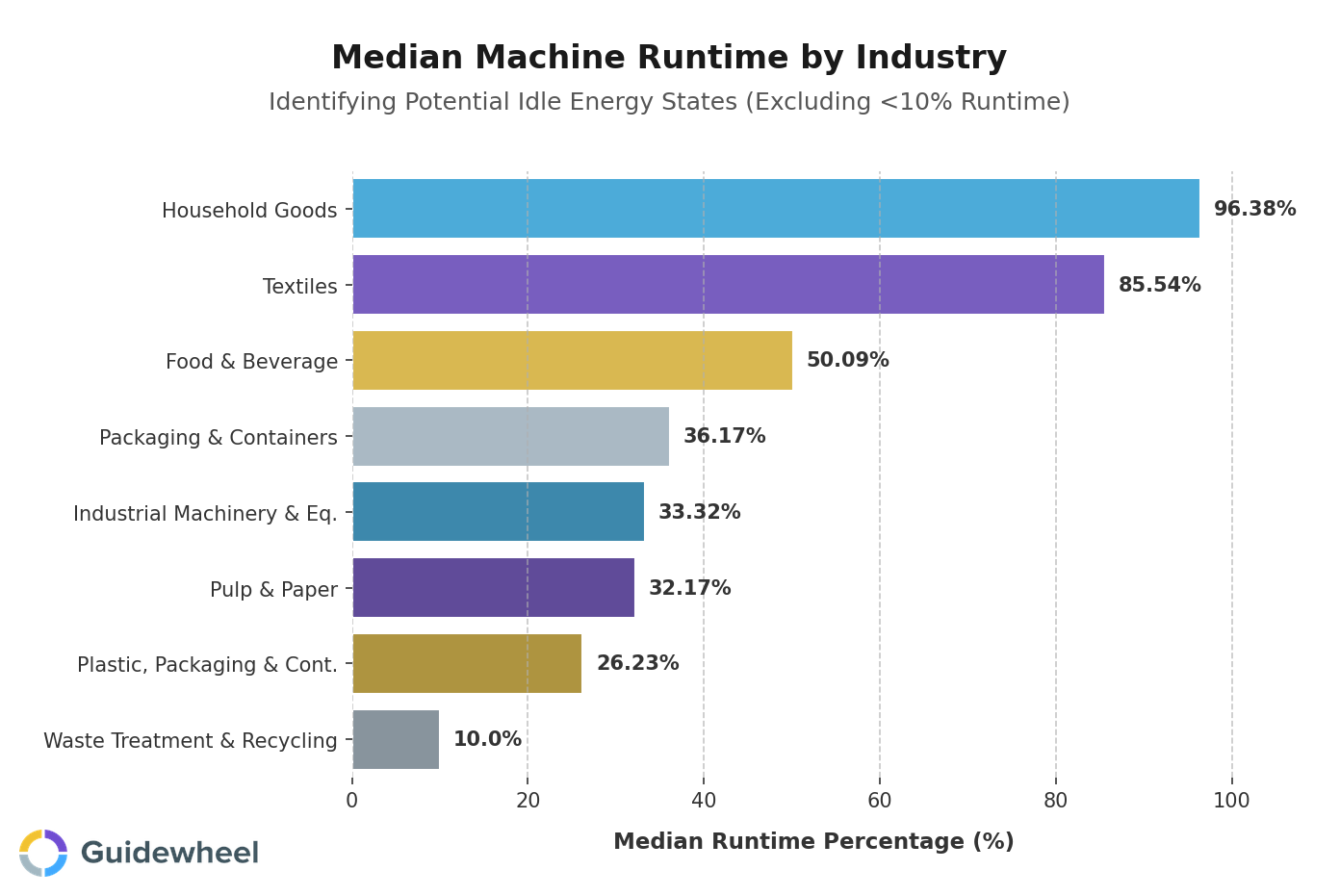
The gap between the top and bottom performers is striking. In sectors where median runtime sits below 50%, machines spend the majority of their tracked time in non-productive states, still drawing base-load power without generating output. These benchmarks serve as reference points rather than universal targets; every facility's product mix, batch sizes, and scheduling constraints create a unique operating profile.
Where your actionable downtime hides
While lack of orders may drive the longest individual delays, the downtime categories within your direct control are where energy savings become practical. Staffing gaps, material shortages, maintenance windows, and mechanical issues all create extended periods of idle power draw:
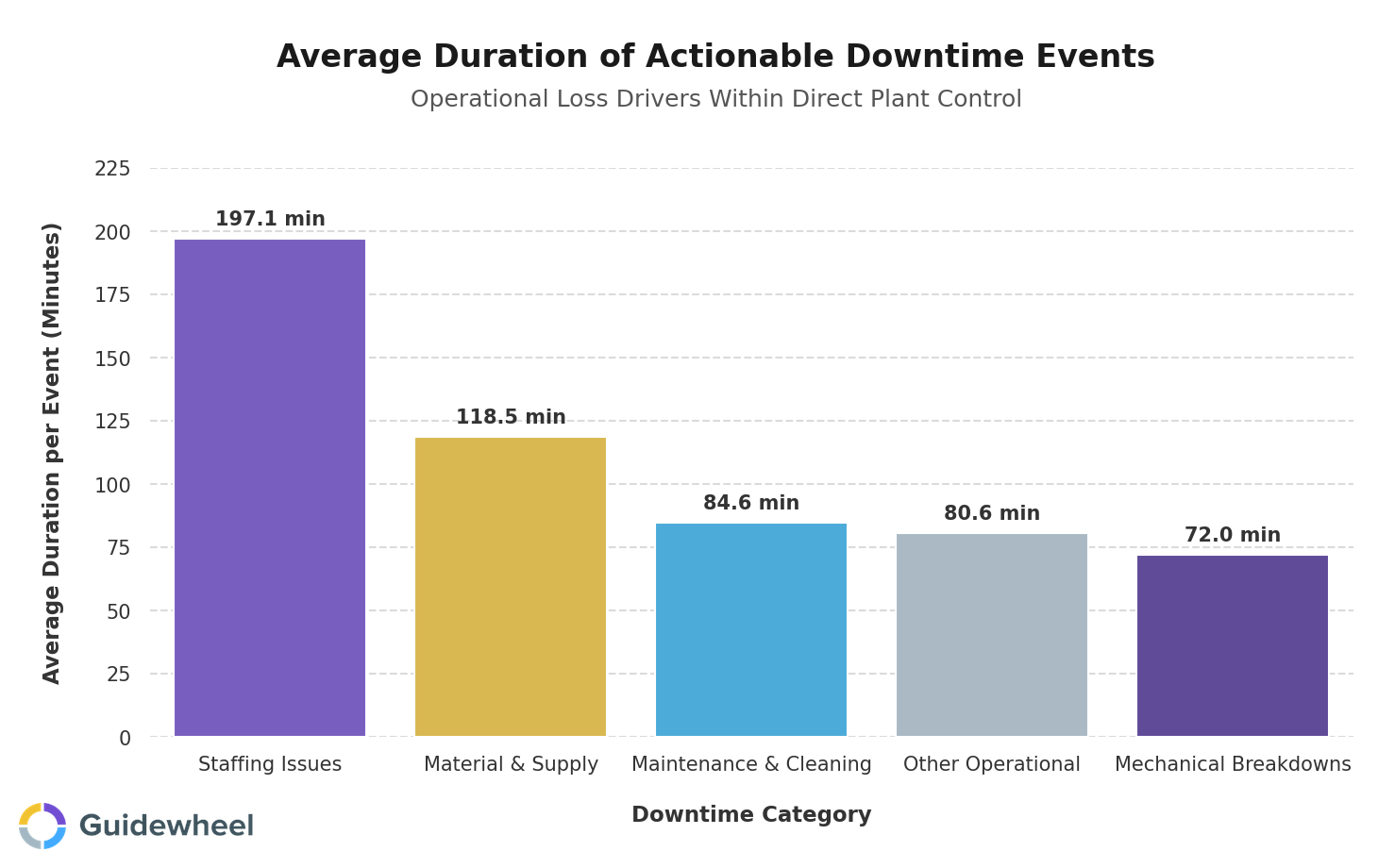
Each of these categories represents time your equipment is consuming energy without producing output. The key question: how do you tie energy spikes to these downtime events? Automated machine-level monitoring, like Guidewheel's FactoryOps platform with its clip-on current sensors that work on any equipment from legacy machines to brand-new lines, connects power draw data directly to machine states and downtime reasons. That connection turns a monthly utility bill into something a plant team can act on.
Five quick wins that pay for themselves
You don't need a capital project to start. These operational changes deliver measurable results within weeks:
Quick win |
Typical effort |
Estimated annual savings |
Payback |
|---|---|---|---|
Stagger machine start-ups by 2 minutes |
PLC or SOP change |
$5,000–$17,000 |
Days |
Shut down spindle cooling if idle > 30 min |
Operator protocol |
$500–$1,000 |
Immediate |
Implement weekend shutdown for non-critical assets |
Scheduling change |
$3,000–$5,500 |
Immediate |
Shift high-energy work to off-peak hours |
Schedule optimization |
5–15% of energy cost |
Weeks |
Install automated power monitoring on top 5 consumers |
Sensor deployment |
$3,000–$15,000/machine/year |
2–8 months |
Start small, measure the impact, and let the results fund the next improvement. Energy projects typically deliver 200–400% ROI with 3–12 month payback, far outpacing traditional capital equipment investments.
Start measuring what your machines actually cost to run
Calculating energy cost per machine line accurately isn't complicated, but it does require visibility most plants don't have yet. The formula is straightforward: segment consumption by machine state, allocate demand charges to the assets that cause them, and stop averaging costs across your entire facility.
The fastest path? Pick your top three energy-consuming machines, monitor their actual power draw across all states for two weeks, and run the numbers. You'll likely find idle consumption, demand spikes, and phantom loads that add up to real money. From there, the quick wins practically identify themselves.
If you want to skip the spreadsheet phase and get machine-level energy data flowing automatically, Book a Demo to see how clip-on sensors and automated analytics can give you that view across every asset on your floor.
With Guidewheel, we now get key metrics like production, downtime, downtime codes, scrap, and cycle time automatically and accurately. Our team no longer takes time to track manually and has been able to instead invest that time in improvements. Everybody knows when we're winning or losing. Each teammate understands how their work drives the success of the organization, and that every decision they make has a direct impact on the business.
Edgar Yerena, Custom Engineered Wheels. Source: Custom Engineered Wheels via Guidewheel's Customer Research.
💡
Frequently asked questions
What are phantom loads in a factory and how much do they cost?
Phantom loads are the power draw from equipment that's nominally off or idle but still consuming electricity through control circuits, heaters, circulation pumps, and safety interlocks. In discrete manufacturing, phantom loads typically account for 5–15% of total facility energy consumption. A single 8-machine CNC shop can lose roughly $1,600 per year to overnight standby alone. In injection molding facilities with thermal hold requirements, that number can climb to $4,800–$7,200 annually.
How do peak demand charges work in industrial electricity bills?
Demand charges are based on your highest 15-minute average power draw during a billing cycle, typically 30 days. One spike, even if it only lasts 15 minutes, sets your demand charge for the entire month. For medium-to-large industrial facilities, demand charges can represent 30–50% of the total electricity bill. The most common culprits are simultaneous equipment start-ups, compressor load transitions, and heating element ramp-ups at shift change.
How can I calculate energy cost per unit produced for each line?
Use the segmented formula: sum energy consumed across all machine states (run, idle, standby) at their applicable rates, then add an allocated share of the facility demand charge based on each machine's peak contribution. Divide the total by units produced. This gives you a true cost-per-part that accounts for non-productive power draw and demand spikes, not just blended kWh consumption.
What should an energy dashboard include for plant managers?
At minimum, a useful factory energy dashboard should display machine state in near-real-time (run, idle, standby, off), energy cost by machine and shift, demand charge trending with spike alerts, idle hours by asset with root-cause classification, and benchmarking views that let you compare similar machines or lines. Integration with production and uptime data is what turns raw energy numbers into operational decisions.
What ROI should a plant expect from machine-level energy monitoring?
Energy monitoring projects typically deliver 200–400% first-year ROI with payback periods of 3–12 months. Hardware and software costs generally run $500–$2,000 per machine, while annual savings per machine range from $3,000 to $15,000 depending on facility size, utilization patterns, and local utility rates. The fastest wins, like staggering equipment start-ups and implementing shutdown protocols, can pay for themselves within weeks.
About the author
Lauren Dunford is the CEO and Co-Founder of Guidewheel, a FactoryOps platform that empowers factories to reach a sustainable peak of performance. A graduate of Stanford, she is a JOURNEY Fellow and World Economic Forum Tech Pioneer. Watch her TED Talk—the future isn't just coded, it's built.