No items found.
blog
2026 Benchmark Guide to Pneumatic Conveyor Monitoring for Plastics Processors and Container Manufacturers
By: Guidewheel
Updated:
December 19, 2025
11 min read

Every plant manager in the plastics and packaging sector knows the specific silence that falls over a facility when a pneumatic conveying system goes down. It is not just one machine stopping; it is the cessation of material flow that starves extruders, halts injection molders, and idles packaging lines. While primary processing equipment often commands the bulk of capital investment and management attention, recent performance data indicates that the humble conveyor acts as the critical operational backbone—and a significant hidden opportunity for efficiency gains.
This article serves as a benchmark guide for operations directors and maintenance leaders looking to optimize pneumatic conveyor performance. We analyze current industry data to establish realistic reference points, identify the specific downtime drivers impacting material handling systems, and outline practical monitoring strategies that convert raw data into operational stability.
2026 Benchmark Guide to Pneumatic Conveyor Monitoring for Plastics Processors and Packaging Plants
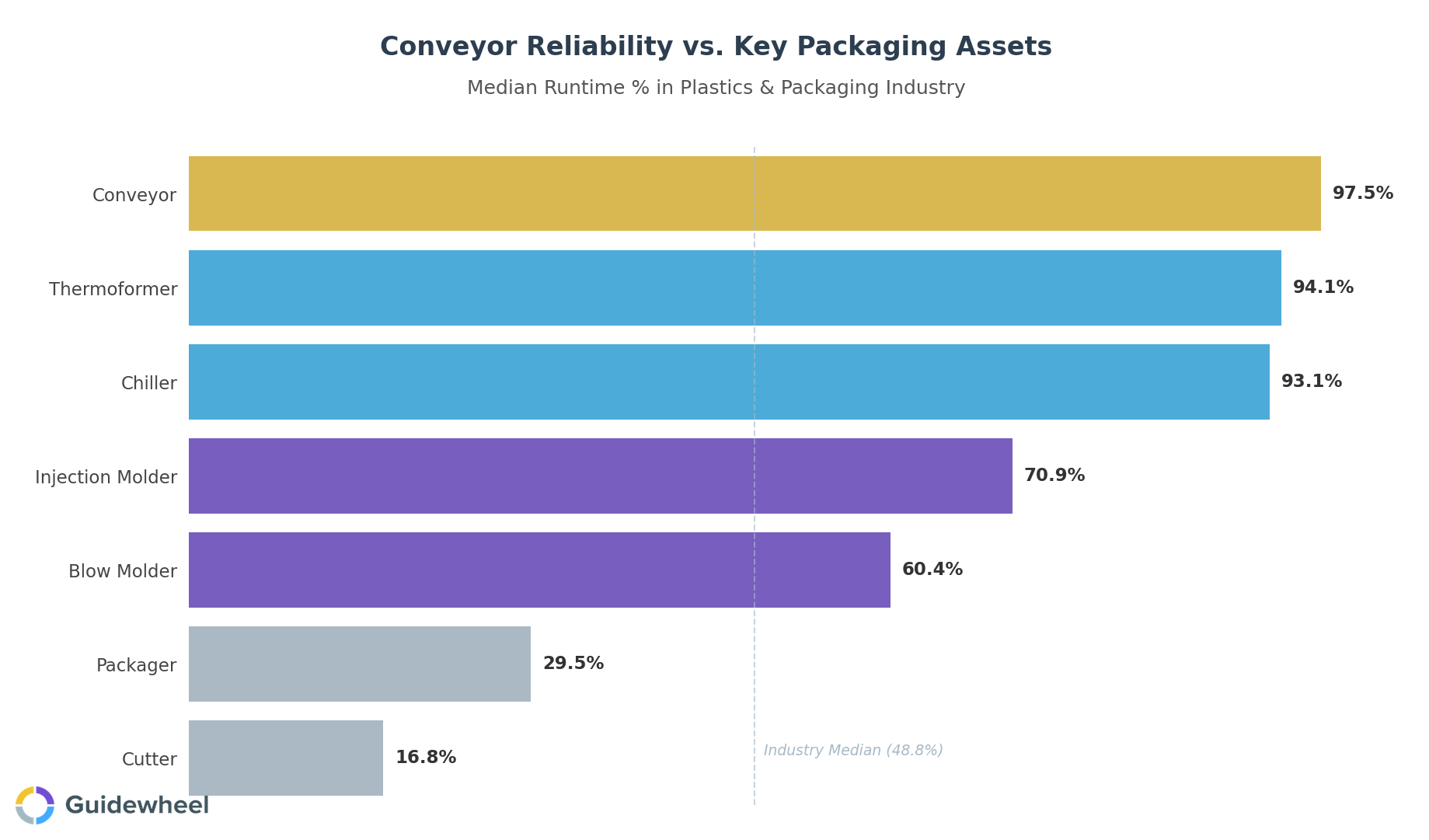
(Source: Guidewheel Performance Analysis, n=36.5 million machine-minutes)
To understand what constitutes "good" performance in 2025 and beyond, we must look at the data. The benchmarks referenced throughout this guide are drawn from insights based on Guidewheel's sensors over the last few months, between September and November 2025. This analysis encompasses a dataset of n=36.5 million machine-minutes across the Plastics, Packaging, & Containers sectors.
It is important to note that these findings represent insights from the specific facilities and machine types covered in the dataset. Operations vary significantly based on material types (virgin resin vs. regrind), facility age, and production goals. Therefore, the following benchmarks should serve as reference points for your own continuous improvement journey rather than universal mandates.
Analyzing the Real Drivers of Downtime
Maximizing uptime requires understanding exactly why machines stop. In the Plastics & Packaging sector, a significant portion of total downtime (approx. 65%) is categorized as "No Business/Orders" (Source: Guidewheel Performance Analysis). While economically significant, this category is generally outside the control of plant operations teams.
To drive operational efficiency, leaders must focus on the remaining 35% of "controllable downtime." The analysis highlights the specific categories where maintenance and operations teams can make an impact.
1. Other Operational Issues (32%)
This is the single largest controllable loss driver in the Packaging & Containers subset (Source: Guidewheel Performance Analysis). For pneumatic conveyors, "Other Operational" typically refers to non-mechanical flow interruptions:
- Material Jams and Bridging: Resin pellets bridging in the hopper or fusing in the line due to friction heat.
- Sensor Faults: False positives from dust coating optical eyes or capacitive sensors.
- Process Anomalies: Minor stops required to clear lines or reset operational parameters.
- Flow Imbalances: Air velocity dropping below the saltation velocity, causing material to settle and clog pipes.
2. Mechanical Breakdowns (29%)
Mechanical failure remains a persistent challenge, accounting for nearly a third of active downtime events (Source: Guidewheel Performance Analysis).
- Component Fatigue: Failures in blower motors, rotary airlock valves, and diverter valves.
- Wear Patterns: Elbows and bends blowing out due to the abrasive nature of conveyed plastics.
- Drive Systems: Belt slippage or breakage on the blower drives.
- Duration: The average duration for these events is approximately 53 minutes (Source: Guidewheel Performance Analysis). This indicates that while prolonged failures occur, many breakdowns are shorter, frequent interruptions that fragment production shifts.
3. Maintenance & Cleaning (11%)
Planned maintenance and cleaning cycles are essential but costly in terms of time.
- Extended Duration: Unlike mechanical quick-fixes, maintenance and cleaning events average over 200 minutes (approx. 3.5 hours) per occurrence (Source: Guidewheel Performance Analysis).
- Changeover Impact: In plastics processing, cleaning lines between color changes or resin types is a significant impact on availability. Reducing this time through better monitoring of line clear-out can significantly boost OEE.
| Downtime Category | Impact (Packaging Subset) | Average Duration | Operational Focus |
|---|---|---|---|
| Other Operational | 32% | ~81 mins | Flow, Jams, Sensors |
| Mechanical Breakdowns | 29% | ~53 mins | Motors, Valves, Bends |
| Maintenance & Cleaning | ~11%* | ~209 mins | Changeovers, PMs |
(Source: Guidewheel Performance Analysis. * Note: Maintenance % based on broader Plastics dataset context)
Common Pneumatic Conveyor Challenges in Plastics
Translating the data into physical reality, plastics processors face unique challenges that drive the "Other Operational" and "Mechanical" downtime statistics.
- Angel Hair and Streamers: When conveying plastic pellets (especially PE or PP) in dilute phase systems, friction against pipe walls generates heat. This can cause pellets to melt and smear, creating "angel hair" or streamers. These distinct operational issues eventually clog filters, jam receiver screens, and contaminate the final product (Source: Jenike).
- Filter Blinding: Pneumatic systems rely on separating the air from the material at the destination. Dust from regrind materials frequently clogs (blinds) filter media. As filters blind, system pressure rises, conveying capacity drops, and eventually, the system stalls—a classic "Other Operational" downtime event that develops slowly but hits suddenly (Source: Deltaducon).
- Air Leakage: Leaks are factors that reduce energy efficiency and performance. A leak in a pressure system means the compressor works harder to move less material. In vacuum systems, leaks introduce ambient air that reduces the vacuum level needed to pull material, leading to reduced throughput and eventual line plugging (Source: Cs-Instruments).
From Reactive to Proactive: The Monitoring Solution
The data reveals a clear opportunity: nearly 60% of controllable downtime (Operational + Mechanical) stems from issues that often present early warning signs. Jams rarely happen instantly; they are often preceded by motor strain. Filters do not blind in a second; they clog over hours. Bearings do not seize without first vibrating or heating up.
To close the gap between median industry performance (53%) and world-class reliability, facilities are increasingly turning to real-time monitoring solutions.
Addressing the Visibility Gap
The primary challenge for legacy pneumatic systems is invisibility. Air moves inside pipes; motors sit on mezzanines; blowers operate in sound-insulated rooms. Operators simply cannot see or hear a problem developing until the system stops.
Real-time monitoring bridges this gap by giving the machine a "voice." By tracking the electrical heartbeat of the equipment, operations teams can detect the subtle precursors to failure.
- Motor Current Analysis for Jam Detection: As a blockage begins to form or a filter blinds, the load on the blower motor changes. In a pressure system, a developing clog increases backpressure, forcing the motor to draw more current (amps). In a vacuum system, a clogged intake might cause amperage to drop as the blower spins in a vacuum. Monitoring these trends allows for intervention before a total line stoppage (Source: F7I).
- Vibration Monitoring for Mechanical Health: Rotary airlock valves and blower bearings generate specific vibration signatures as they degrade. Detecting these changes allows maintenance to schedule repairs during planned downtime rather than reacting to a seized bearing mid-shift (Source: Bannerengineering).
- Cycle Timing for Throughput Optimization: By monitoring the cycle times of vacuum receivers or pressure pots, teams can identify when cycle times drift from the ideal baseline—often an indicator of reduced conveying efficiency or upstream feed issues.
The Guidewheel Approach to Conveyor Monitoring
Guidewheel addresses the specific downtime drivers identified in the performance analysis—"Other Operational" issues and "Mechanical Breakdowns"—through a practical, non-intrusive monitoring architecture.
Recognizing that plastics facilities operate a mix of equipment—from brand-new resin handling systems to legacy blowers that have run for thirty years—the solution utilizes simple clip-on current sensors. These sensors can be installed in minutes on any electrically powered asset without requiring downtime or integration with complex PLCs.
Solving "Other Operational" Downtime: The analysis showed that 32% of downtime comes from operational issues like flow interruptions. Guidewheel’s proprietary algorithms analyze the high-resolution power draw of blower motors to create a digital "heartbeat" of the process.
- Anomaly Detection: The system learns the normal power profile of a conveying cycle. When the profile deviates—indicating a filter is clogging or material is bridging—it triggers an alert.
- FactoryOps Visibility: This data is not locked in a maintenance office; it is displayed on mobile-friendly dashboards for operators. This empowers the frontline team to see a "Micro-Stop" pattern emerging and clear a filter or check a hopper before the line goes down.
Solving "Mechanical Breakdowns": With 29% of downtime attributed to mechanical failure, early warning is essential.
- Trend Analysis: By tracking motor current and cycle duration over weeks and months, the platform identifies long-term degradation trends that humans miss. A 5% increase in average power draw over a month might indicate bearing wear or belt friction that warrants inspection.
- Contextual Alerts: Rather than generic alarms, the system provides context, helping maintenance teams prioritize which asset requires attention during the next planned maintenance window (Source: Guidewheel).
This approach transforms the conveyor from a passive, invisible asset into an intelligent part of the production ecosystem. It allows facilities to move away from calendar-based maintenance (which consumes 11% of time, sometimes unnecessarily) toward condition-based maintenance, ensuring that downtime is taken only when actually needed.
Operational Best Practices for Implementation
Technology is only as effective as the processes that surround it. To truly impact the downtime statistics, monitoring data must be integrated into daily workflows.
- Structured Shift Handovers: Use data to eliminate the "he said, she said" of shift changes. Instead of relying on memory, review the downtime pareto chart from the previous shift. If the data shows three short stops on the regrind conveyor, the incoming shift knows to watch that specific asset, preventing a repeat occurrence (Source: Tervene).
- Empower the Frontline (FactoryOps): Operators are often the first to sense a problem, but they lack the data to prove it. Giving operators access to real-time scoreboards validates their intuition. When they see the "Other Operational" downtime ticking up in real-time, they are empowered to act. This shifts the culture from "run it until it breaks" to "own the machine's health."
- Start Small, Scale Fast: Recognizing that every facility has unique constraints, successful leaders often start by monitoring the most critical bottleneck assets—typically the main resin feed systems or scrap removal conveyors. Once the value is proven through reduced jams and faster response times, the monitoring can be scaled to auxiliary lines.
Improving Your Benchmarks
The gap between the industry median runtime (approx. 53%) and the top-quartile performance (near 98%) represents a massive opportunity for capacity unlocking. While "No Business" downtime may be out of your hands, the 60%+ of downtime tied to operational and mechanical issues is solvable.
By treating pneumatic conveyors not as simple pipes, but as intelligent assets worthy of monitoring, plastics processors can secure their material flow, protect their equipment, and drive sustainable productivity gains.
Start Optimizing Your Operations
Transforming your pneumatic conveying efficiency starts with visibility. Don't let invisible blockages and silent mechanical wear dictate your production schedule.
Ready to unlock hidden capacity in your facility?
About the Author
Lauren Dunford is the CEO and Co-Founder of Guidewheel, a FactoryOps platform that empowers factories to reach a sustainable peak of performance. A graduate of Stanford, she is a JOURNEY Fellow and World Economic Forum Tech Pioneer. Watch her TED Talk—the future isn’t just coded, it’s built.