No items found.
blog
How a 140-Year-Old Manufacturer Found 20% Energy Savings Across 80 Plants
By: Guidewheel
Updated:
March 6, 2026
6 min read
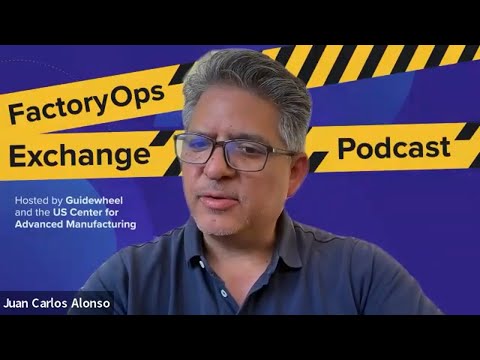
How a 140-year-old manufacturer found 20% energy savings across 80 plants
In this episode of the FactoryOps Exchange, Juan Carlos Alonso (former Chief Strategy Officer at Bekaert) joins Lauren Dunford, CEO of Guidewheel, to discuss uncovering hidden capacity, driving AI in manufacturing, and bridging strategy with factory floor execution.
Top 5 takeaways
💡
Here are the top takeaways from Juan Carlos Alonso's conversation on the FactoryOps Exchange:
- Hidden capacity exists in every operation. Even at a 140-year-old company with 80 plants, a focused pilot uncovered 15 to 20% energy savings that no one had organized an effort to find.
- Small fixes beat big capital projects. Over 200 small initiatives, not massive CapEx, drove the majority of efficiency gains. Better visibility into current assets is often the fastest path to ROI.
- Cross-generational teams break thinking constraints. Pairing 30-year veterans with newer engineers removed assumptions and surfaced opportunities that neither group would have found alone.
- Manufacturing leadership is too risk-averse on AI. Engineers already use industrial AI for material optimization, but broader adoption stalls because executives perceive complexity that often is not there.
- Strategy without frontline buy-in does not stick. Pushing initiatives through without bringing key stakeholders along creates hard feelings that undermine long-term sustainability of the gains.
Best practices and key learnings
Uncovering hidden efficiency through cross-functional collaboration
When Juan Carlos joined Bekaert as Chief Strategy Officer, he assumed a company that consumed massive amounts of electricity would already have mature energy efficiency programs. It did not. There were scattered initiatives at individual factories, but no organized, cross-plant effort.
The initial response from operational heads was cautious: improvements of two to four percent, requiring significant capital. Juan Carlos and his team chose to test that assumption with a small pilot. They selected a plant manager who was open to experimentation, then assembled a diverse team. Thirty-year veterans. Engineers with two to three years of experience. People from different plants and geographies. They gave them a week or two to explore with no constraints.
The result: 15 to 20% energy efficiency opportunities. They replicated the pilot across four to five more plants. Same result. Then 30 to 40 plants. Same result. By the time Juan Carlos left Bekaert, the team had captured roughly 9% in realized savings, with more in the pipeline.
"Just kind of removing a little bit the typical limitations of the way that we used to think and the experts that know everything and bringing a variety, diversity of opinions, of experiences, and without those boundaries, you end up with very nice improvements that are really significant and are really impactful."
Juan Carlos Alonso
The lesson is clear: real-time visibility into what is actually happening on the factory floor, combined with diverse perspectives, reveals capacity that even seasoned operators did not know existed. Most of the 200 initiatives were small. Fixing leaks no one had looked at. Adjusting processes. Rethinking workflows. When you add them up, they become significant. The few larger capital investments that were needed carried attractive returns of three to four years.
This pattern, where better data and broader collaboration reveal 15 to 30% hidden capacity, is exactly what manufacturers using AI for data analytics and real-time monitoring platforms discover consistently.
How we found 20% energy savings by ignoring the 'experts'
"So we put them to work together for a week or two with the head of the plant and to explore with no limitations. Capital, we will figure out afterwards. And what they found was that they could find 15 to 20% energy efficiency opportunities."
Why AI adoption stalls and what to do about it
Juan Carlos was candid about a frustration many manufacturing leaders share: industrial AI works well for narrow engineering tasks like material optimization and motor tuning, but broader adoption across the business hits a wall.
The barrier is not technical complexity. It is perceived complexity. Executive committees in manufacturing tend to be conservative and risk-averse about experimenting with AI software in areas like back office operations, internal sales, and R&D, even when those areas are full of repetitive, high-input tasks where AI automation can deliver immediate efficiency gains.
"Many times people think oh this is super complex. I'll wait, I will understand it later and I will implement it later. But it moves so fast that you don't start today you're already very late."
Juan Carlos Alonso
Juan Carlos's advice: expose leadership to practical, working examples. Not theoretical presentations. Not vendor pitches. Real implementations in adjacent industries where AI in manufacturing is already delivering measurable results. He described attending an AI fair and seeing simple sales agent tools that automatically surface the right questions and context for customer conversations. Not rocket science. But transformative for teams that previously did not have the time or tools to do it manually.
✅
The fastest way to overcome AI hesitation in manufacturing is to start with a single, low-risk experiment targeting a repetitive, data-heavy task — such as scheduling, quality checks, or sales support. Measure the result within weeks, not months, and use that concrete outcome to build the internal case for broader adoption. The cost of waiting compounds faster than the cost of a small pilot that does not work out, so avoid delaying action while waiting for a perfect enterprise-wide AI strategy.
The key insight for any manufacturer evaluating AI: start with low-risk experiments in areas with repetitive tasks and measurable outcomes. Do not wait for a perfect enterprise strategy. The cost of waiting compounds faster than the cost of a small pilot that does not work out.
Strategy meets execution: focus, trim, and bring people along
Beyond operational efficiency, Juan Carlos shared a strategic lesson that applies to any manufacturer managing complexity. Bekaert served 23 different industries with hundreds of products. Capital was dispersed. Nobody knew what to prioritize. Profitability suffered.
The fix was straightforward in concept and difficult in practice: go to the market, understand where the real needs are, and focus. Bekaert narrowed to three high-growth industries (energy, construction, and mobility), trimmed low-value segments, and redirected resources where they could make a difference.
But Juan Carlos was equally honest about what went wrong. In the push to move fast on sustainability strategy, his team stepped on feet. They did not bring enough stakeholders along for the journey. People who were overlooked eventually moved into positions of influence and carried hard feelings that undermined the initiative's long-term momentum.
The lesson: choosing priorities and choosing what not to work on is critical. But the how matters as much as the what. Identify not just today's stakeholders, but tomorrow's. Build buy-in across the organization before pushing through, even when the urgency feels real.
How to put these insights into practice
These are not theoretical frameworks. They are actions you can take this quarter.
Run a focused pilot with a diverse team. Pick one plant. Assemble a cross-functional group that mixes experienced operators with newer engineers from different locations. Give them a bounded timeframe and a clear mandate: find efficiency opportunities with no constraints on what they can propose. You will be surprised by what surfaces when you remove the usual thinking limitations.
Audit your energy and downtime data today. If you do not have organized visibility into energy consumption or downtime patterns across your plants, that is your first move. You cannot improve what you cannot see. Plug-and-play monitoring solutions can get you real-time data across every machine type without IT overhead or production disruption.
Start a small AI experiment this month. Identify one repetitive, data-heavy task in your operation, whether in scheduling, quality checks, or sales support. Deploy a simple AI software tool to handle it. Measure the result. Use that result to build the case for broader adoption. Do not wait for the executive committee to develop a comprehensive AI strategy.
Map your stakeholders before you push. Before launching any cross-plant initiative, list every person who could influence its success, not just today, but 12 to 18 months from now. Build their input into the process early. The fastest path to lasting change is one where people feel ownership, not resentment.
Focus your portfolio ruthlessly. Audit which products, markets, and SKUs actually drive margin. Trim what creates complexity without proportional return. Redirect resources to where you can make the biggest difference. Simple to say, hard to do, essential to do anyway.
Conclusion
The throughline across every insight Juan Carlos shared is this: the biggest gains in manufacturing are not locked behind massive capital investments or multi-year digital transformation programs. They are hidden in plain sight, waiting for someone to look at the operation with fresh eyes, diverse perspectives, and real-time data.
Whether it is energy savings, AI adoption, or strategic focus, the pattern is the same. Start small. Prove value fast. Bring people along. Scale what works.
The manufacturers who will lead the next decade are not the ones with the biggest budgets. They are the ones willing to run the pilot, question the assumption, and act on what the data tells them, starting today.
Ready to see what is hiding in your operation? Book a Demo to learn how Guidewheel helps manufacturers uncover hidden capacity and drive measurable results across every plant.
Watch and listen
Watch the webinar now:
Listen on Apple Podcasts: FactoryOps Exchange